The learning cellar
Build a palate that can explain itself.
Work in order or revisit a single idea. Every lesson includes preparation, a video or coming-soon state, clearly indexed background chapters, primary sources, and a quiz.
Level 1
Taste without intimidation
Learn the sensory foundations and finish with a complete, evidence-first tasting note.
Watch the complete Level 1 playlist ↗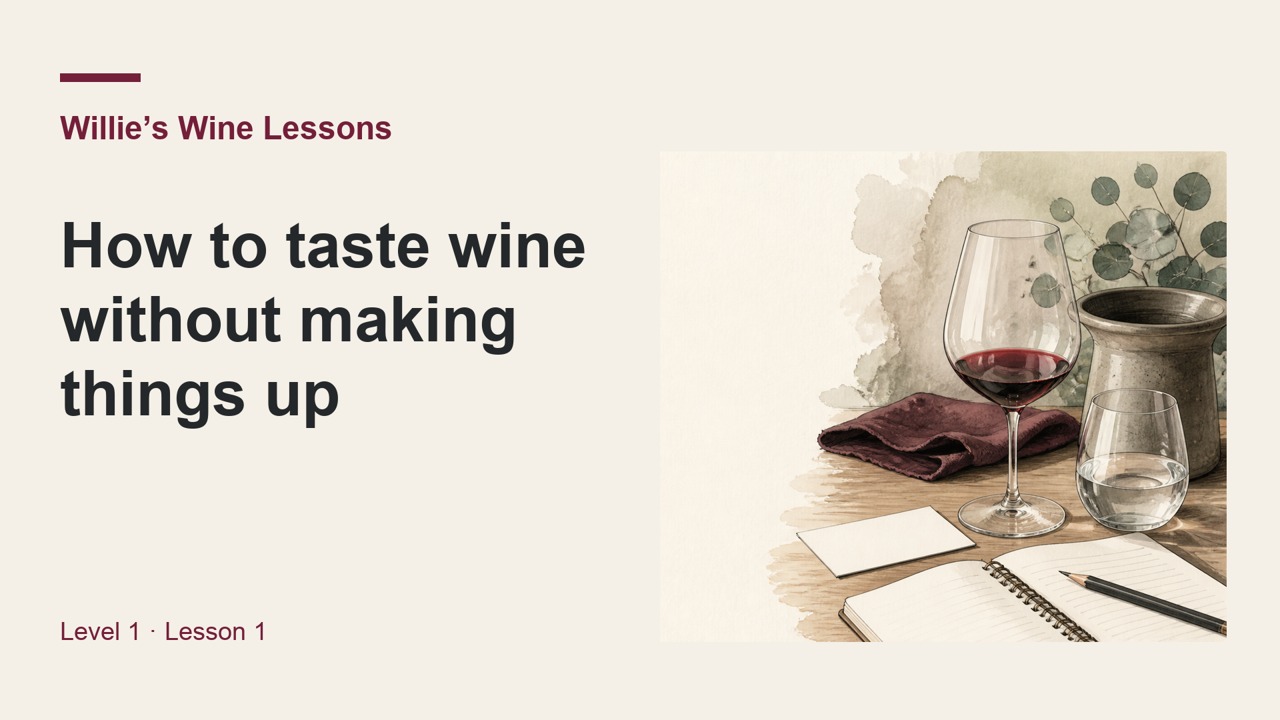
Level 1 · Lesson 1
How to taste wine without making things up
Complete two written observations: smell strength after swirling and mouth sensation after a sip.
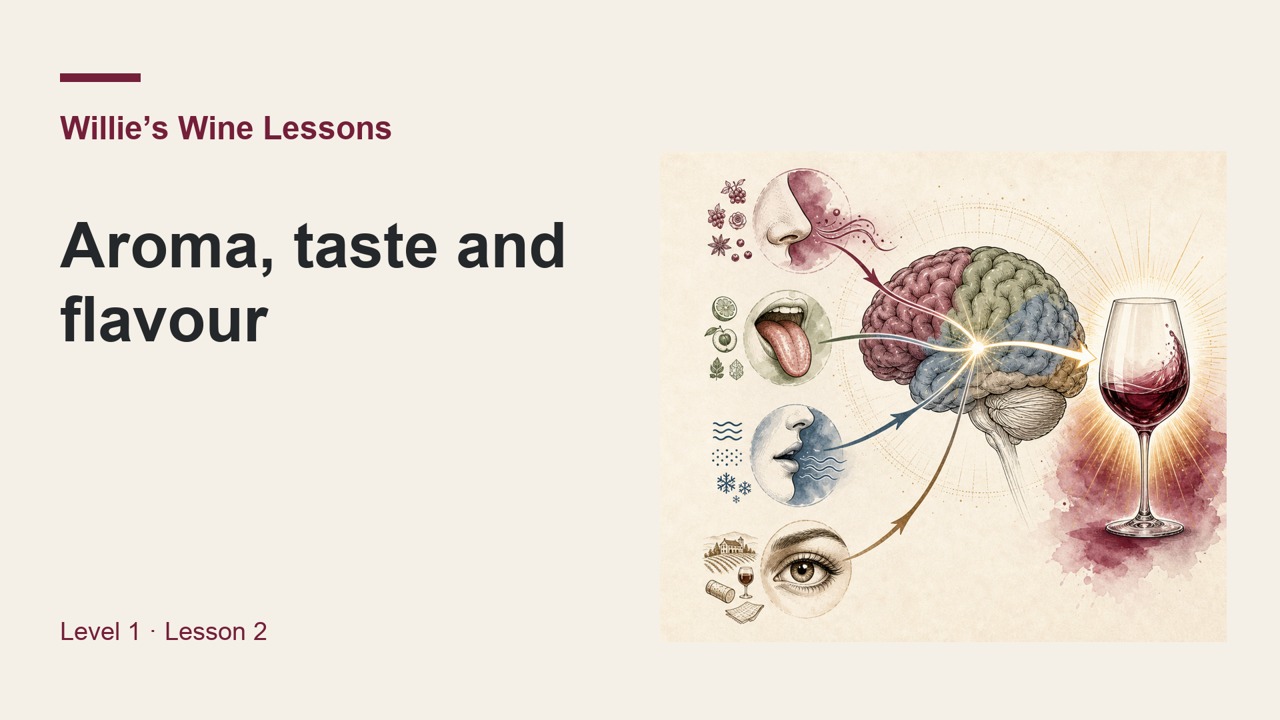
Level 1 · Lesson 2
Aroma, taste and flavour
Distinguish smell, basic taste and physical sensation before combining them.
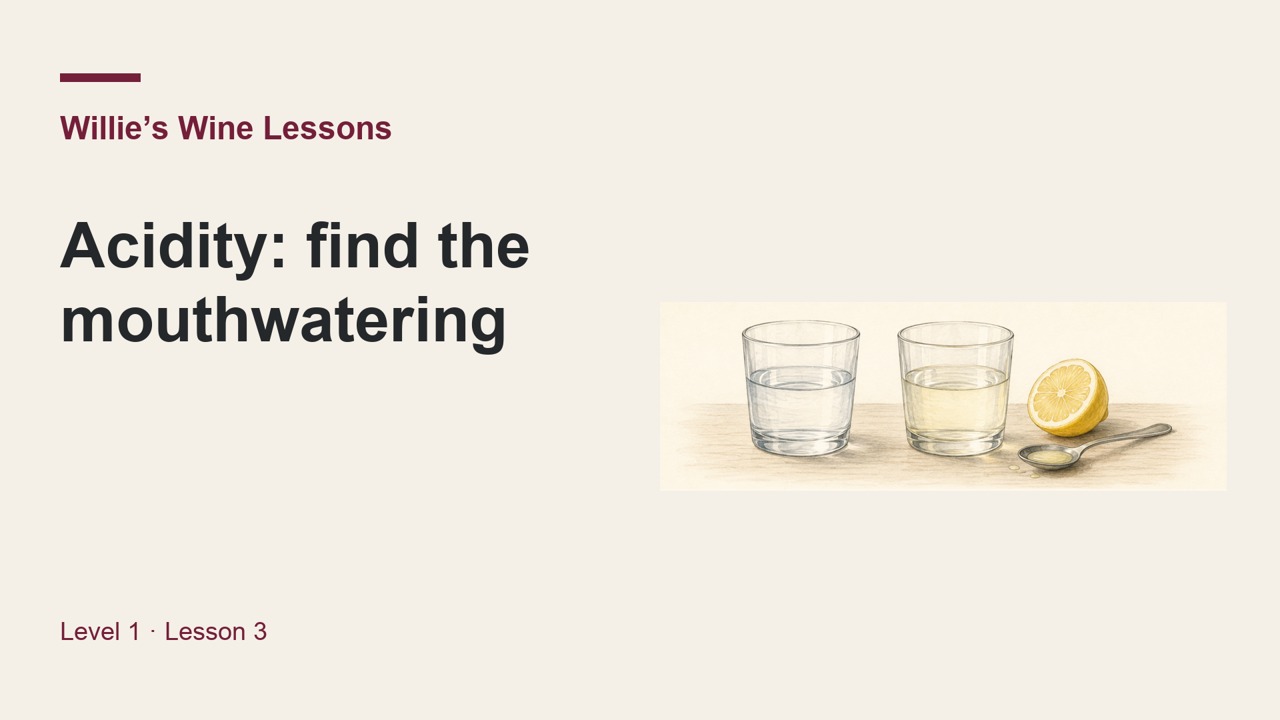
Level 1 · Lesson 3
Acidity: find the mouthwatering
Recognize sourness and mouthwatering while distinguishing drying.
Level 1 · Lesson 4
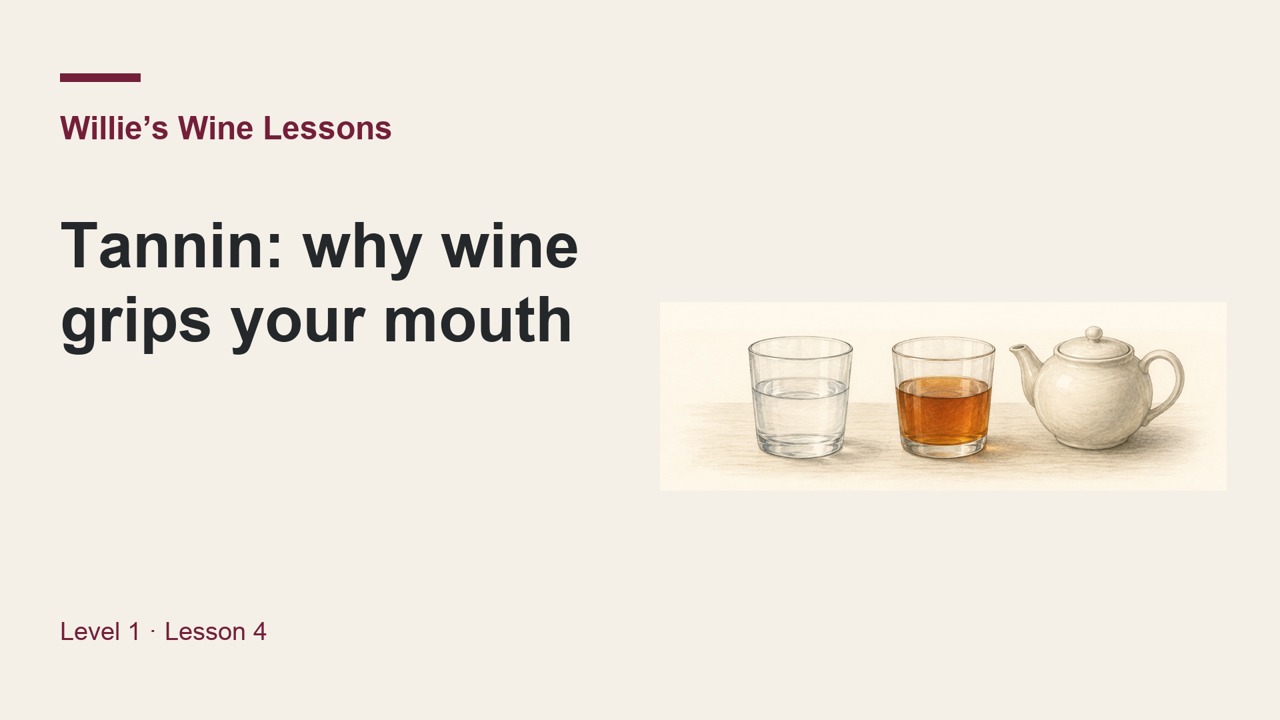
Tannin: why wine grips your mouth
Distinguish astringent drying, bitterness and lack of sweetness.
Level 1 · Lesson 5
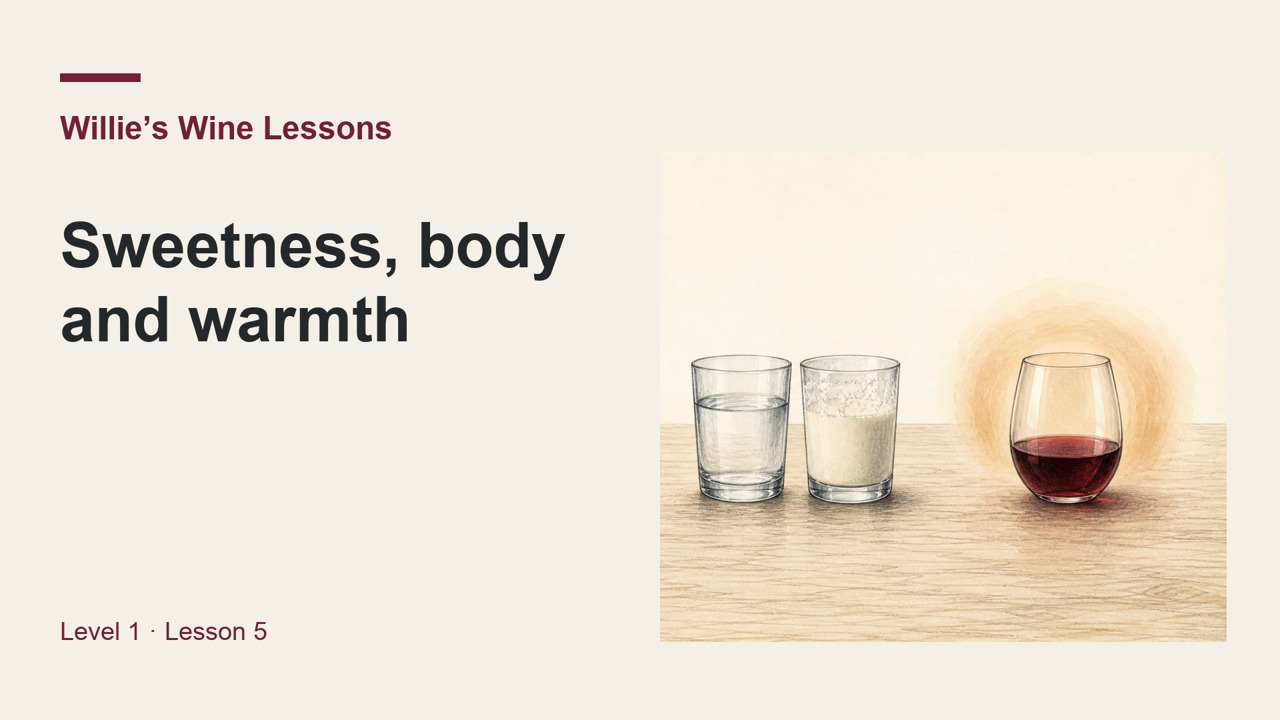
Sweetness, body and warmth
Describe sweetness, apparent weight and alcohol warmth independently before combining them.
Level 1 · Lesson 6
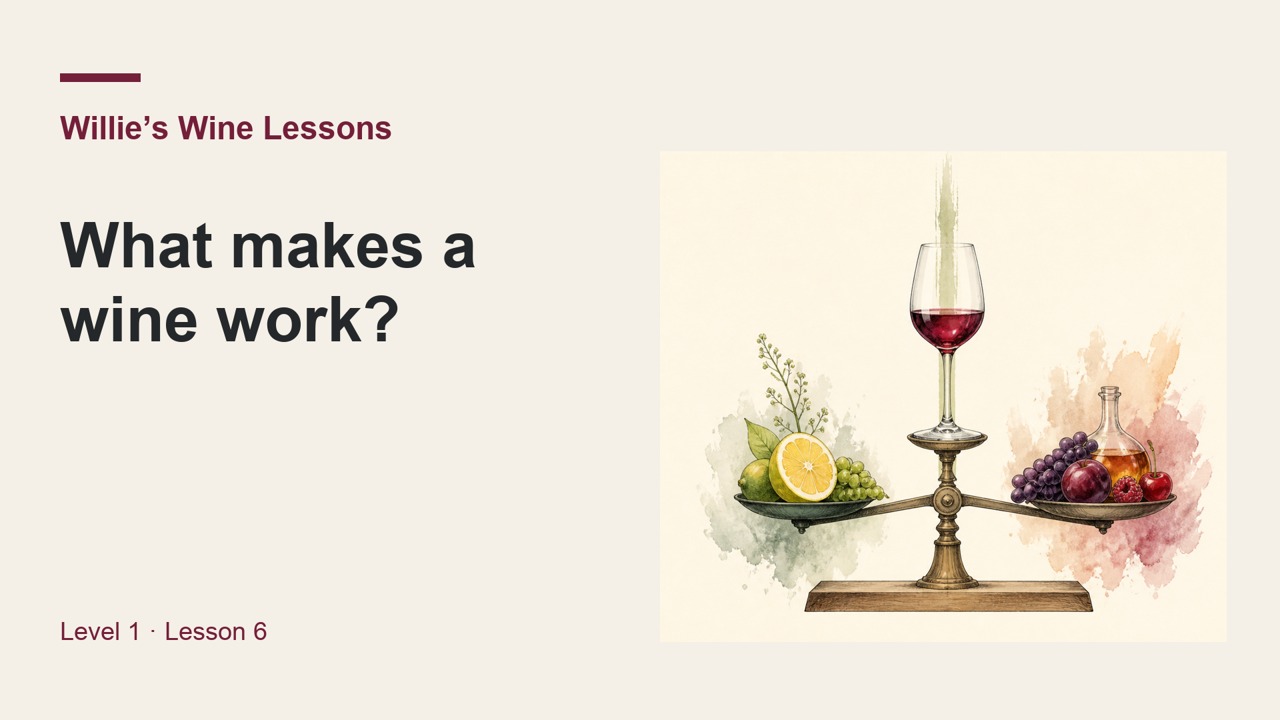
What makes a wine work?
Support an assessment using intensity, finish, complexity and balance without equating them with preference.
Level 1 · Lesson 7
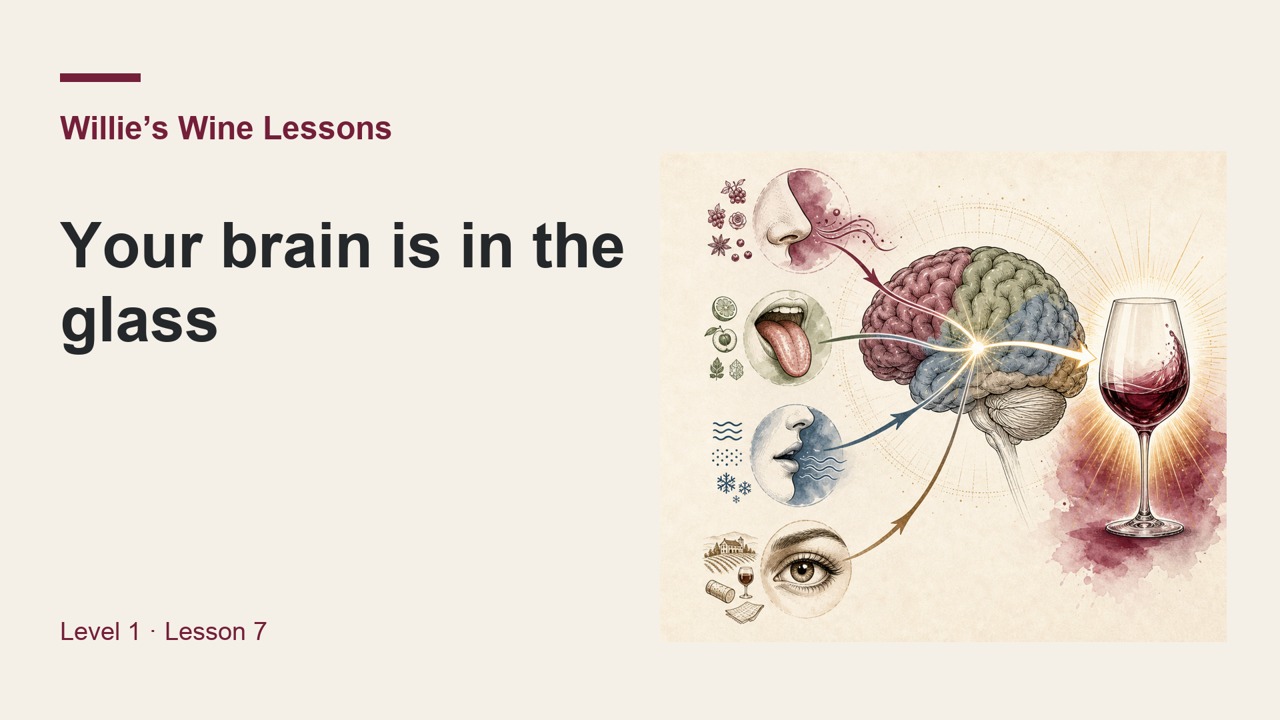
Your brain is in the glass
Distinguish expectation from observation and interpret a retaste without overclaiming.
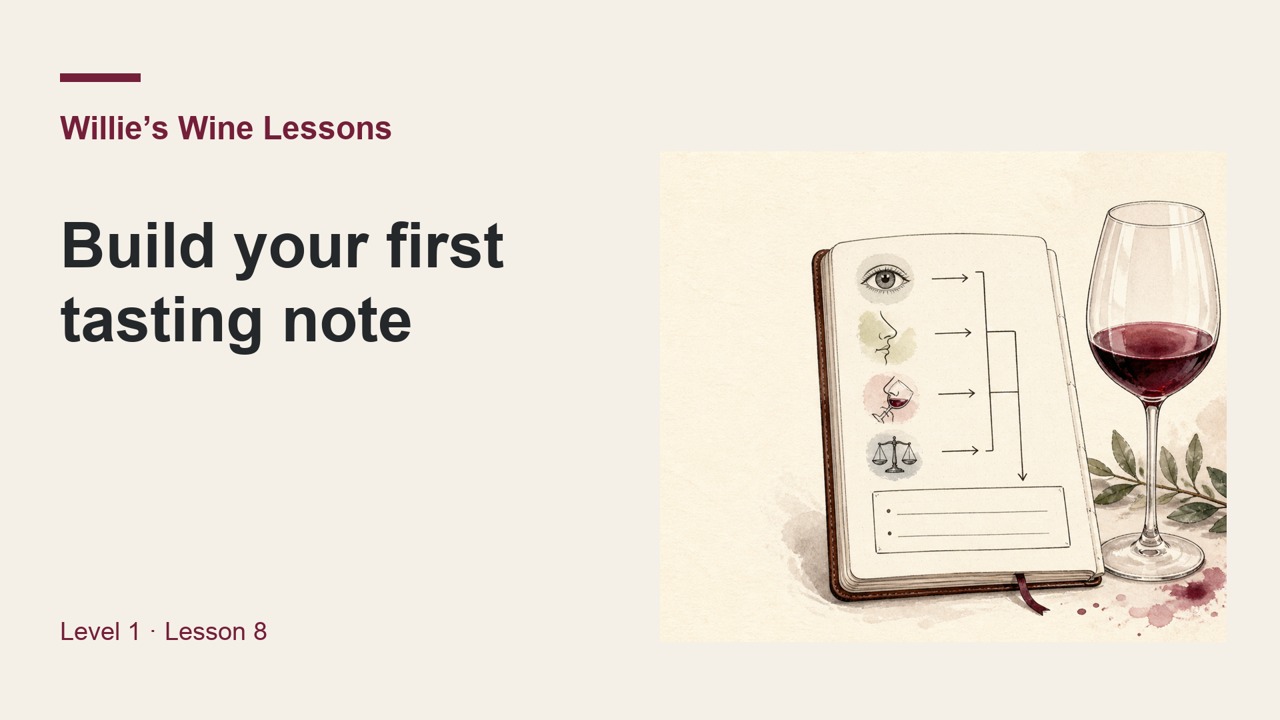
Level 1 · Lesson 8
Build your first tasting note
Combine sensory evidence, a supported judgment and a practical preference; complete Level 1.
Test out of the level
Already know this material? Take 24 questions covering every lesson. Pass with 20 correct to earn the same level badge and certificate.
Test out of the levelOptional science companions
Science behind Level 1
Go deeper on smell, acidity, tannin, and fermentation after learning the Level 1 foundations.
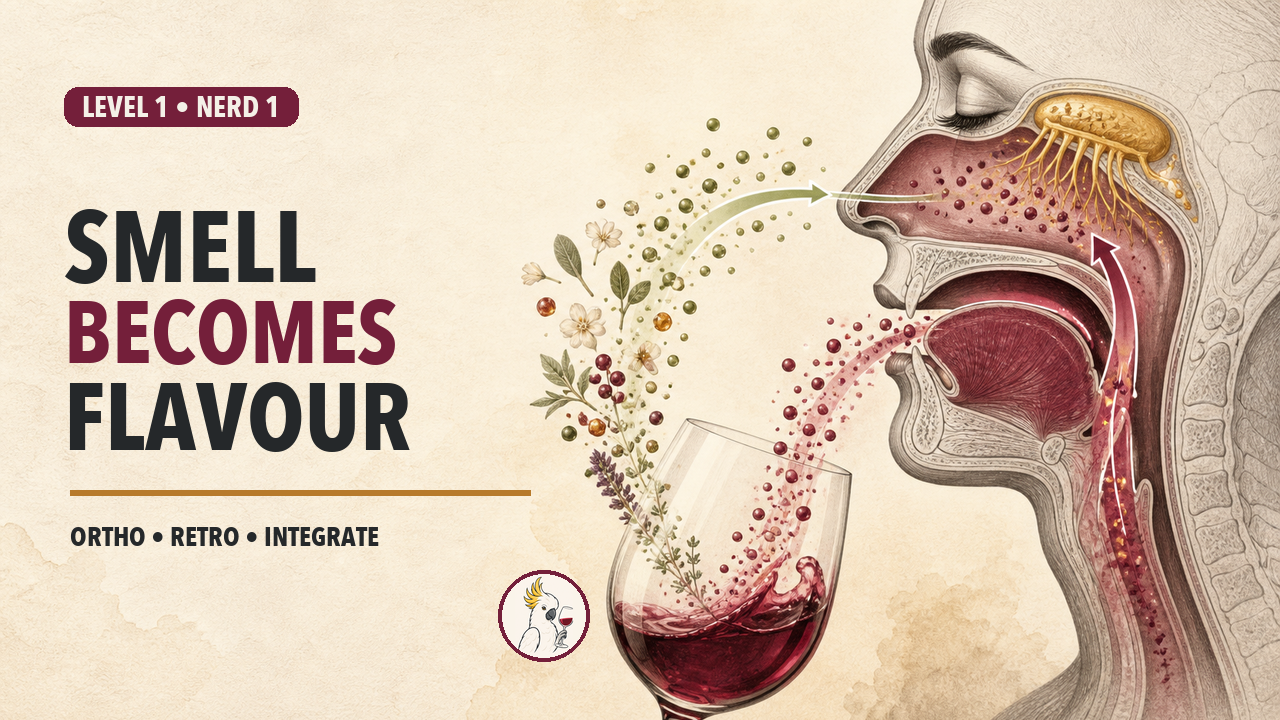
Nerd Mode
How smell becomes flavour
Follow orthonasal and retronasal aroma into an integrated flavour experience.
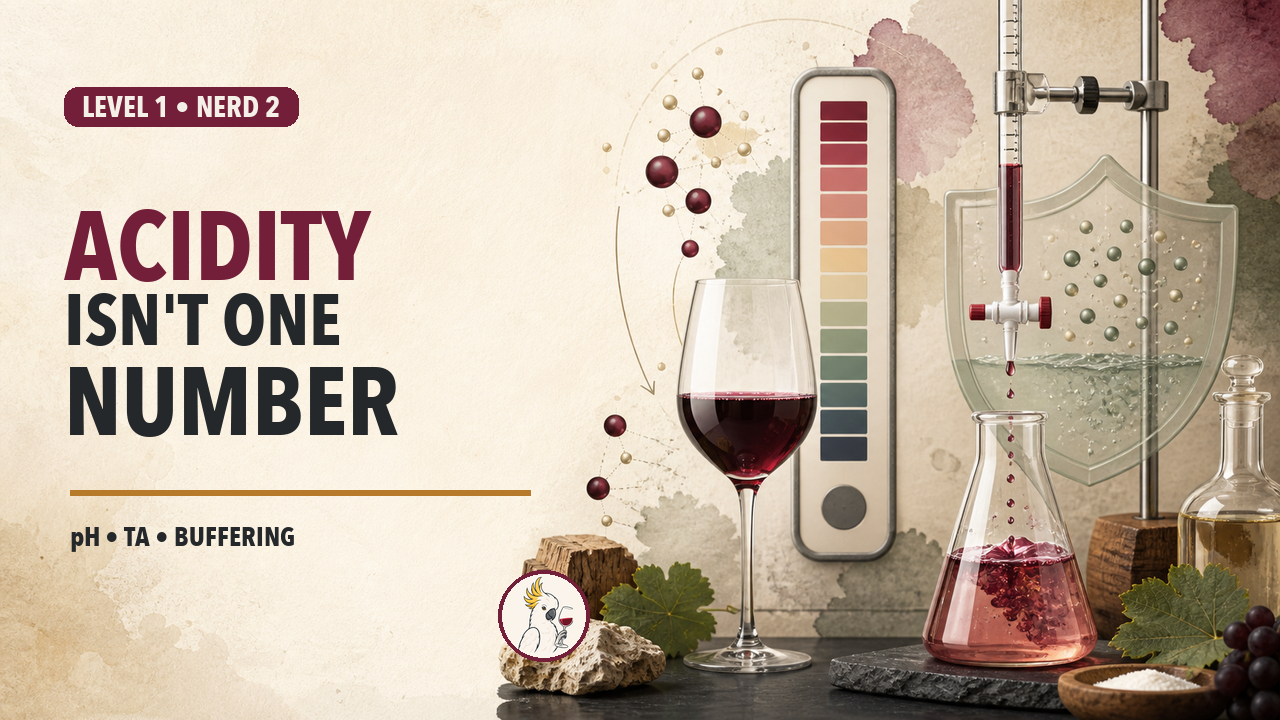
Nerd Mode
Acidity, pH, and buffering
Separate sensory acidity, pH, titratable acidity, and buffering.
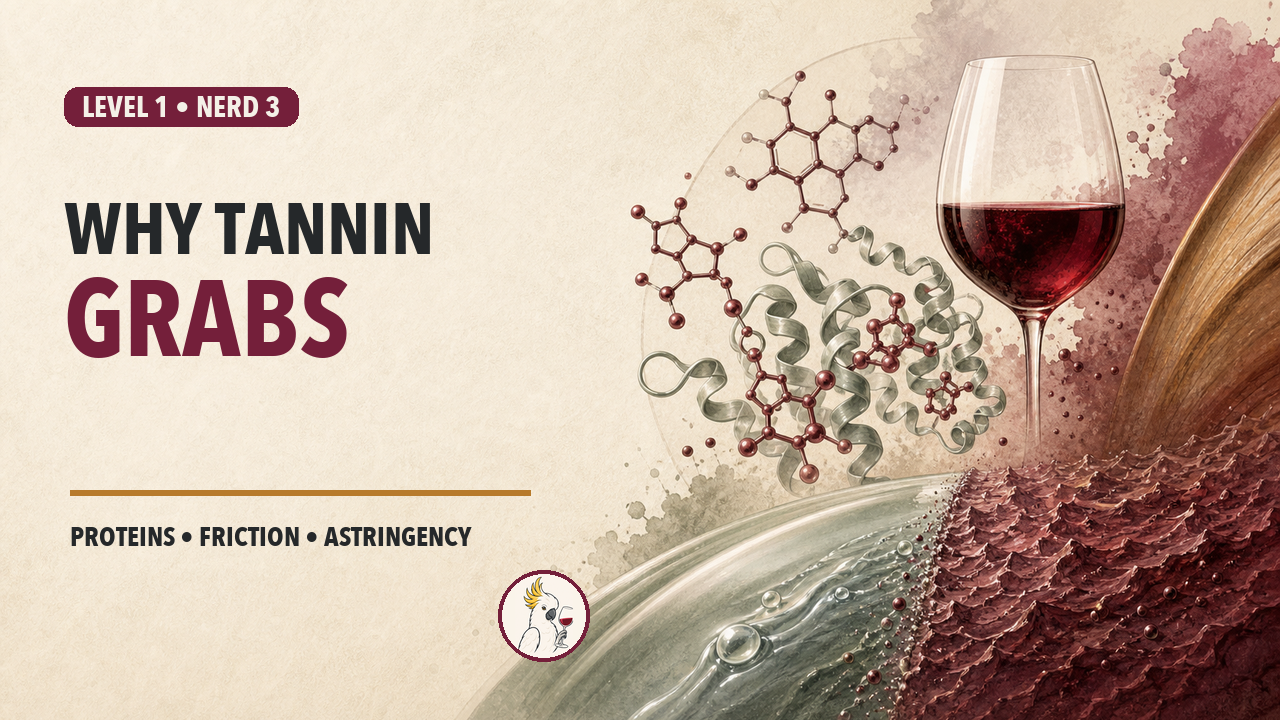
Nerd Mode
Tannins, proteins, and astringency
Look beneath the drying sensation at tannin–saliva interactions.
Nerd Mode
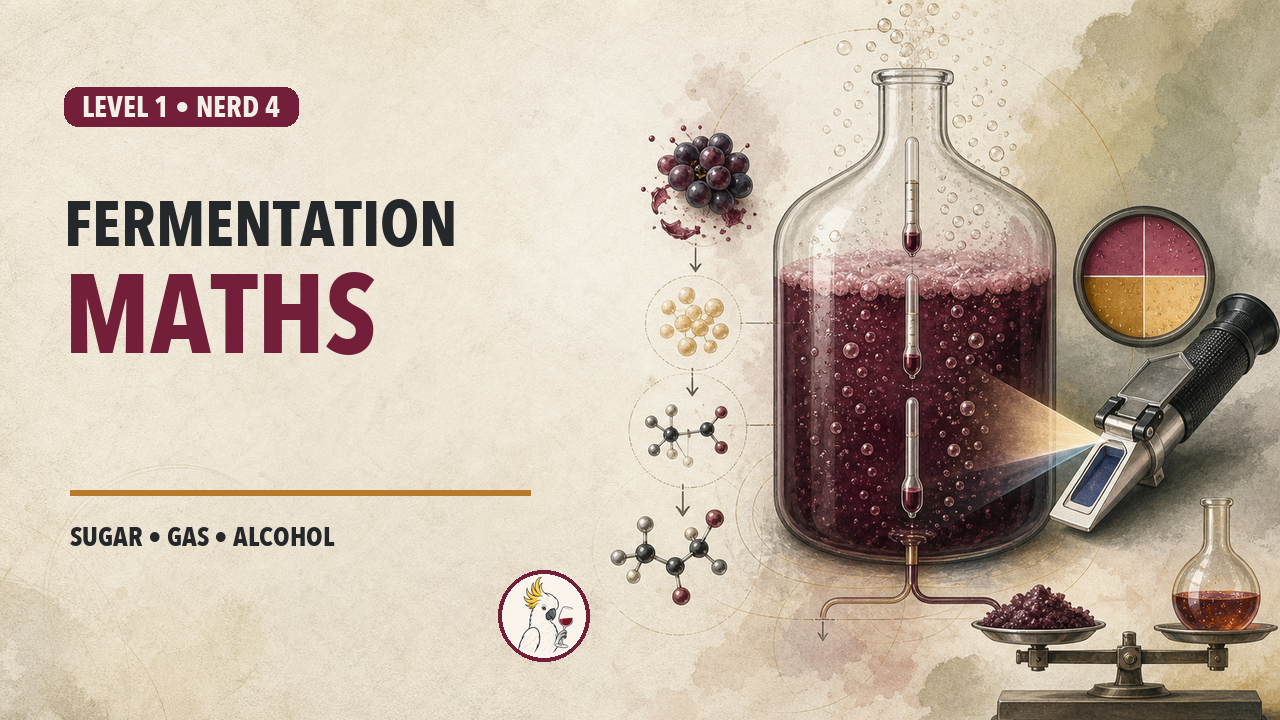
Fermentation mathematics
Connect sugar conversion, alcohol, mass balance, and measurement limits.
Level 2 · Available
Grapes, climate, and style
All eight lessons include preparation, required reading, tasting guidance, video, and a knowledge check.
Level 2 · Lesson 1
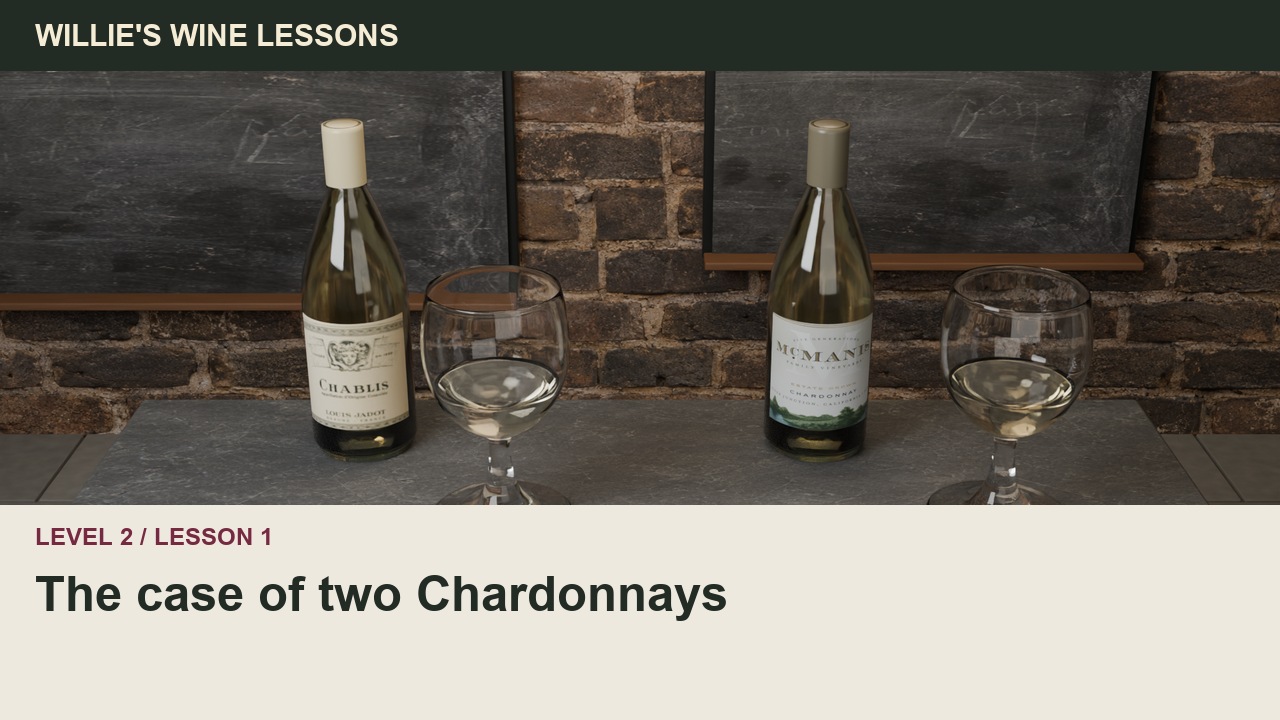
The case of two Chardonnays
Use structure and fruit direction to form a broad climate hypothesis—without turning it into a verdict.
Level 2 · Lesson 2
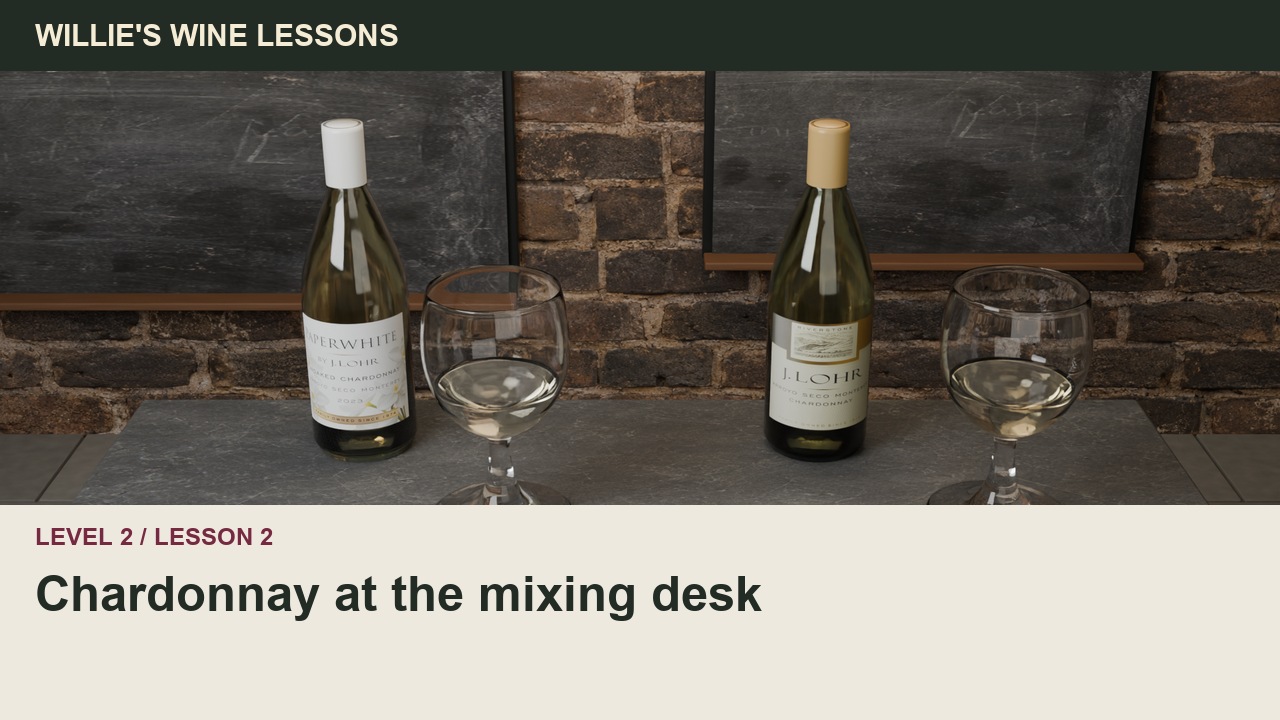
Chardonnay at the mixing desk
Hear Chardonnay as the base track, then separate the cellar controls that may shape the final mix.
Level 2 · Lesson 3
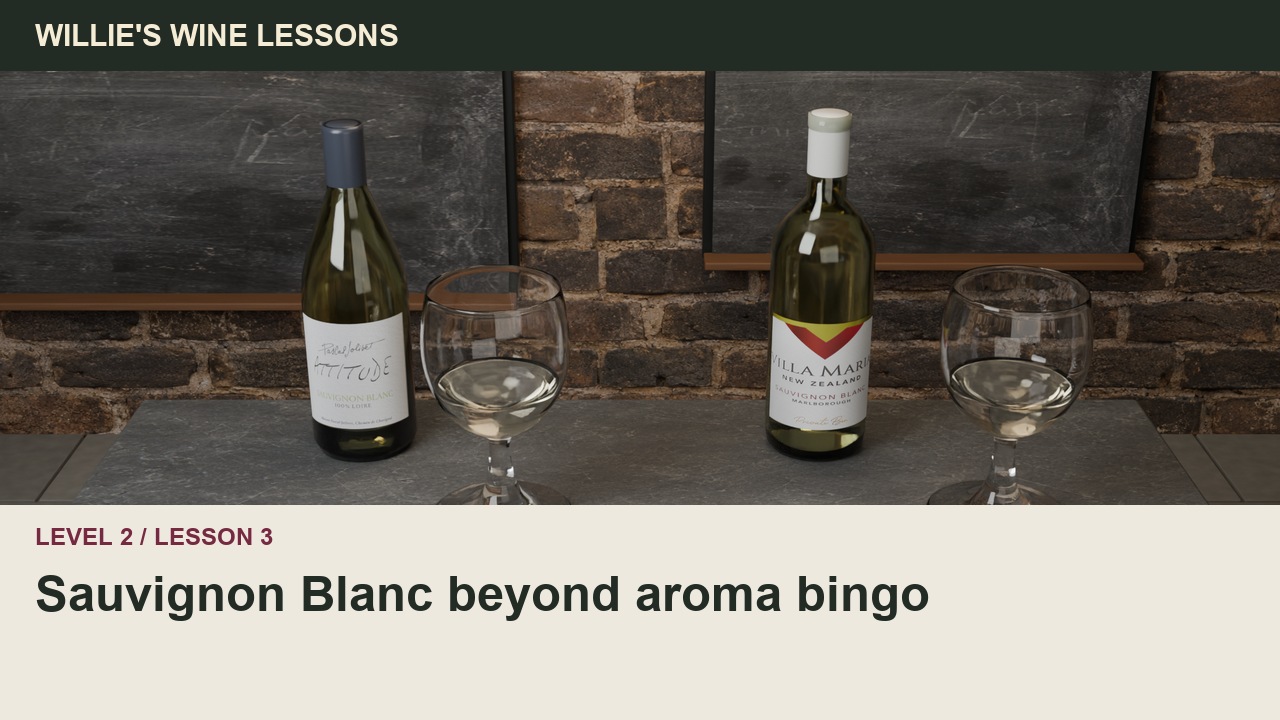
Sauvignon Blanc beyond aroma bingo
Build a Sauvignon Blanc style hypothesis from a whole pattern—not one enthusiastic aroma.
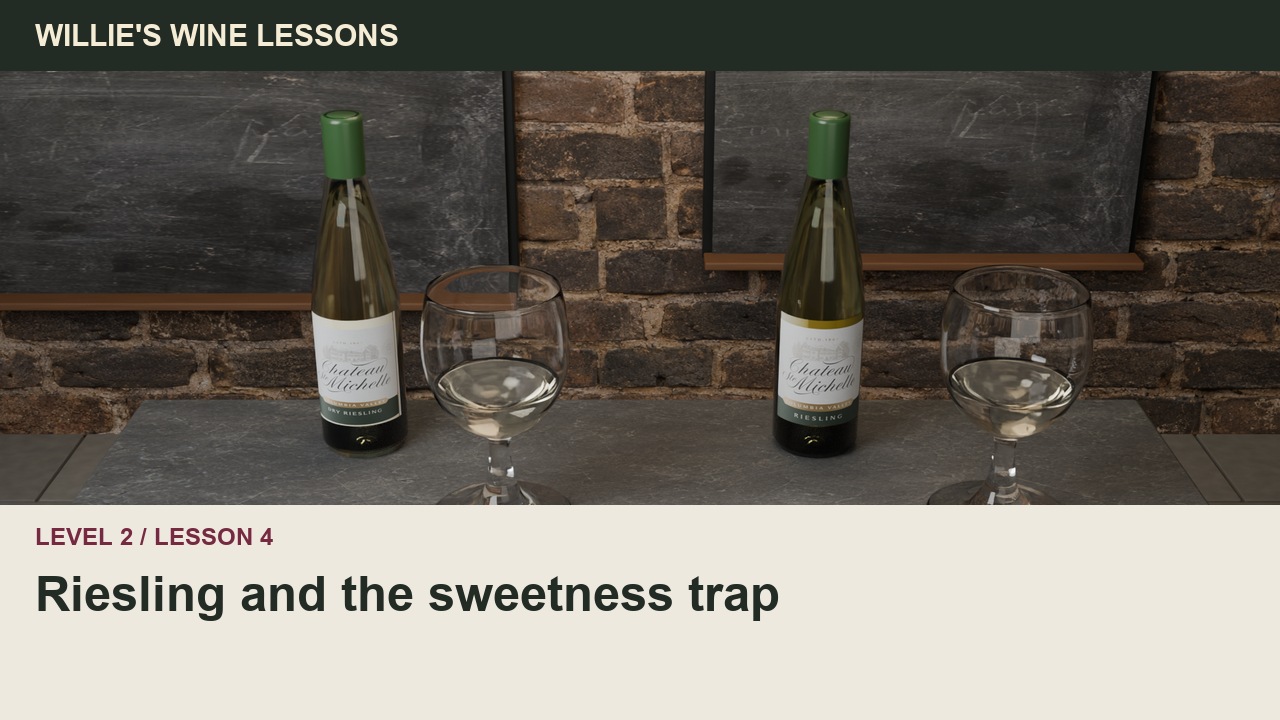
Level 2 · Lesson 4
Riesling and the sweetness trap
Walk Riesling's sweetness-acidity tightrope without assuming the grape, region, or Kabinett category gives away the answer.
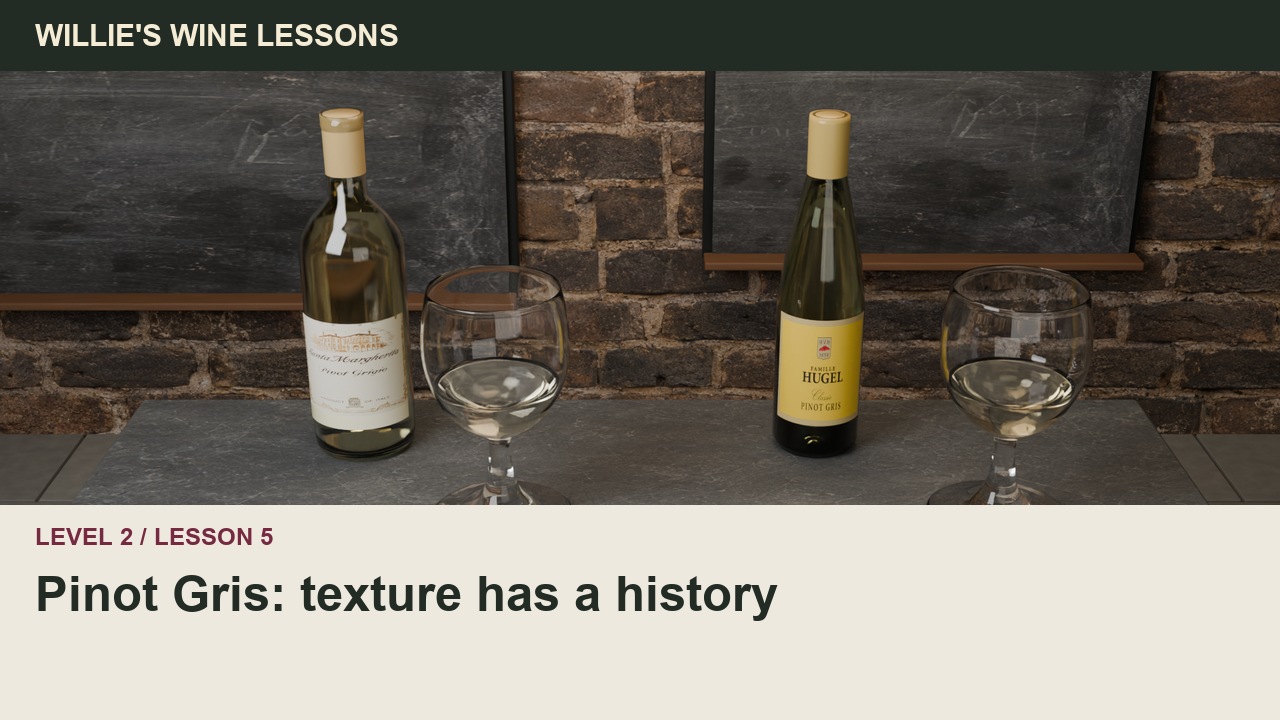
Level 2 · Lesson 5
Pinot Gris: texture has a history
Use one grape's different tailoring to connect texture with ripeness and production choices.
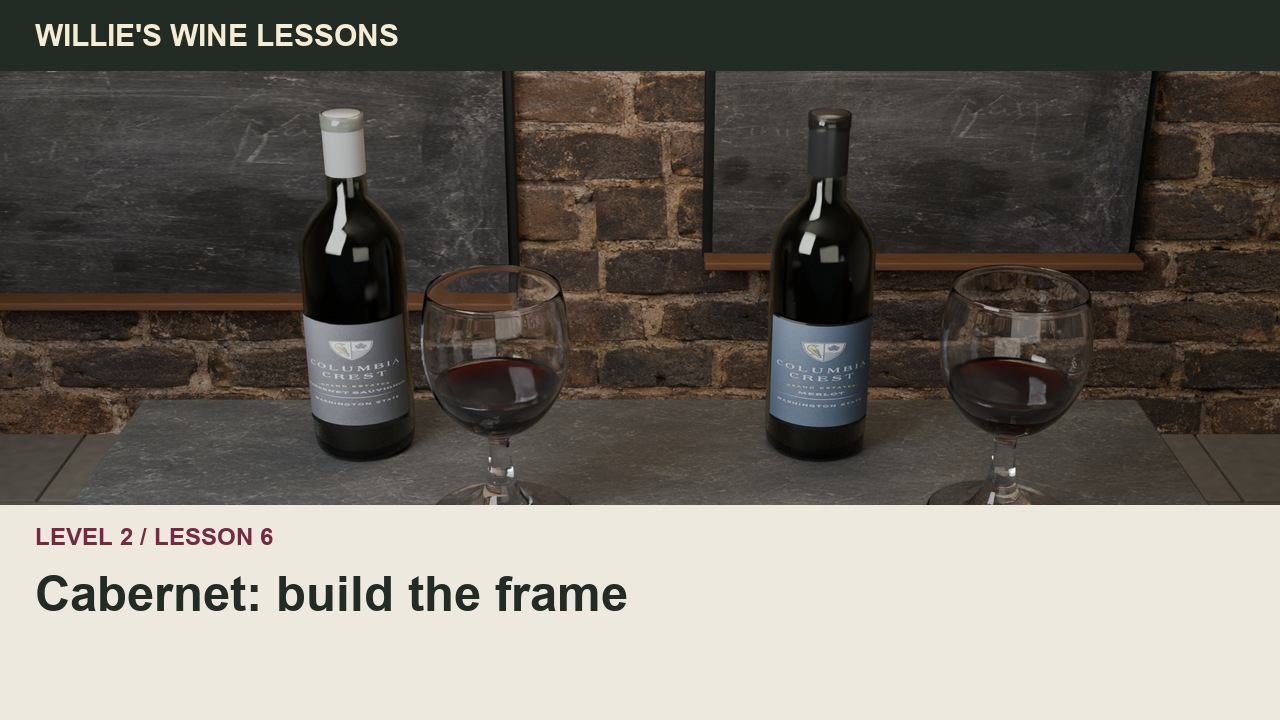
Level 2 · Lesson 6
Cabernet: build the frame
Separate grape tendency from style with A Cabernet-led · Old World-style, B Cabernet-led · New World-style, C Merlot-led · Old World-style, and D Merlot-led · New World-style.
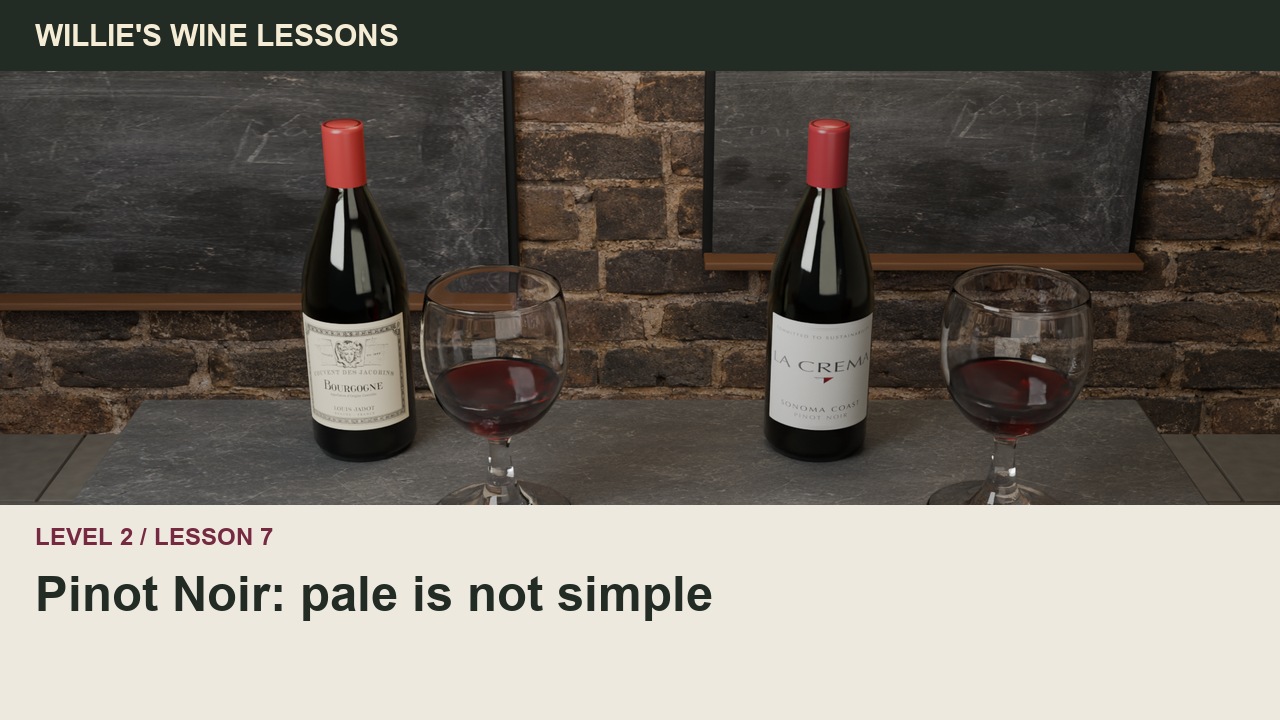
Level 2 · Lesson 7
Pinot Noir: pale is not simple
Recognise typical Pinot Noir relationships while allowing riper, darker, and firmer expressions.
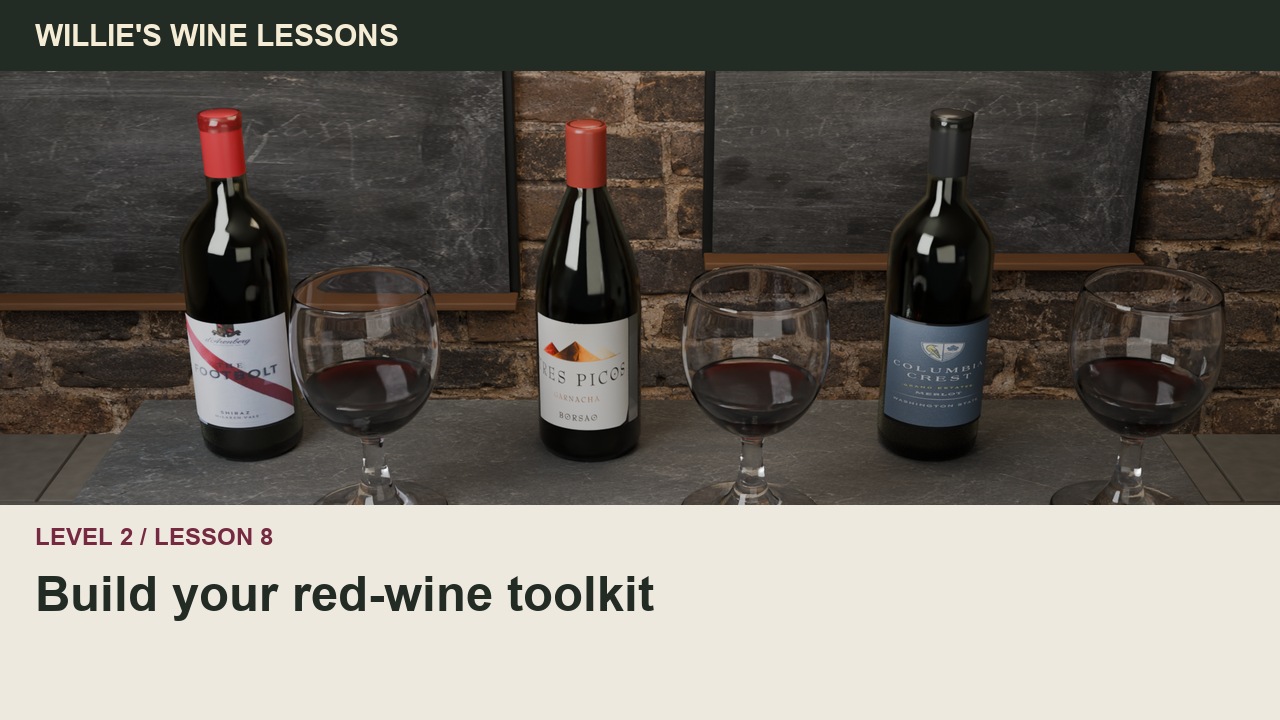
Level 2 · Lesson 8
Build your red-wine toolkit
Compare Syrah, Grenache, and Merlot as structural roles rather than flash cards.
Test out of the level
Already know this material? Take 24 questions covering every lesson. Pass with 20 correct to earn the same level badge and certificate.
Test out of the levelOptional science companions
Science behind Level 2
Explore the aroma chemistry that supports the Level 2 work on grapes and style.
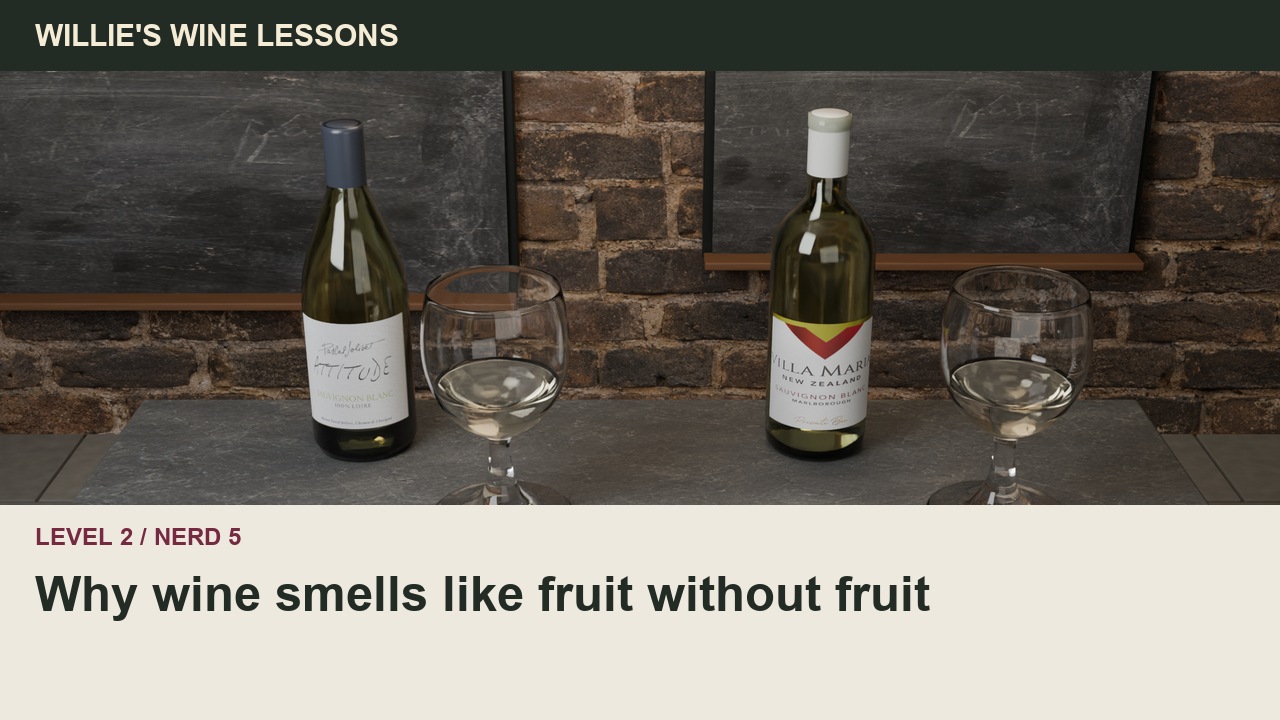
Nerd Mode
Why wine smells like fruit without fruit
Explain aroma through volatility, concentration, thresholds, matrix effects, mixtures, and source pathways.
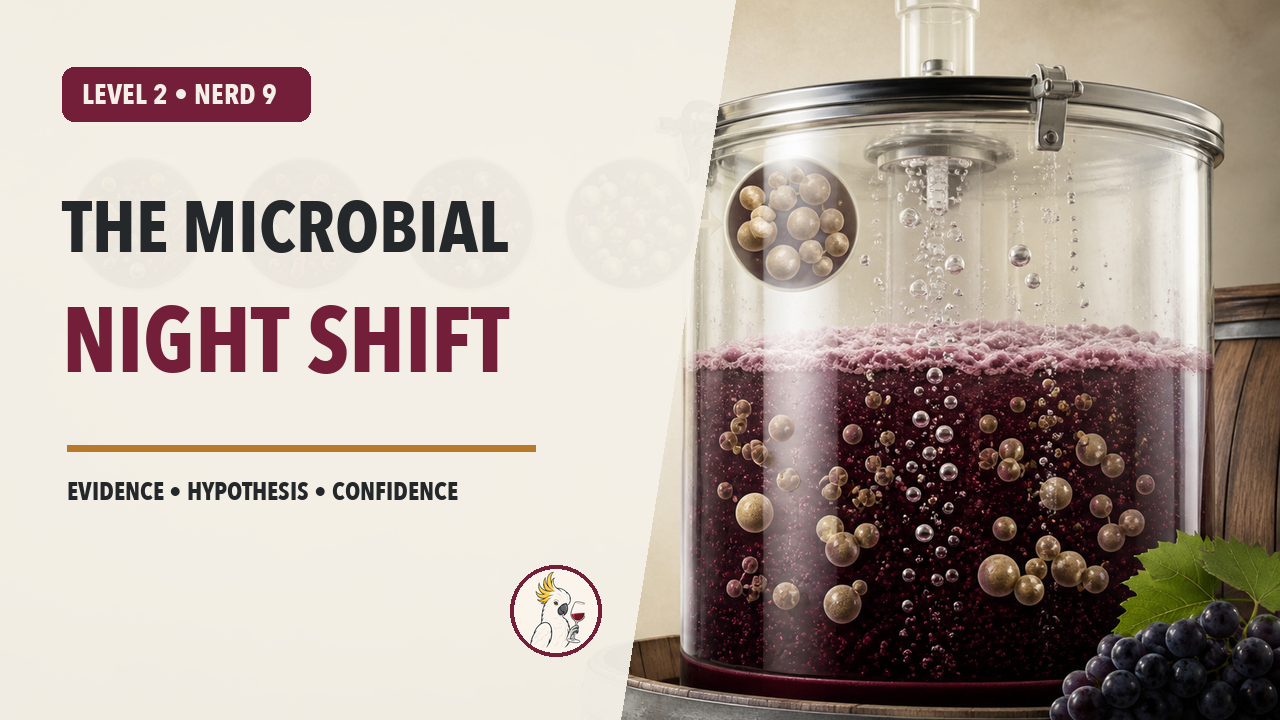
Nerd Mode
Yeast ecology: the microbial night shift
Meet the changing microbial community behind fermentation and diagnose slow progress without one-cause shortcuts.
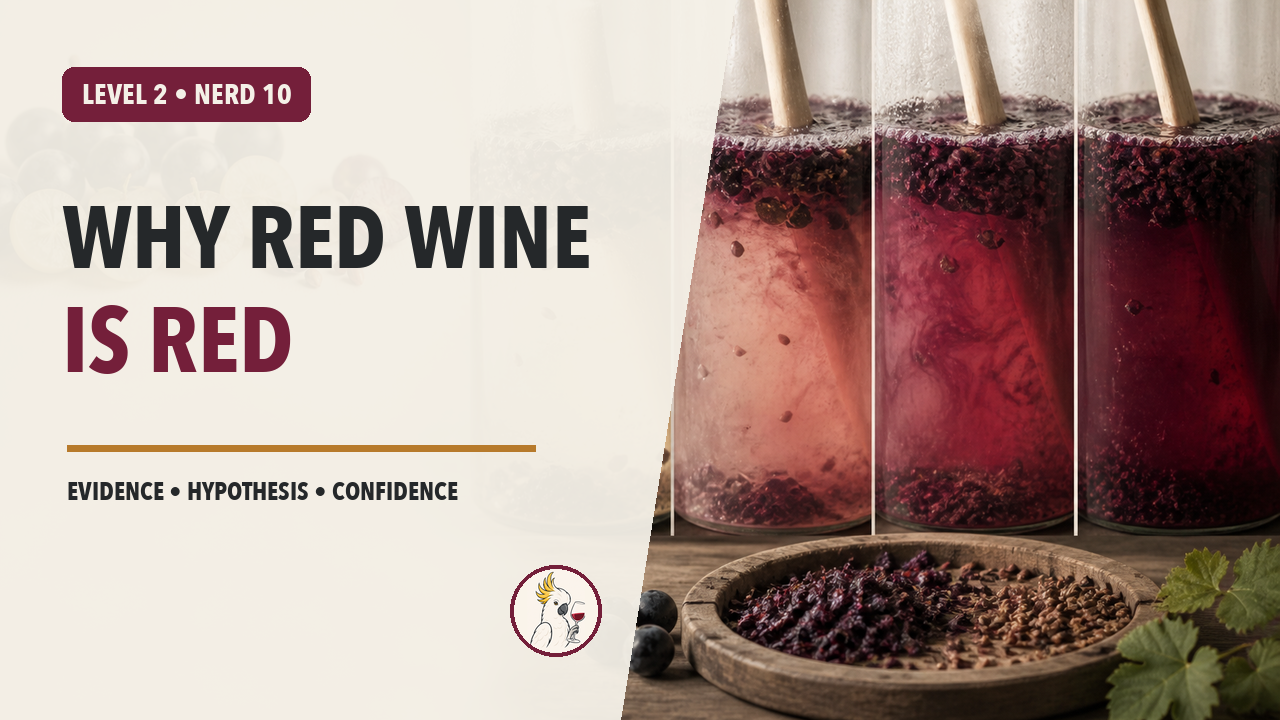
Nerd Mode
Why red wine is red
Separate extraction, visible colour, pigment stability, and astringency.
Nerd Mode
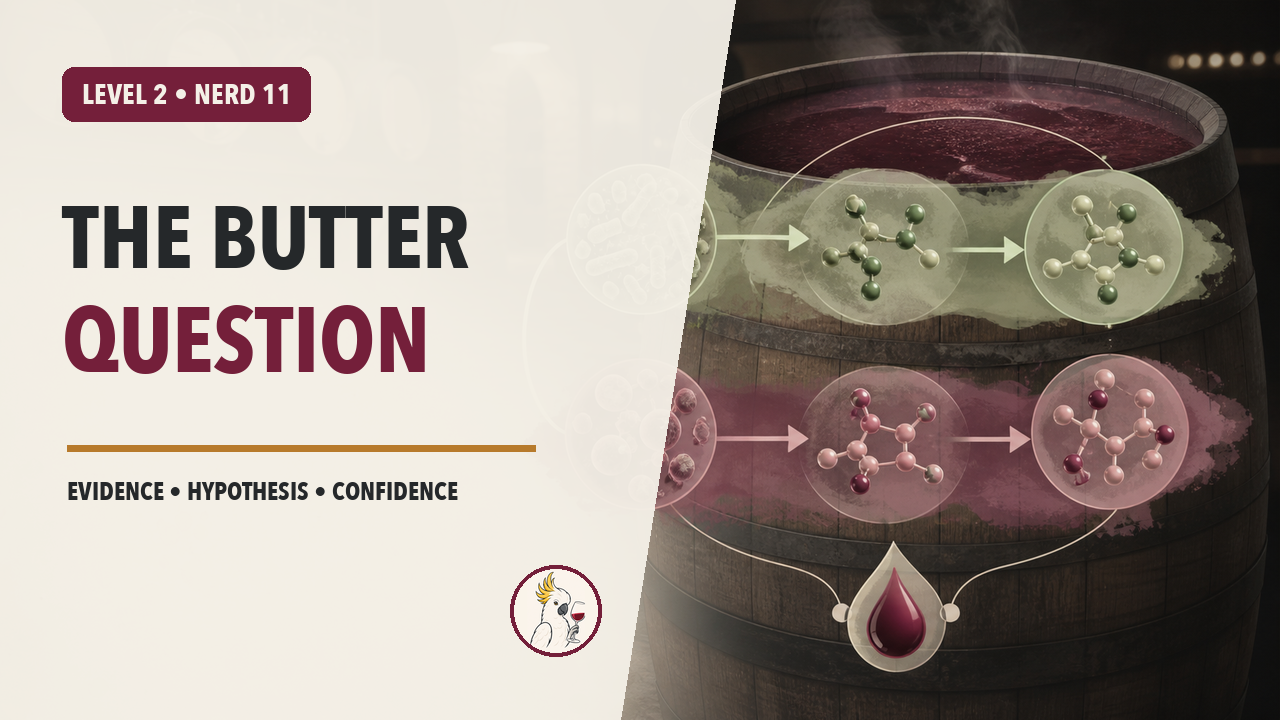
Malolactic conversion, diacetyl, and the butter question
Connect malic-to-lactic acid conversion with bacterial citrate metabolism and diacetyl.
Nerd Mode
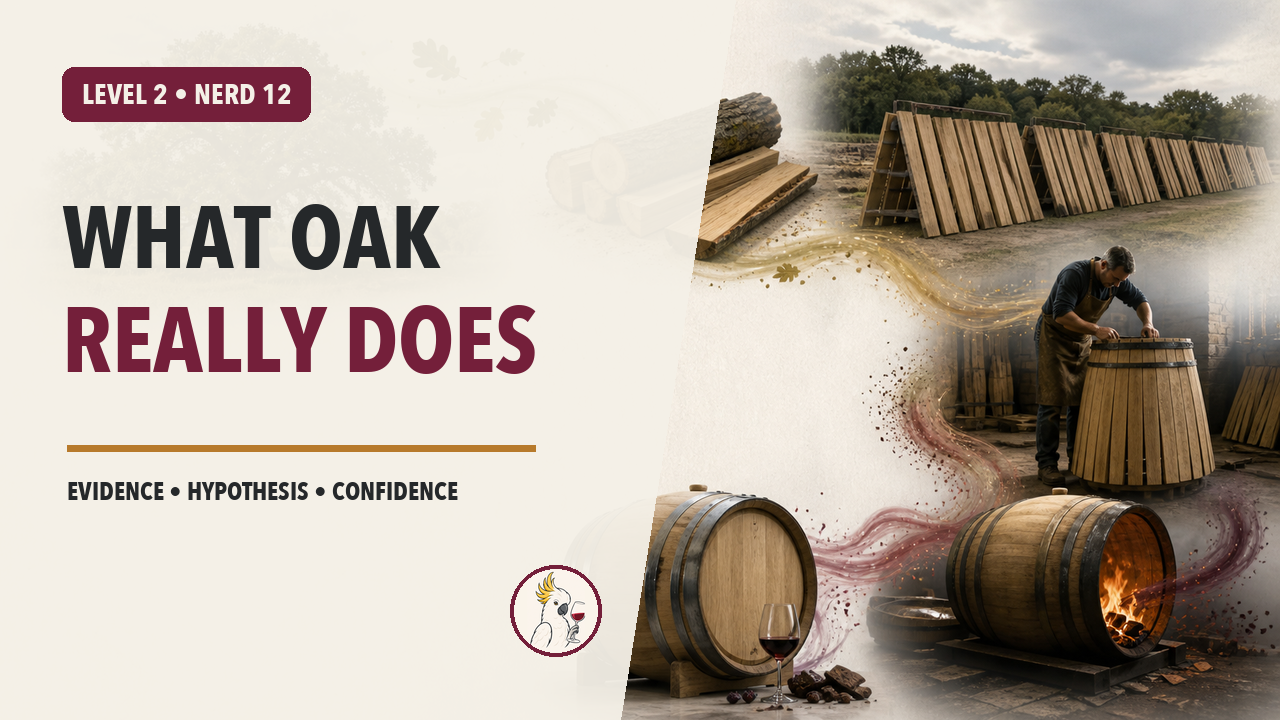
What oak really does
Follow oak from tree to stave and separate wood extraction, vessel geometry, oxygen exposure, time, and wine matrix.
Level 3 · Available
Vineyard and vintage
Follow vine biology, soil and site, farming, threats, vintage, and bottle development through evidence-first causal chains.
Watch the complete Level 3 playlist ↗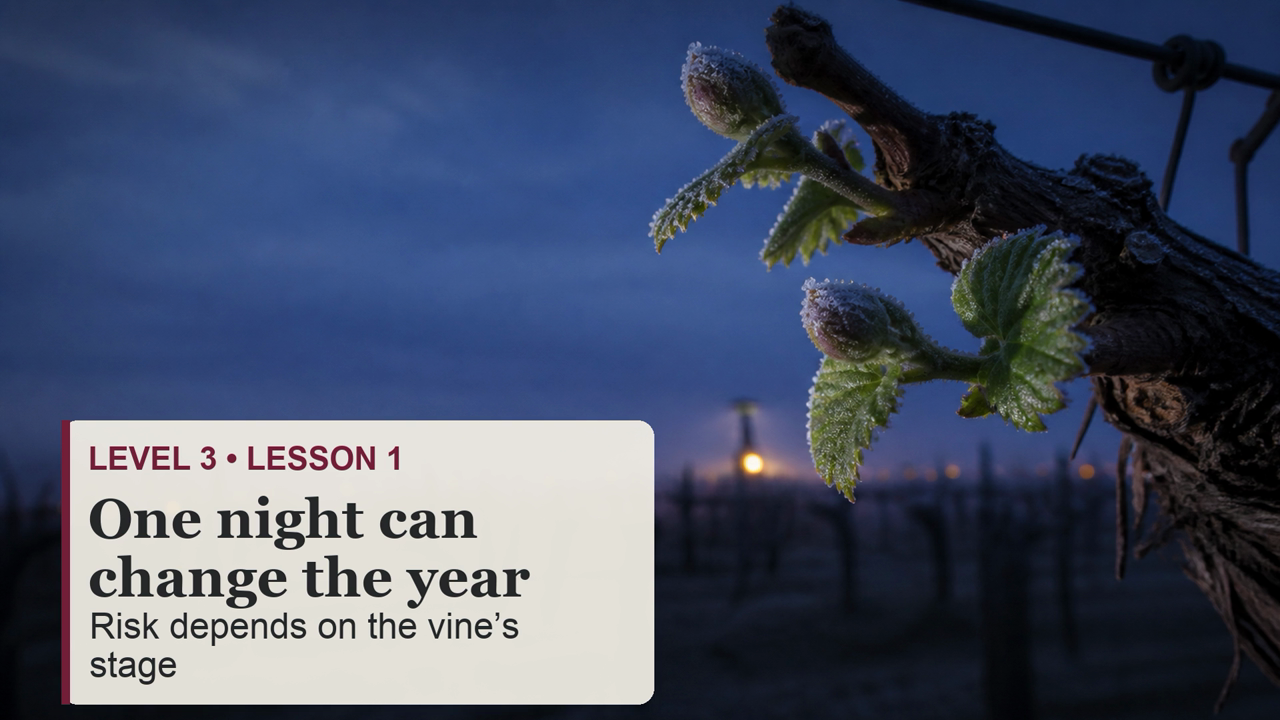
Level 3 · Lesson 1
The vine's year
Follow the vine from dormancy through harvest and connect each vulnerable stage to its real risks.
Level 3 · Lesson 2
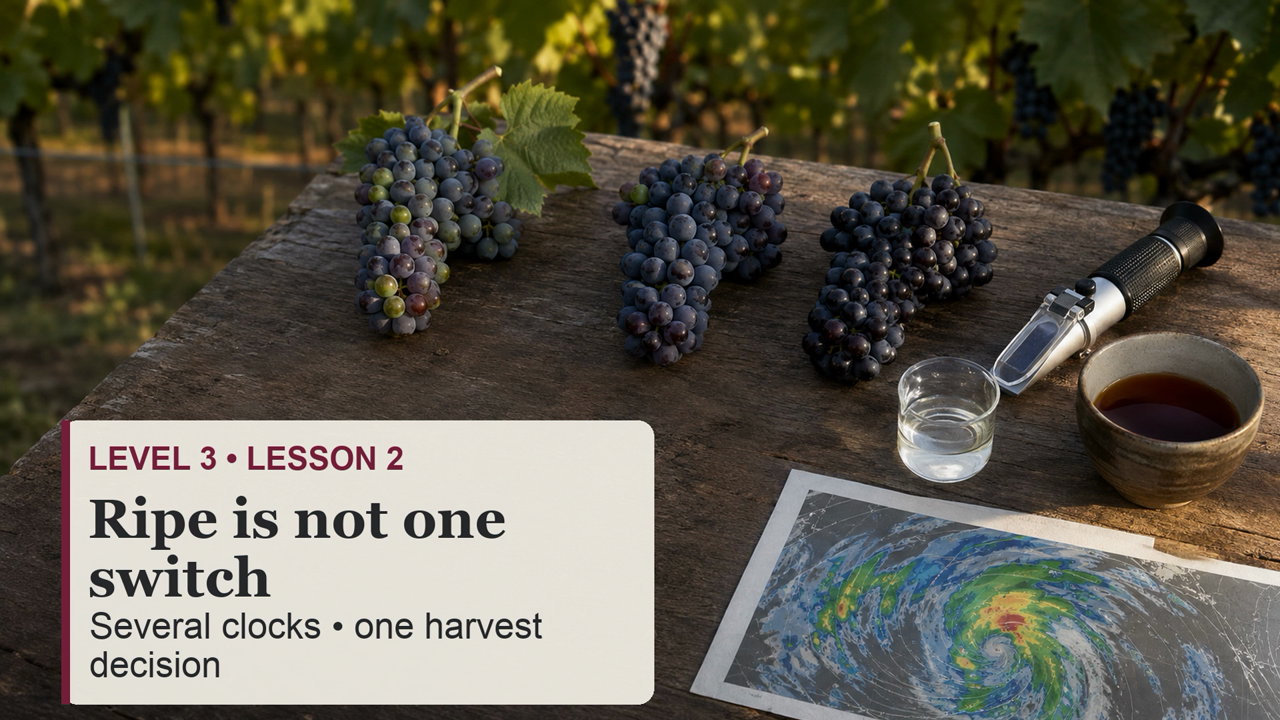
Ripeness is a negotiation
Connect harvest timing to several forms of grape maturity instead of one magic number.
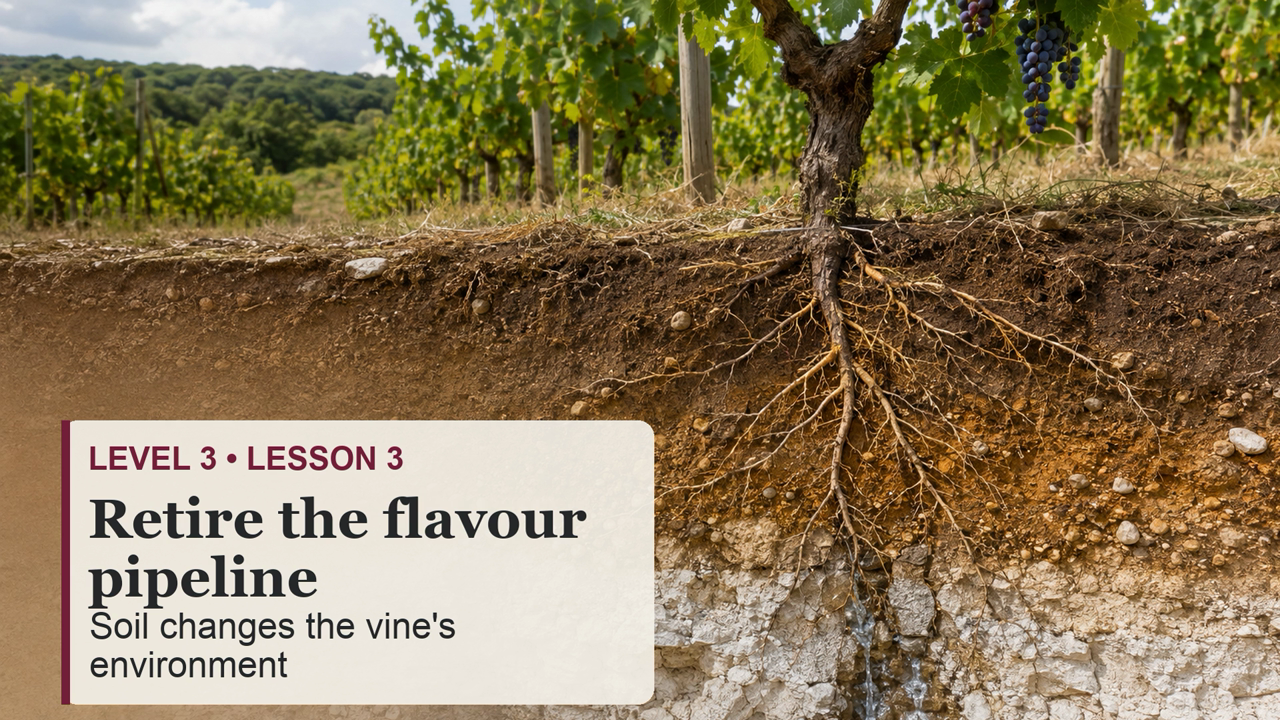
Level 3 · Lesson 3
Soil without the magic rocks
Explain soil through water, air, temperature, nutrients, biology, roots, and management.
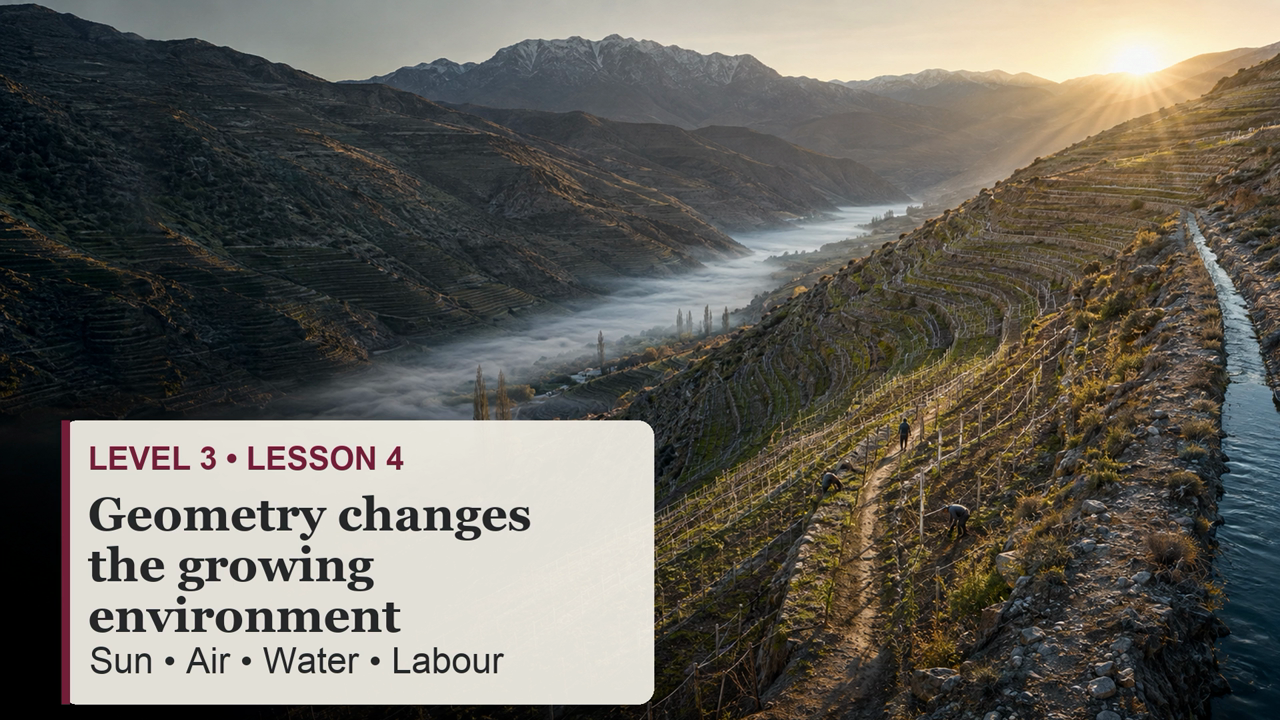
Level 3 · Lesson 4
Slope, aspect, altitude, and water
Read a vineyard as a solar-and-water system inside its regional climate.
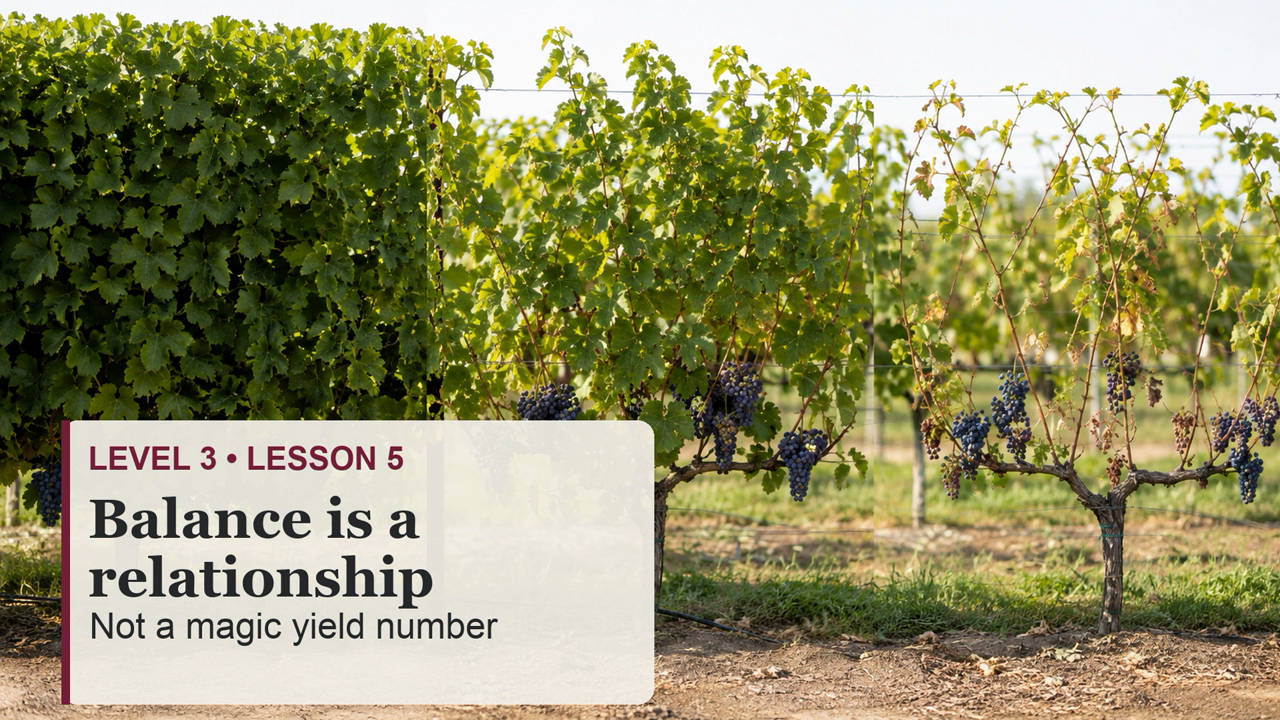
Level 3 · Lesson 5
Canopy, yield, and vine balance
Connect canopy arrangement, crop load, vigour, sunlight, airflow, and reserves.
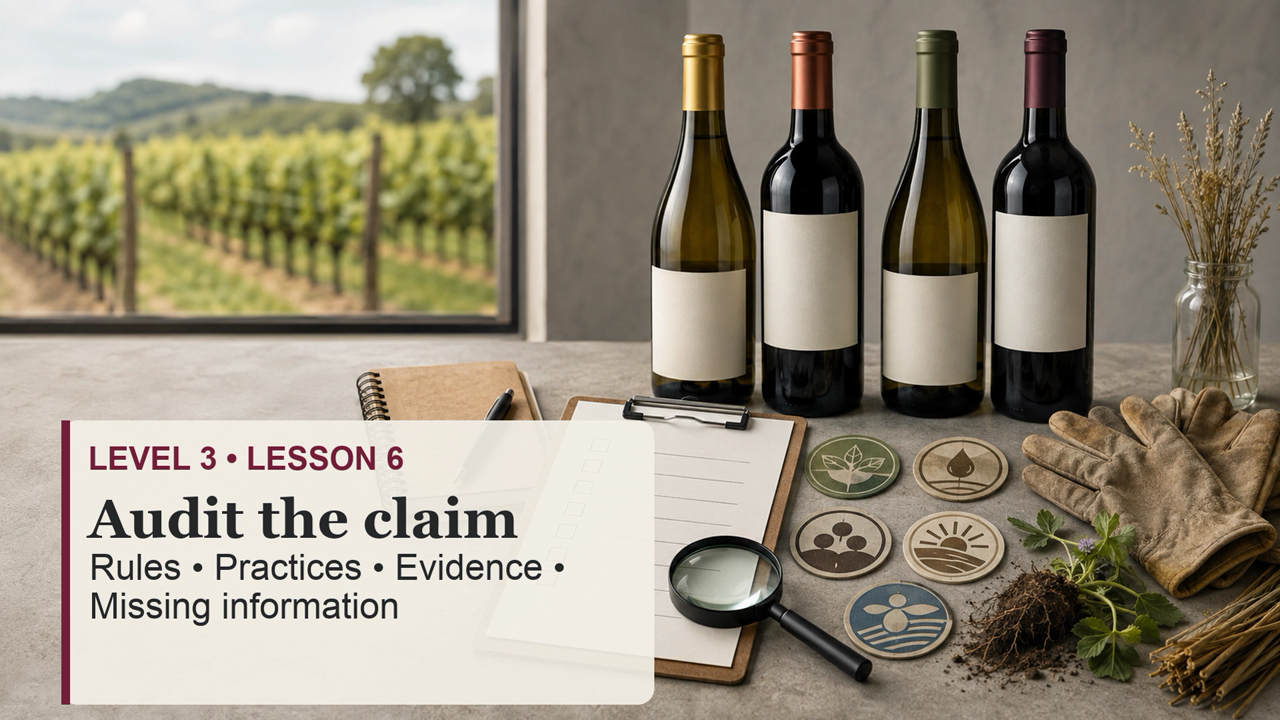
Level 3 · Lesson 6
Farming systems without the halo
Compare farming rules, practices, evidence, and trade-offs without turning labels into virtue scores.
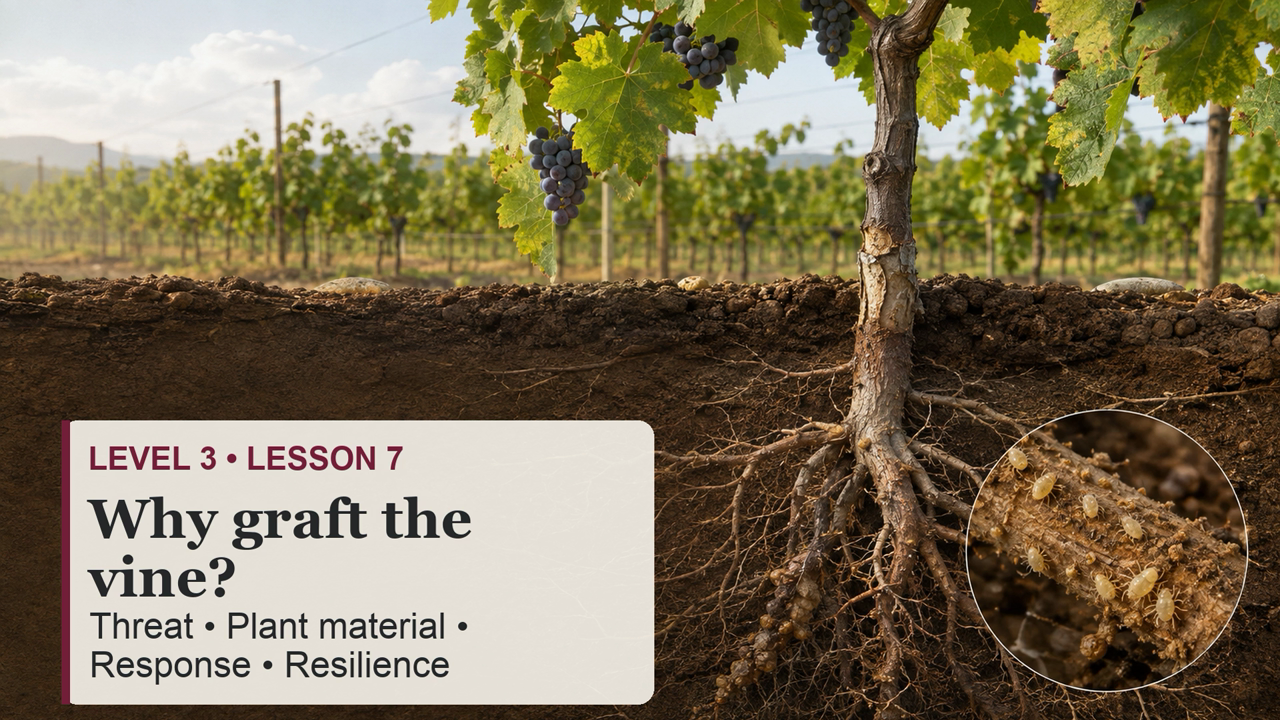
Level 3 · Lesson 7
Pests, disease, and phylloxera
Understand vineyard threats and why phylloxera history, grafting, sand, and isolation belong together.
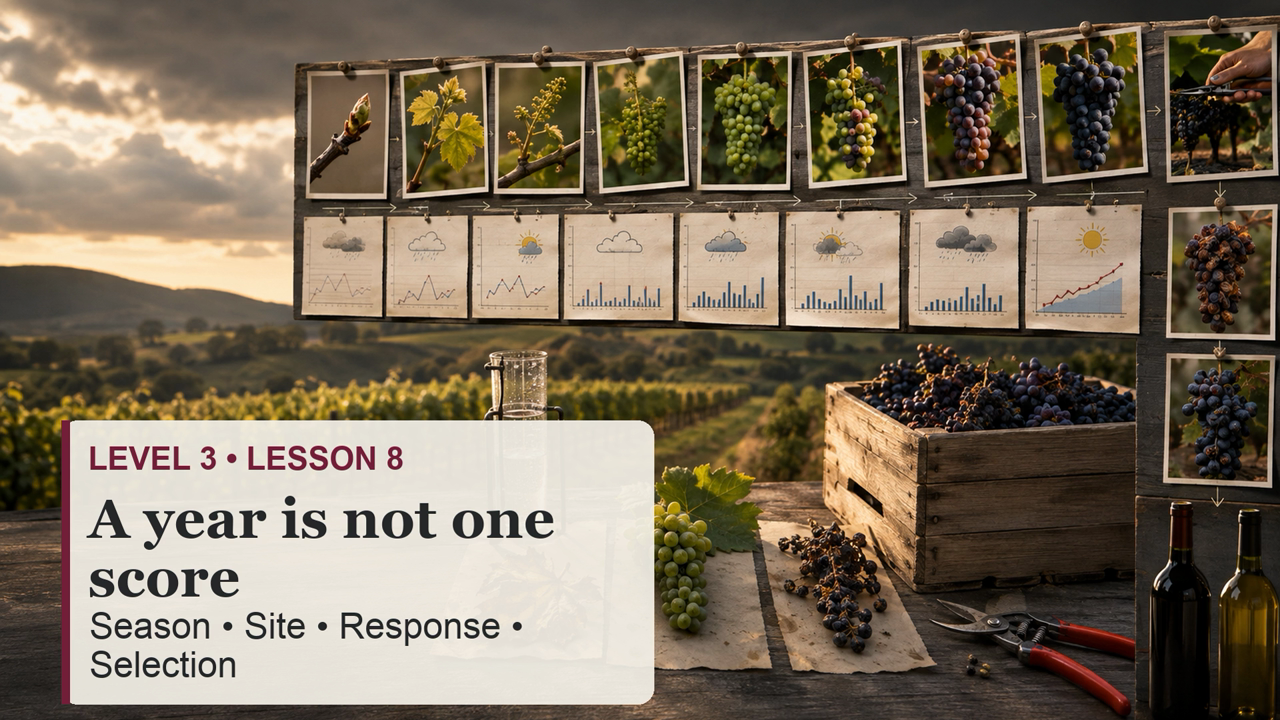
Level 3 · Lesson 8
Vintage: weather becomes wine
Trace a glass backward through season, site, farming response, harvest, grape condition, selection, and bottle development.
Test out of the level
Already know this material? Take 24 questions covering every lesson. Pass with 20 correct to earn the same level badge and certificate.
Test out of the levelOptional science companions
Science behind Level 3
Go deeper on photosynthesis and ripening, the root zone, and phylloxera with the revised image-led Nerd Mode series.
Watch the Level 3 Nerd Mode playlist ↗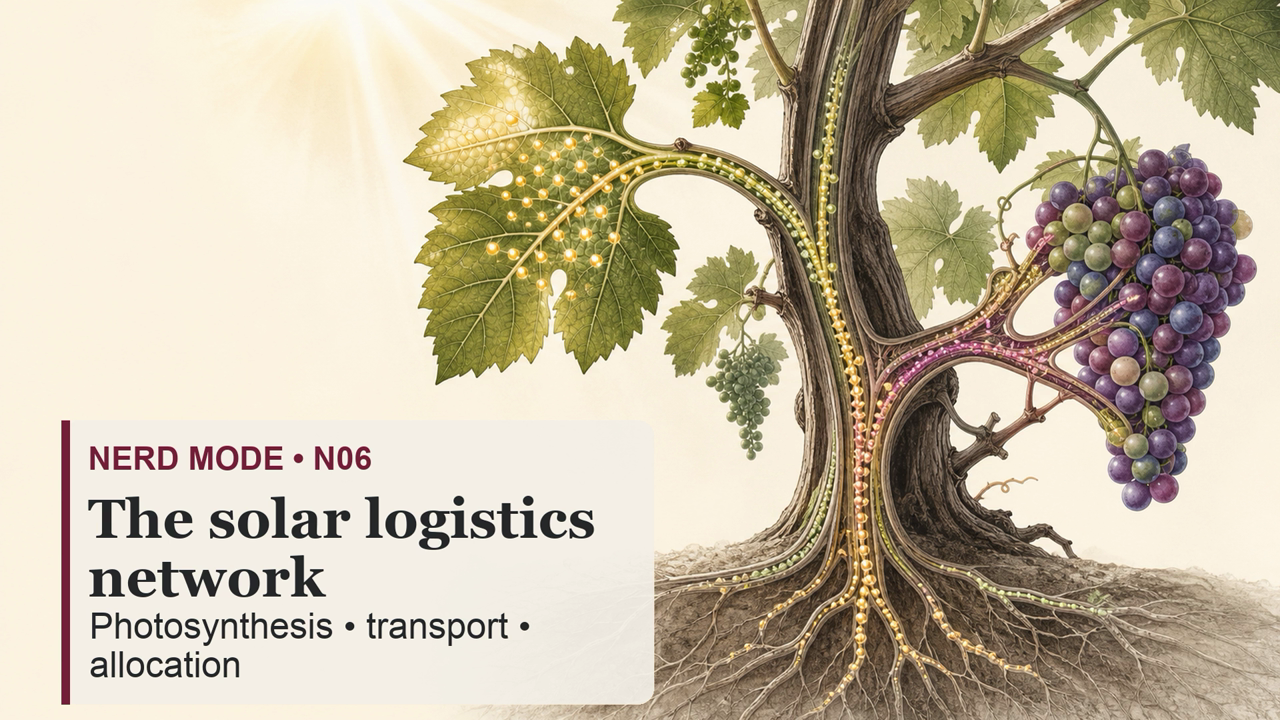
Nerd Mode
Vine photosynthesis and ripening physiology
Follow carbon from leaf to berry and separate sources, transport, sinks, and several ripening clocks.
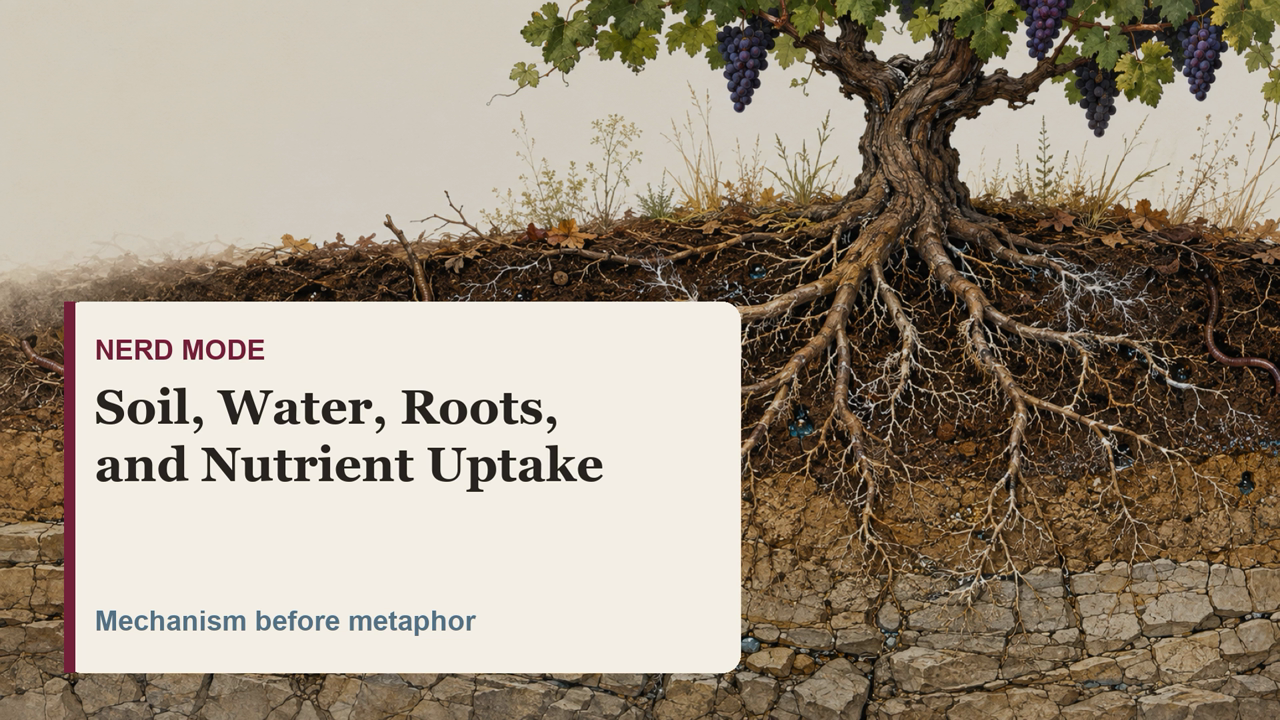
Nerd Mode
Soil, water, roots, and nutrient uptake
Go underground through water movement, soil structure, nutrients, fungi, and evidence boundaries.
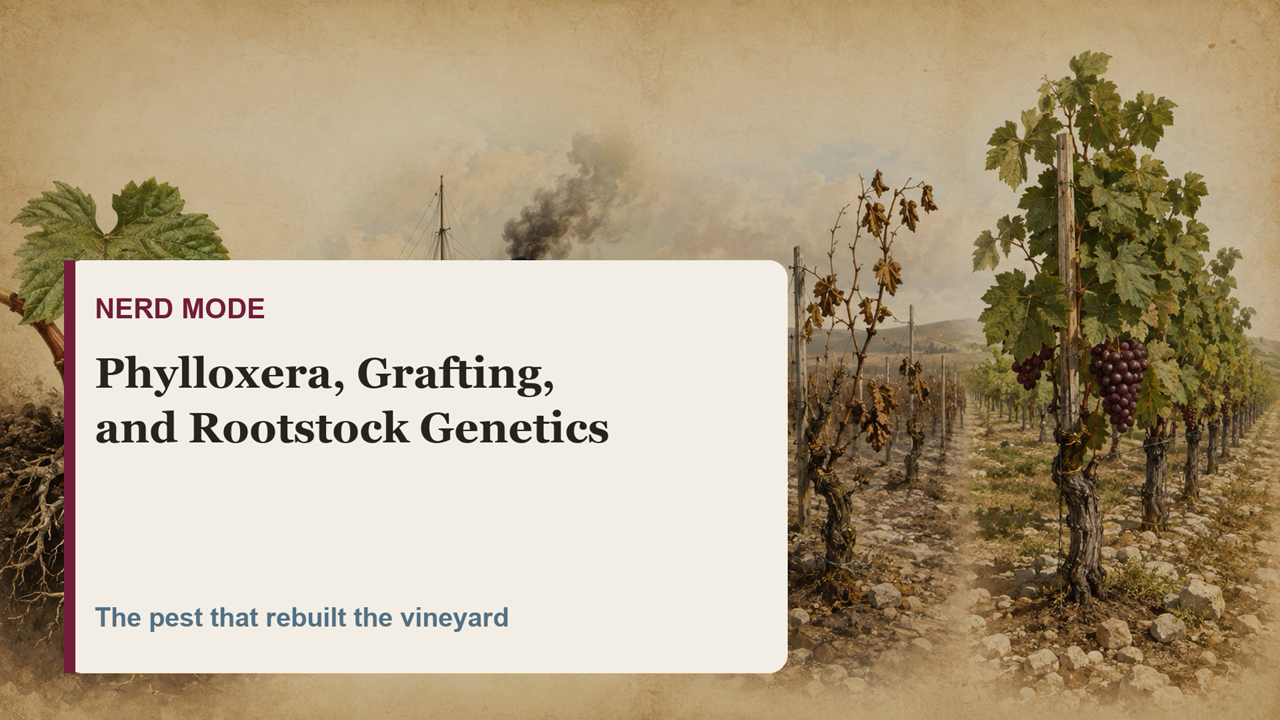
Nerd Mode
Phylloxera, grafting, and rootstock genetics
Trace the pest's history, the grafting response, rootstock trade-offs, and exceptional old-vine survival.
Level 4 · Available
How wine is made
Follow winery decisions from fermentation to bottle ageing. Each lesson includes a real winery example, the technical documents discussed, background reading and a quiz. No wine purchase or advance reading is required.
Watch the complete Level 4 playlist ↗
Level 4 · Lesson 1
Fermentation — The Main Event
Understand yeast, heat, nutrients and monitoring through Ridge’s managed native-yeast fermentation and a worked technical-sheet example.
Level 4 · Lesson 2
White, Red, Rosé, and Amber
Follow juice and skins through pressing and fermentation, using Tablas Creek’s rosé choices to distinguish documented process from colour alone.
Level 4 · Lesson 3
Extraction — Managing the Cap
Explain punch-downs, pump-overs, rack-and-return and heading-down through Penfolds’ documented extraction choices.
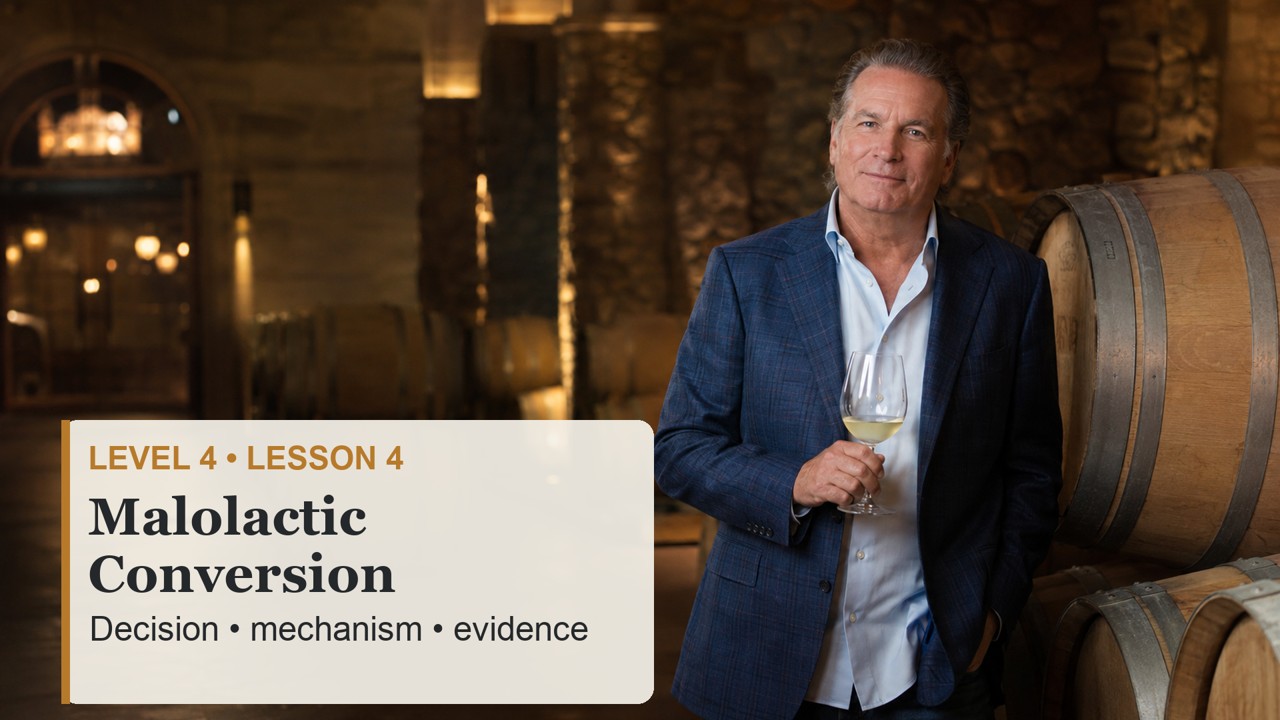
Level 4 · Lesson 4
Malolactic Conversion
Separate bacterial acid conversion, buttery aroma, lees work and oak through Rombauer’s Chardonnay production details.
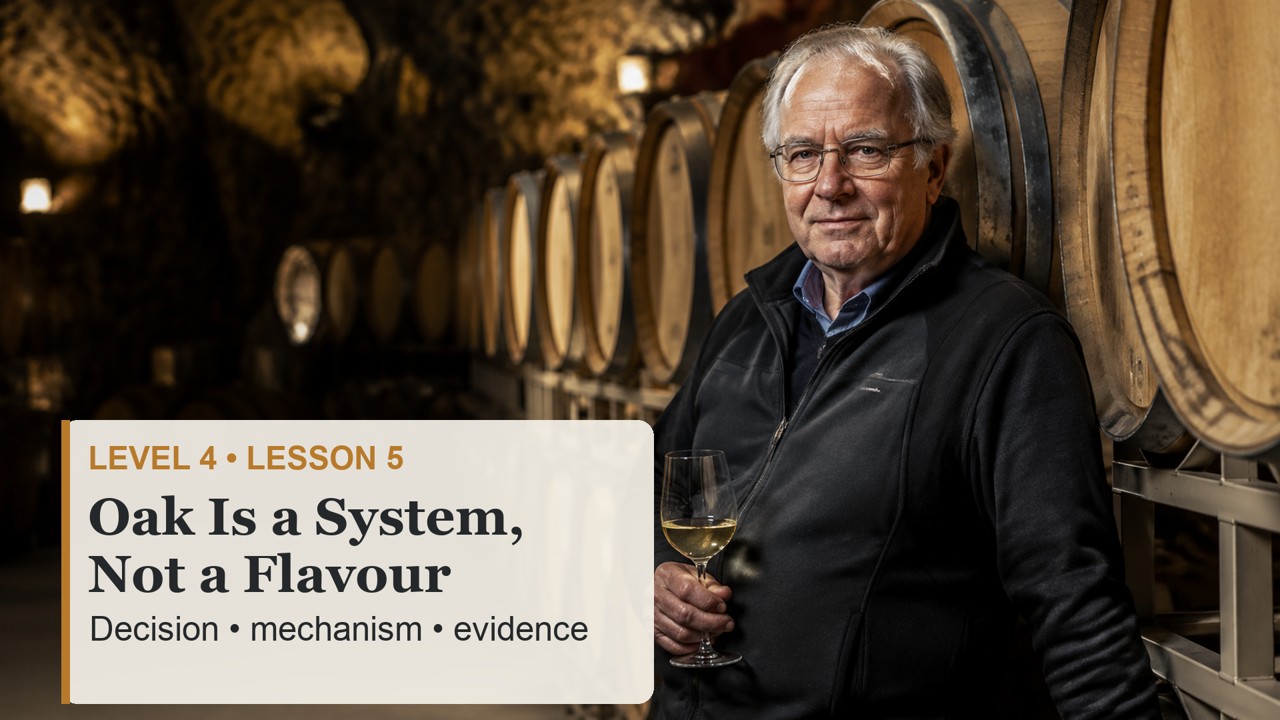
Level 4 · Lesson 5
Oak Is a System, Not a Flavour
Connect species, seasoning, toast, vessel size, barrel age and time to oak’s effects, using Ridge’s detailed barrel disclosures.
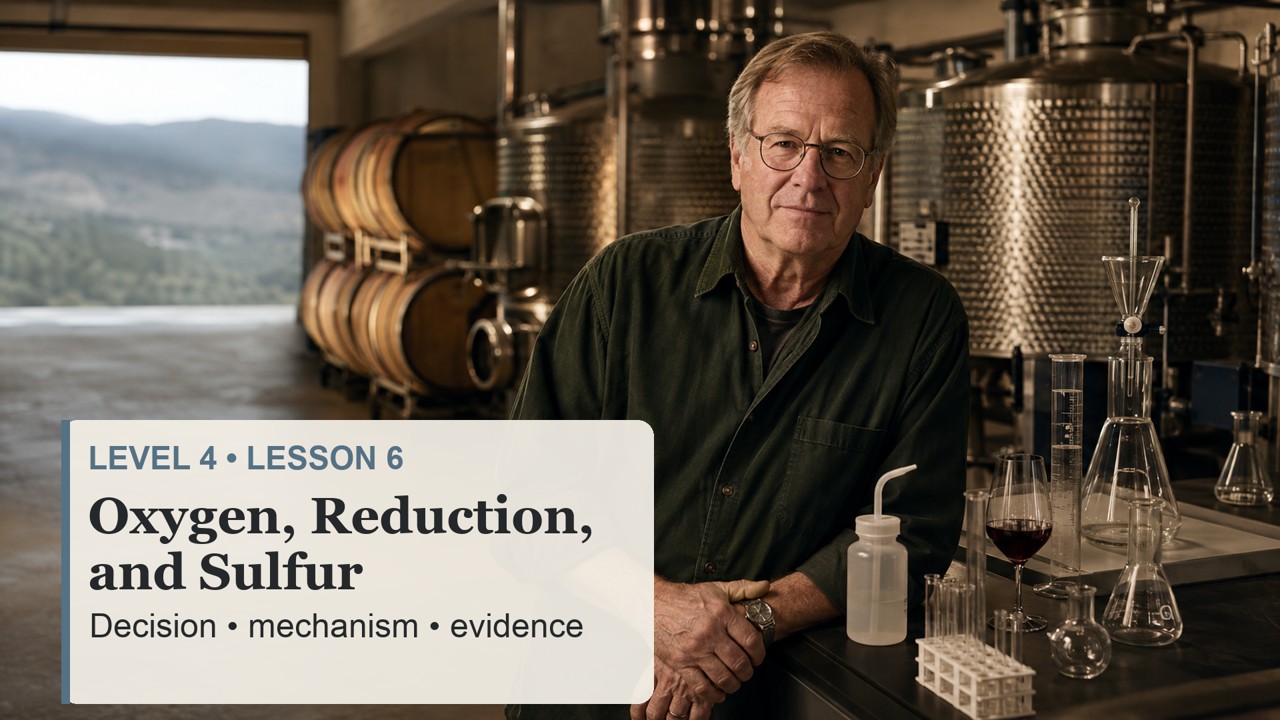
Level 4 · Lesson 6
Oxygen, Reduction, and Sulfur
Understand topping, oxygen exposure and sulfur dioxide while keeping additions, total sulfur and active fractions distinct.
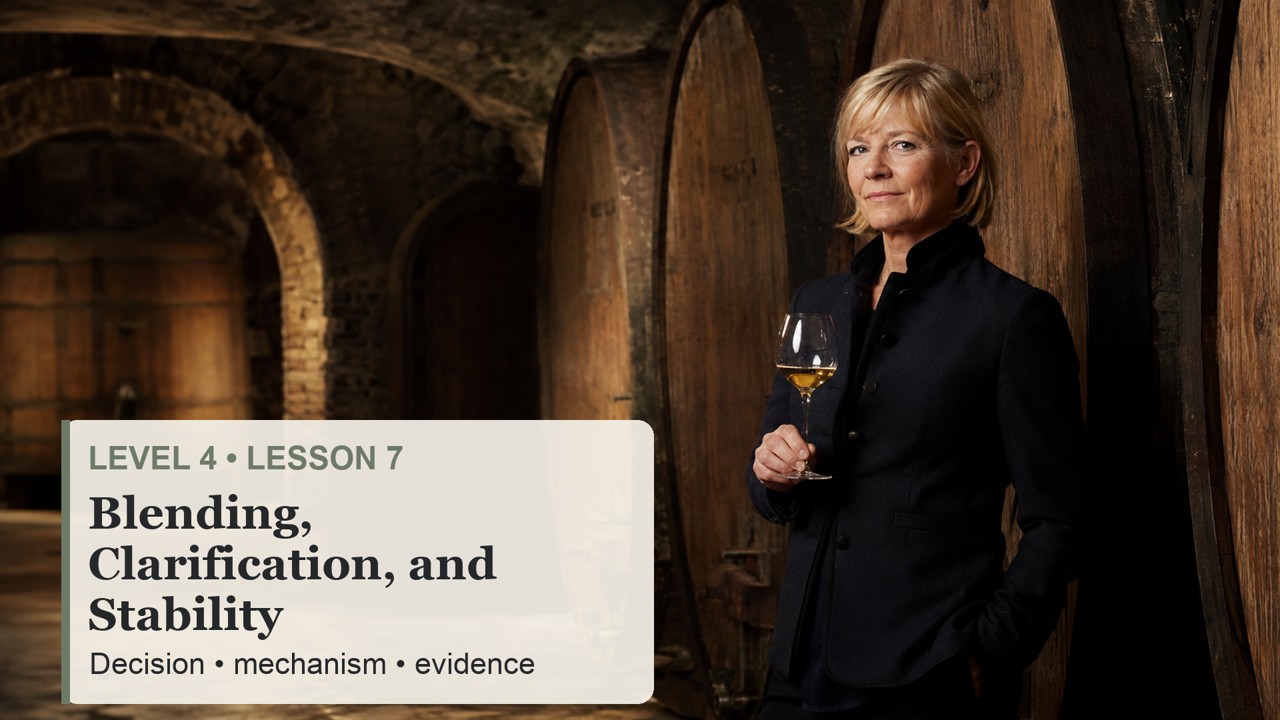
Level 4 · Lesson 7
Blending, Clarification, and Stability
Follow Krug’s component library into blending decisions, then distinguish settling, racking, fining and filtration from stability and quality.
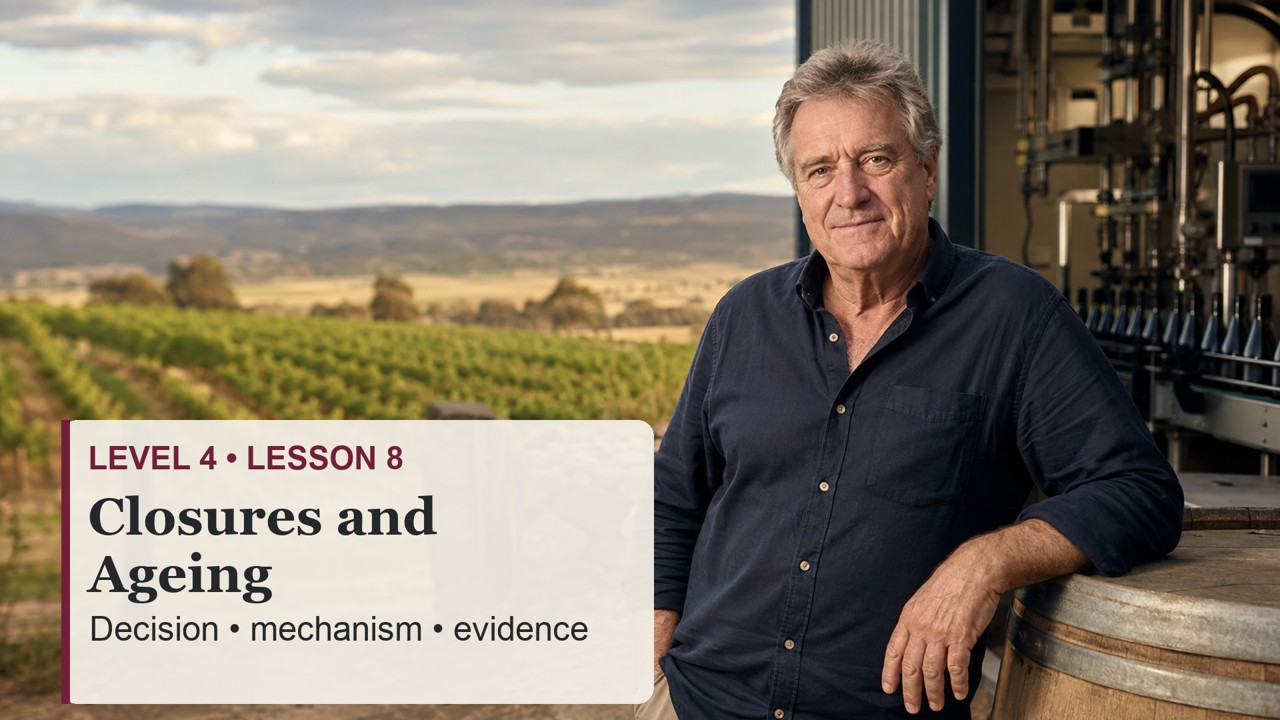
Level 4 · Lesson 8
Closures and Ageing
Use Grosset and the AWRI closure trial to reason about cork, screwcap, oxygen, storage and whether a wine is worth waiting for.
Test out of the level
Already know this material? Take 24 questions covering every lesson. Pass with 20 correct to earn the same level badge and certificate.
Test out of the levelLevel 5 · Available
France: regions, grapes and appellations
Start with the larger map, then explore the grapes, history and bottle-level decisions that make each region distinct. Eight detailed lessons include optional four-to-six-wine open-label tastings, real wine references, background chapters and quizzes. Learn at your own pace, with or without tasting.
Watch the complete Level 5 playlist ↗
Level 5 · Lesson 1
French Appellations: What the Label Promises
Welcome to French Appellations, our first lesson in Level Five. Today we will learn to read an origin claim without turning it into a prediction of pleasure. Four openly identified wines will help us compare categories, producers and our own expectations. Keep the bottle, the map and the glass connected throughout.
Level 5 · Lesson 2
Bordeaux: Rivers, Blends and Reputation
How much can a river bank tell us?
Level 5 · Lesson 3
Burgundy and Beaujolais: Place at Finer Scale
Does a more precise place guarantee a better choice?
Level 5 · Lesson 4
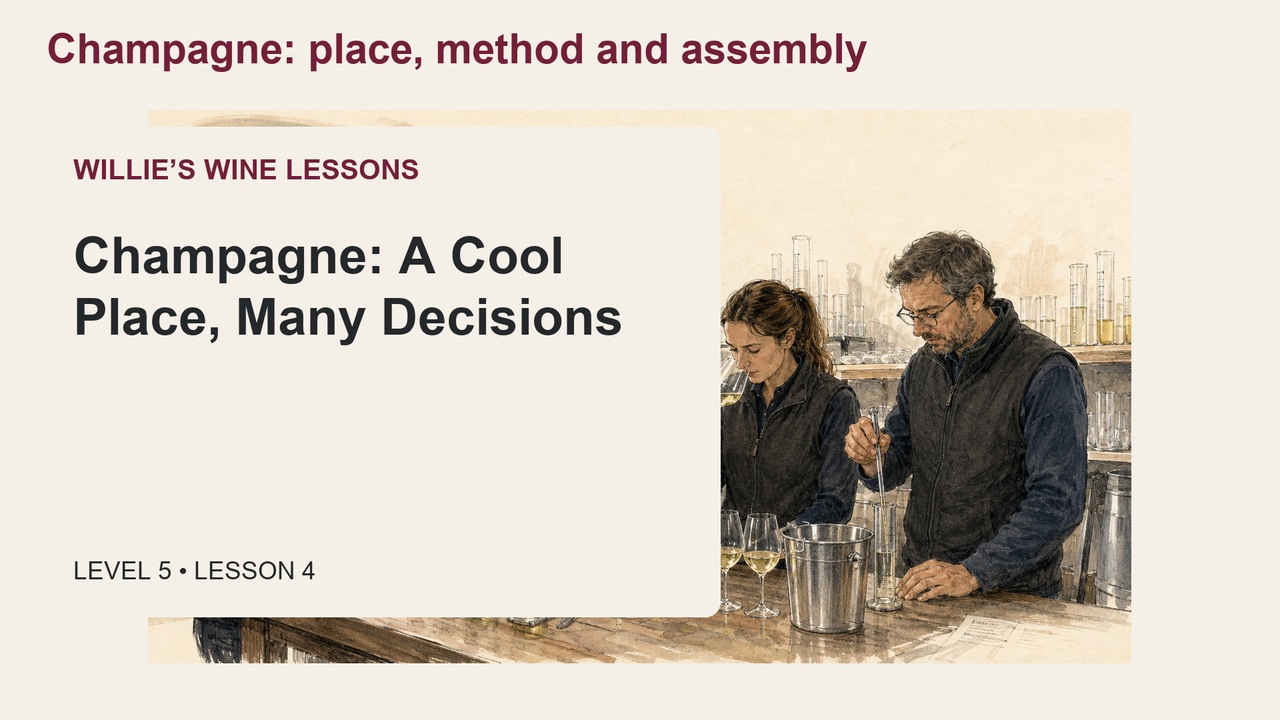
Champagne: A Cool Place, Many Decisions
How does a cool place assemble different sparkling styles?
Level 5 · Lesson 5
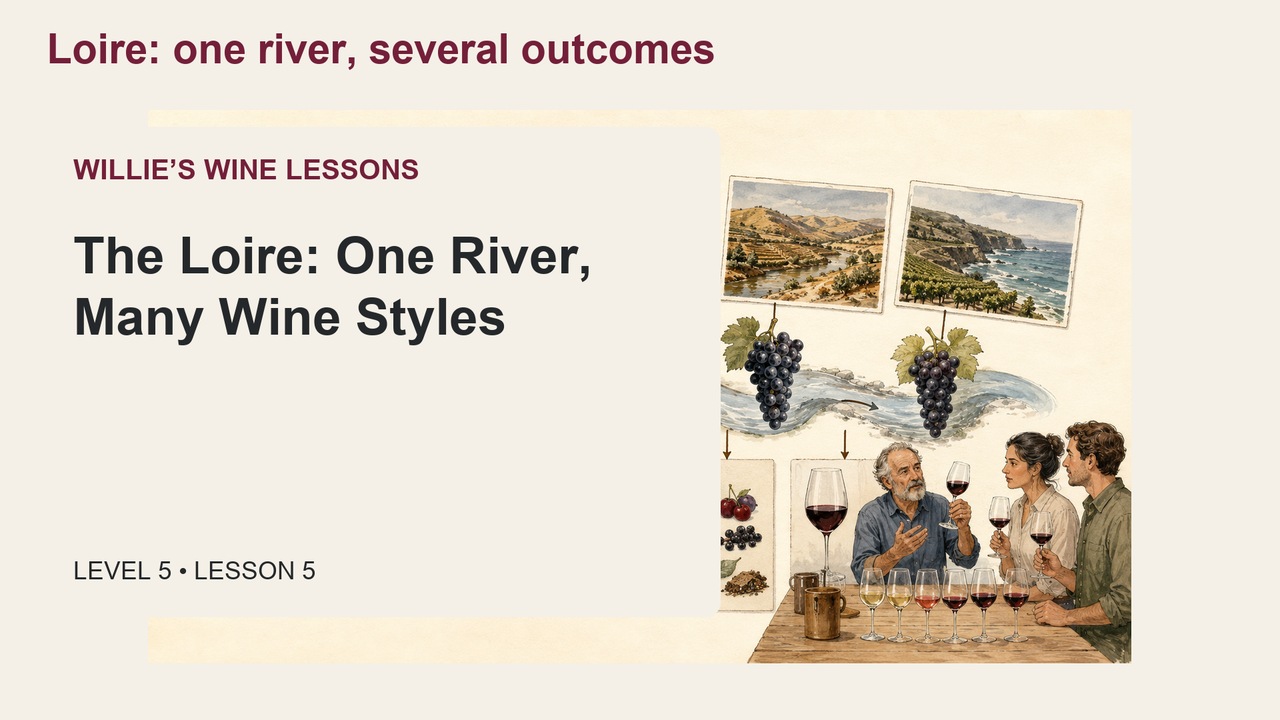
The Loire: One River, Many Wine Styles
What does a place name leave undecided?
Level 5 · Lesson 6
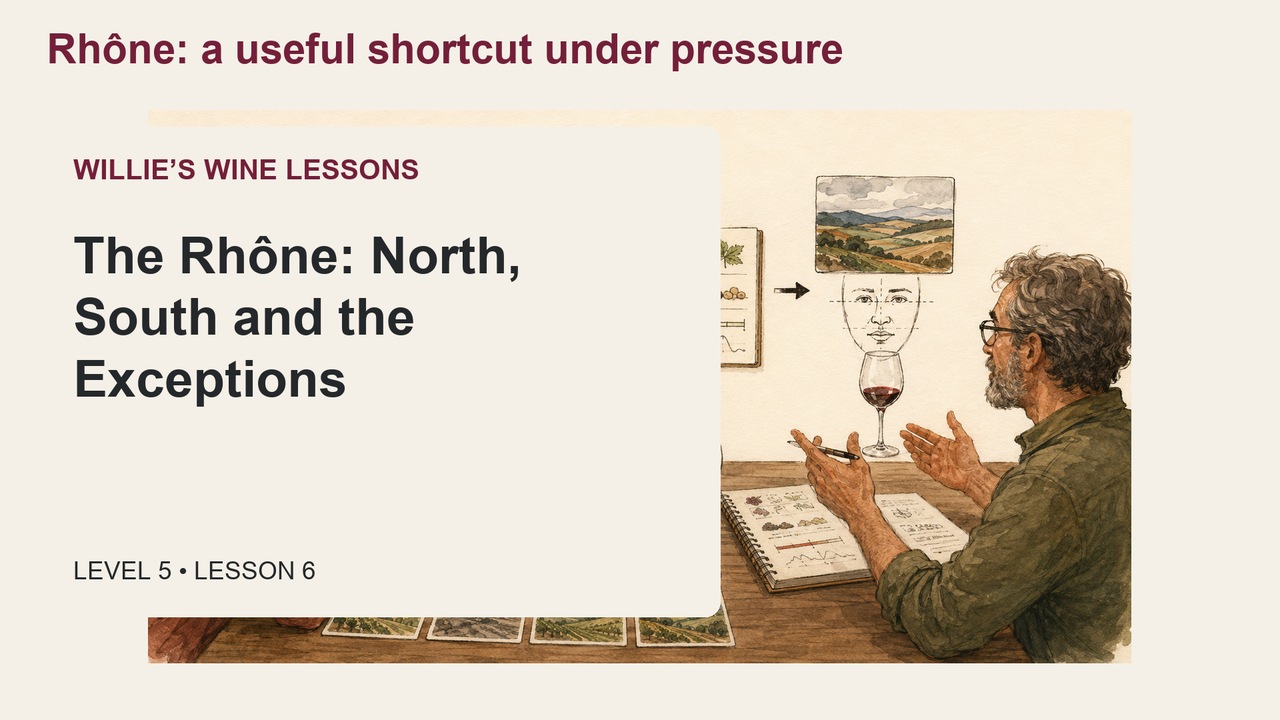
The Rhône: North, South and the Exceptions
When does north versus south help—and what should follow it?
Level 5 · Lesson 7
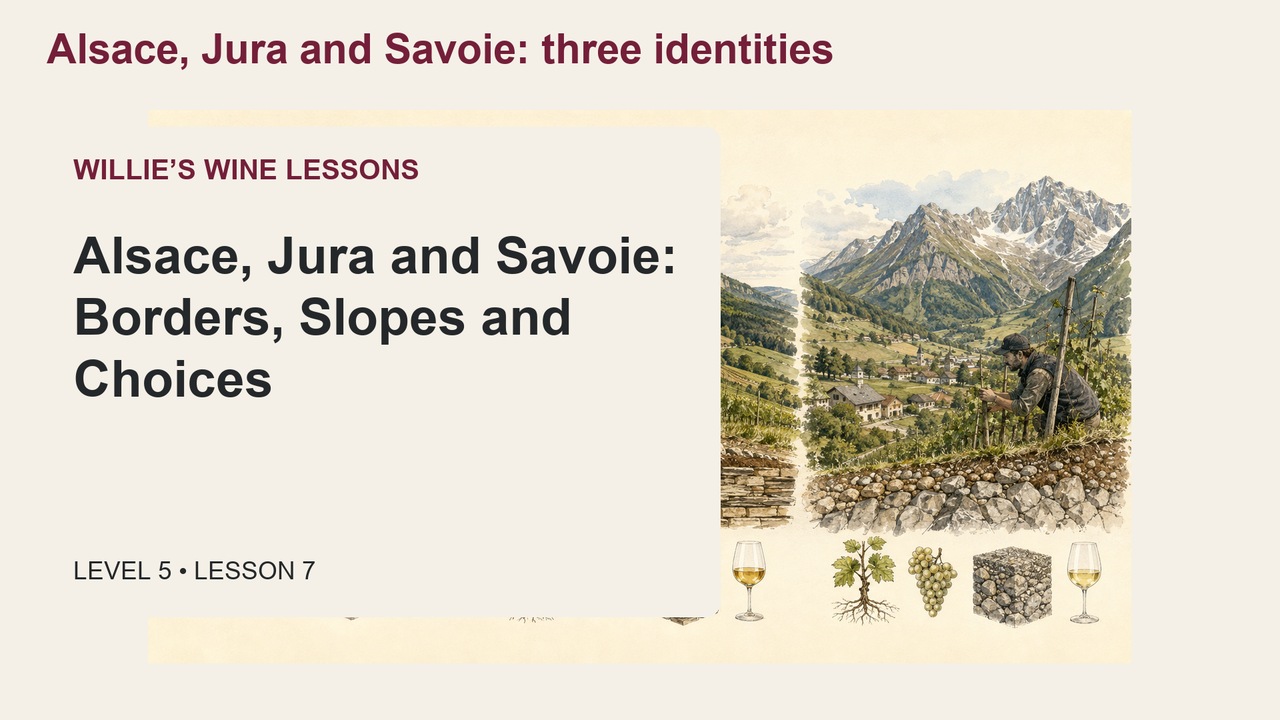
Alsace, Jura and Savoie: Borders, Slopes and Choices
What do mountains explain—and what do they leave out?
Level 5 · Lesson 8
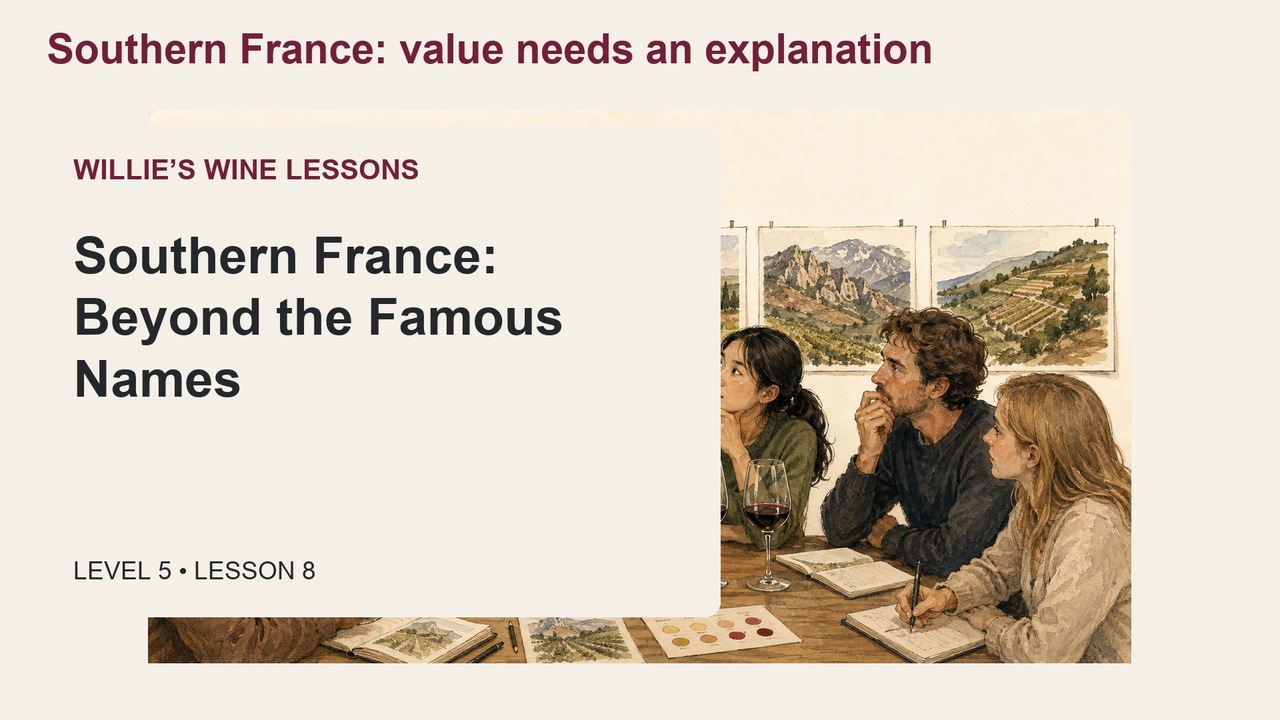
Southern France: Beyond the Famous Names
Where does value come from—and how do we explain it?
Test out of the level
Already know this material? Answer 24 questions covering all eight lessons. Pass with 20 correct to earn the level badge and certificate.
Test out of the levelOptional science companions
Science behind sparkling wine
Follow dissolved gas and pressure, bubble formation and foam, then aroma and sensation. Three illustrated companions to Champagne; no tasting or wine purchase required.
Watch the Level 5 Nerd Mode playlist ↗
Nerd Mode
The Invisible Gas in Sparkling Wine
A sealed bottle can look completely calm and still contain the gas that will make thousands of bubbles. Where is it hiding? Welcome to Willie’s Wine Lessons. We will follow carbon dioxide from fermentation to the glass, beginning with molecules rather than mystique.
Nerd Mode
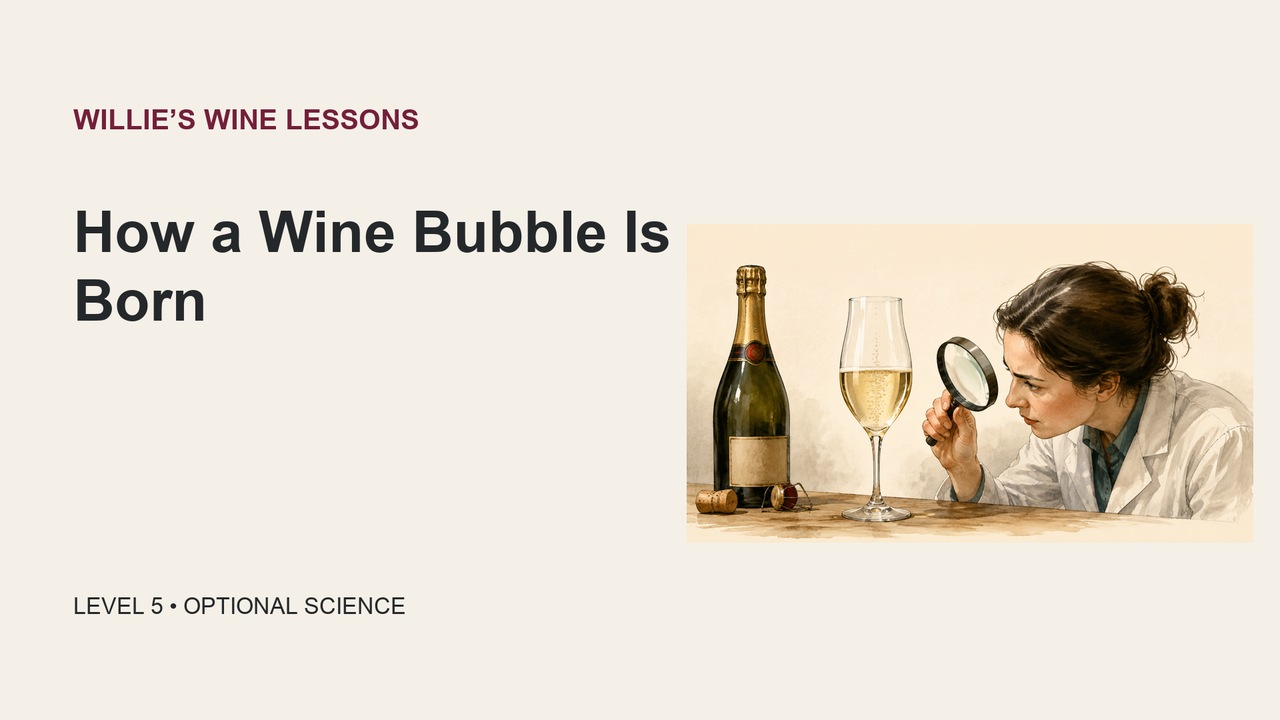
How a Wine Bubble Is Born
Watch a stream of bubbles rising from one point in a glass. Why there? Welcome to Willie’s Wine Lessons. We will follow a bubble from its starting pocket through growth, ascent and foam.
Nerd Mode
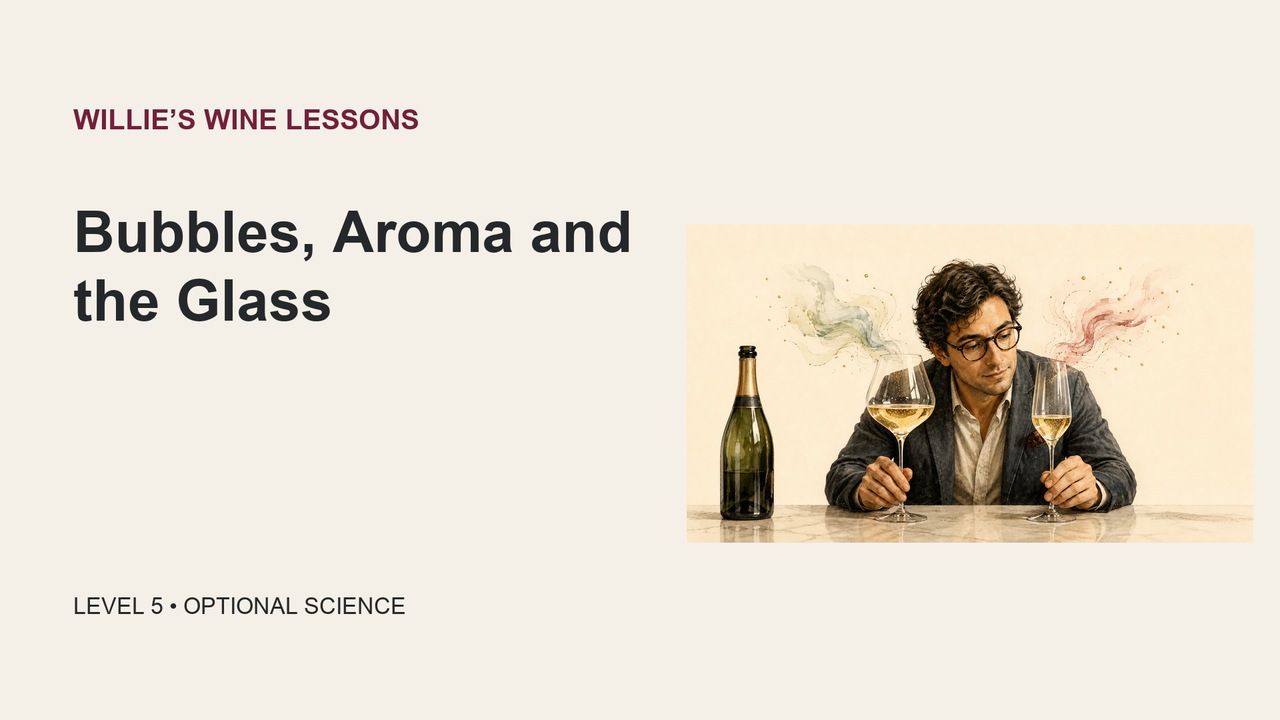
Bubbles, Aroma and the Glass
Two glasses can make the same wine look and smell different. Does that prove one is universally better? Welcome to Willie’s Wine Lessons. We will connect surface bubbles with aroma, distinguish fizz from flavor, and build a fair glassware comparison.
Level 6 · Available
Italy, Spain, Greece and Portugal
Three lessons in Italy, three in Spain, and dedicated journeys through Greece and Portugal. Start with the map, meet each grape, then connect the bottle to its place and producer decisions. Eight lessons include background chapters, optional open-label comparisons, exact document references and quizzes.
Watch the complete Level 6 playlist ↗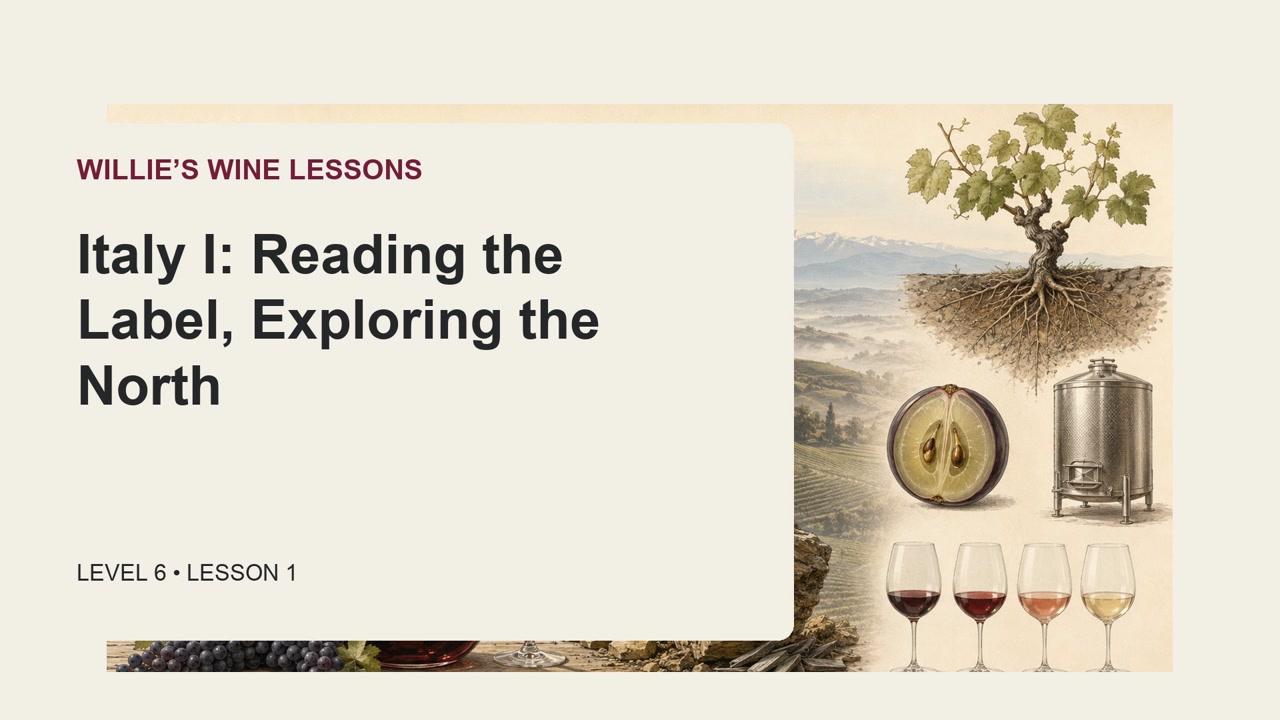
Level 6 · Lesson 1
Italy I: Reading the Label, Exploring the North
How do labels and production evidence explain northern Italy’s varied wines?
Level 6 · Lesson 2
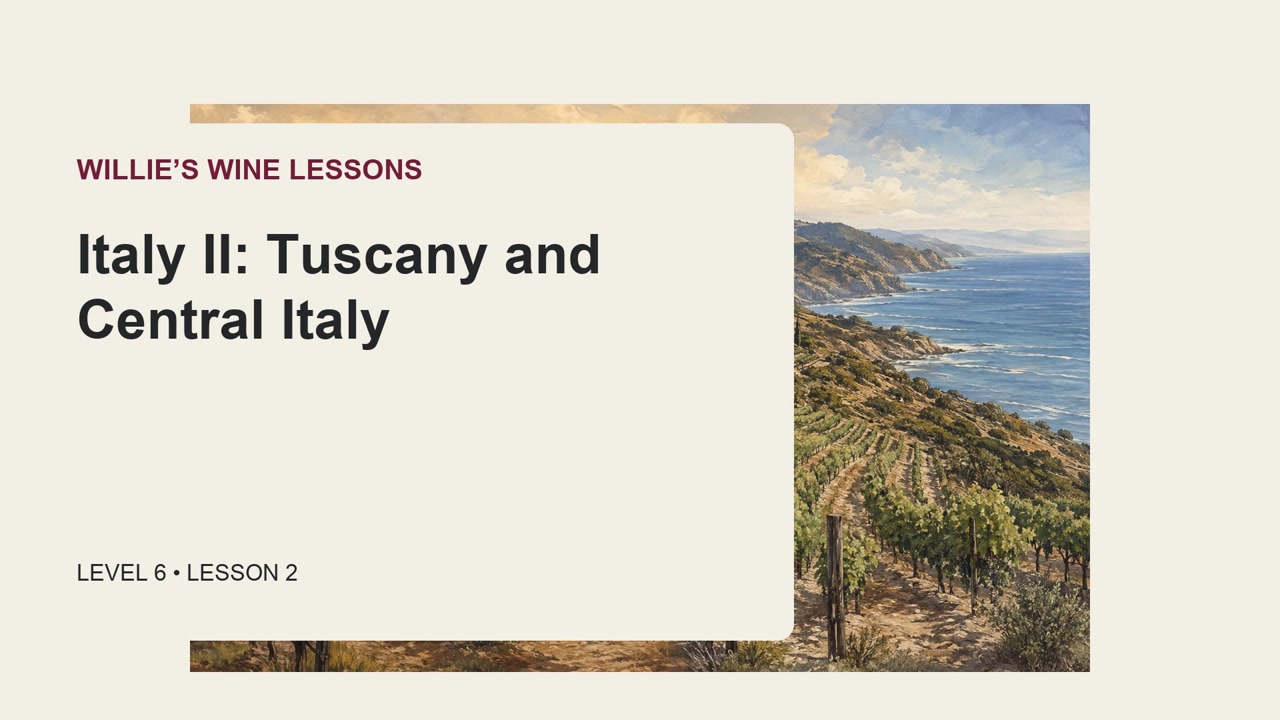
Italy II: Tuscany and Central Italy
When is the name a grape, a place, or a production claim?
Level 6 · Lesson 3
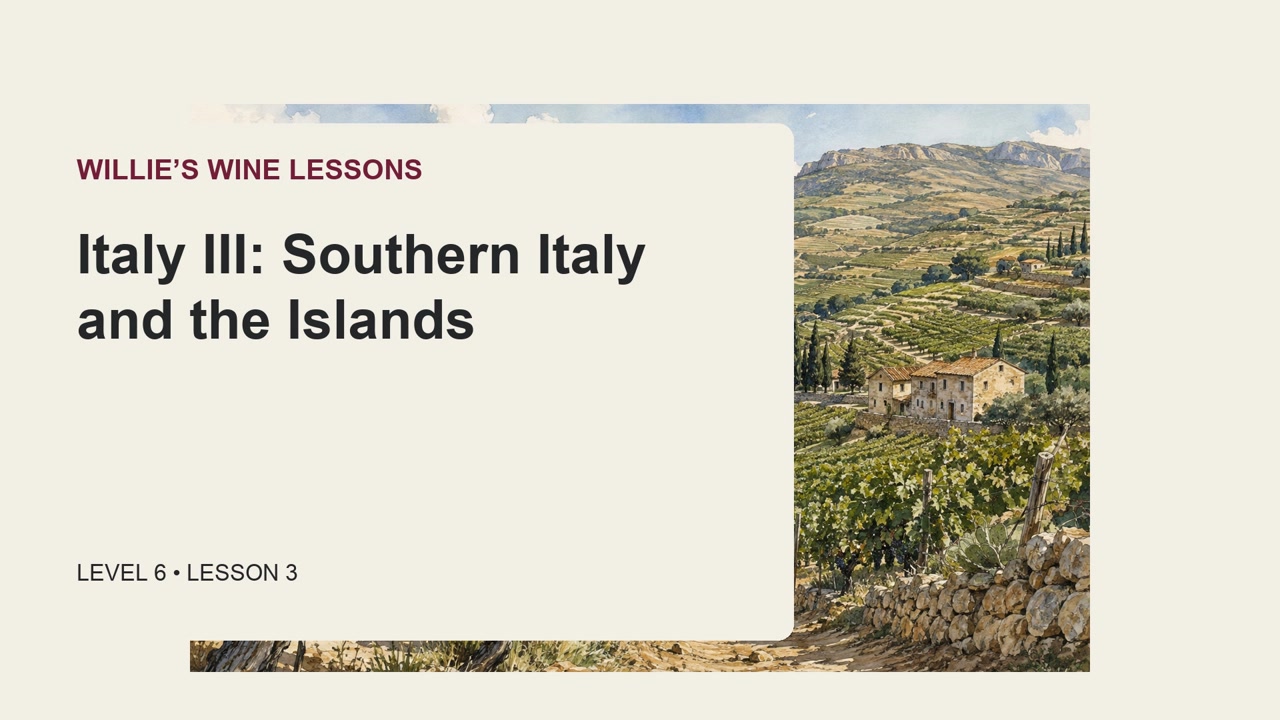
Italy III: Southern Italy and the Islands
How do elevation, water and local grapes complicate the word south?
Level 6 · Lesson 4
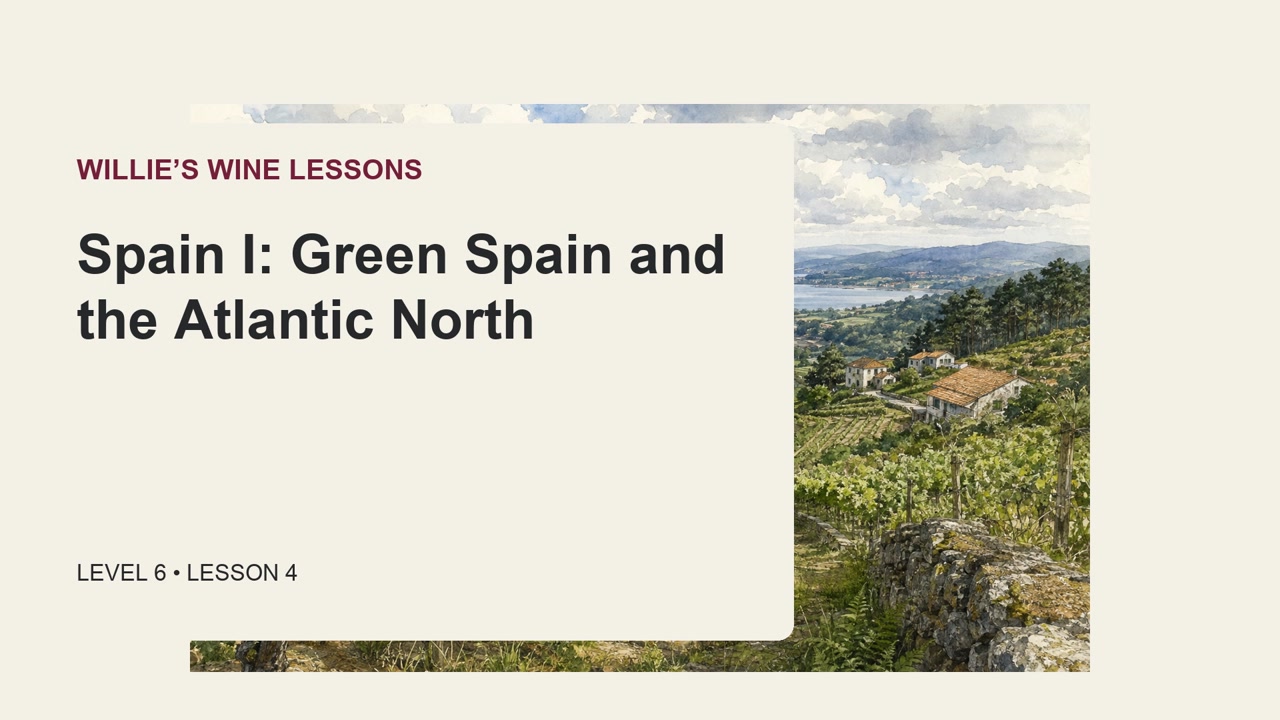
Spain I: Green Spain and the Atlantic North
How do ocean influence and inland terrain change the questions we ask?
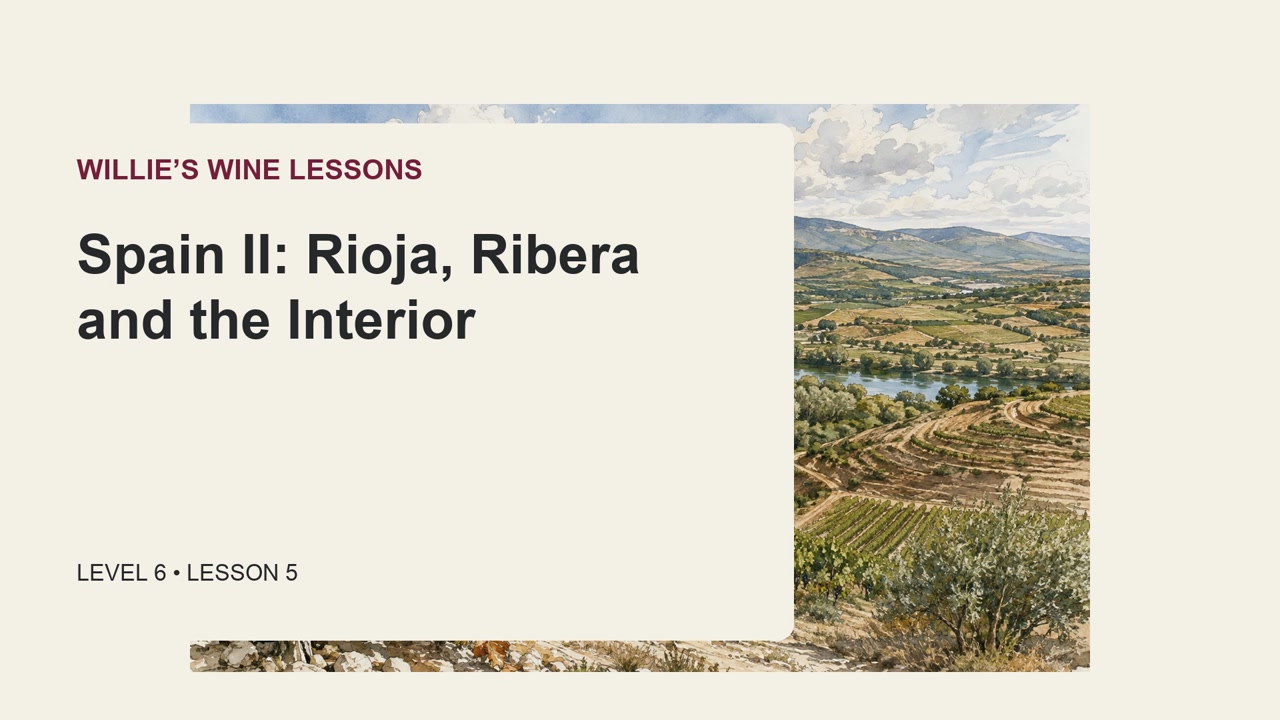
Level 6 · Lesson 5
Spain II: Rioja, Ribera and the Interior
What do geography and maturation terms tell us, and what do they leave open?
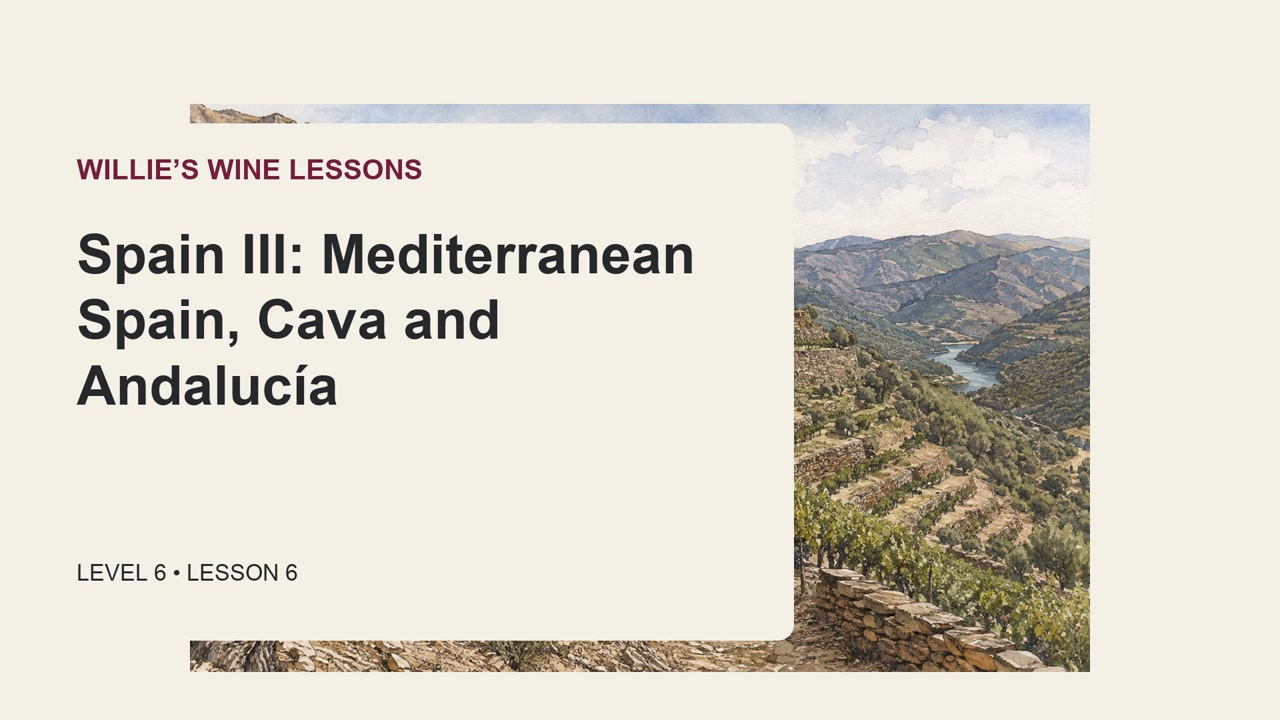
Level 6 · Lesson 6
Spain III: Mediterranean Spain, Cava and Andalucía
How do bubbles, yeast and oxygen change the route from place to glass?
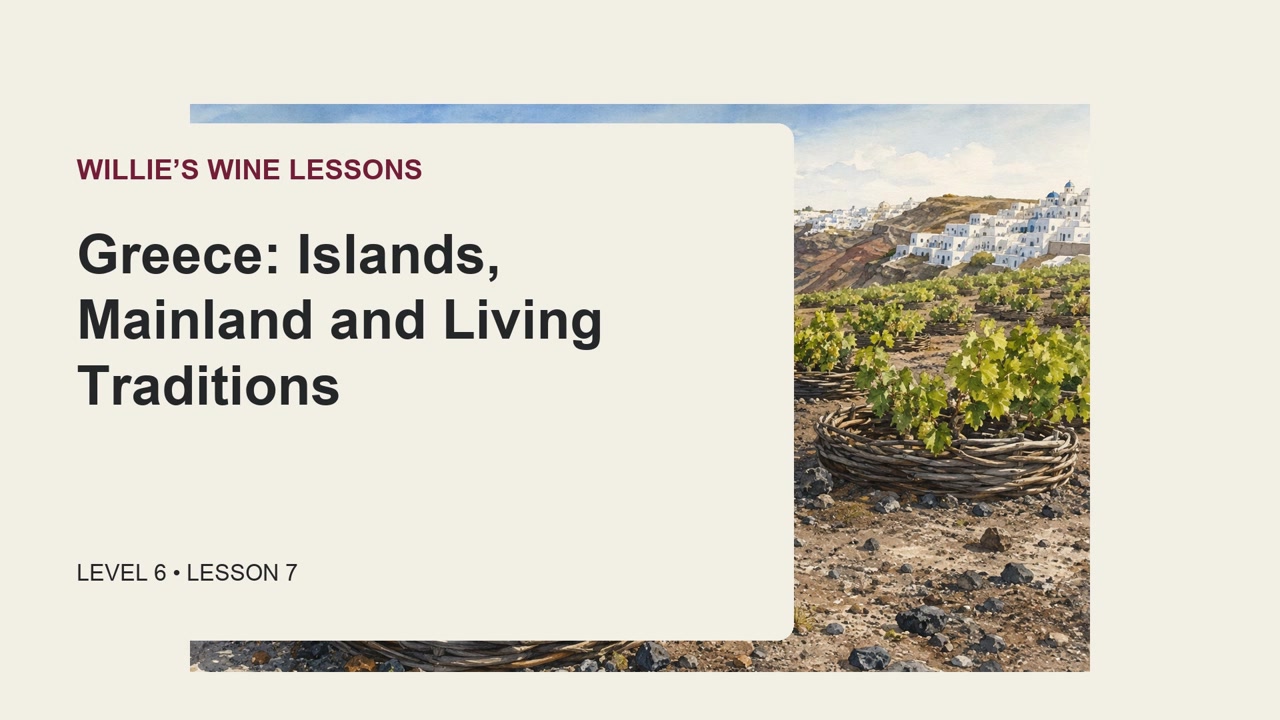
Level 6 · Lesson 7
Greece: Islands, Mainland and Living Traditions
How do local grapes and present choices keep a long wine tradition alive?
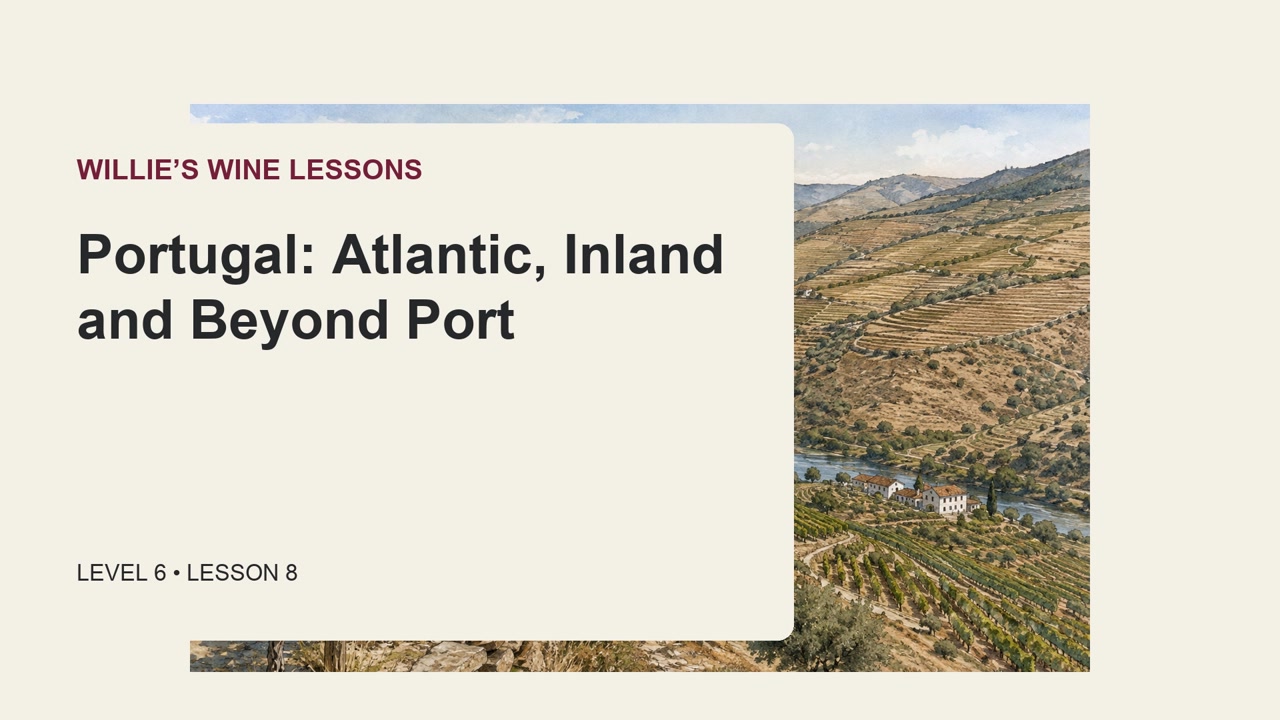
Level 6 · Lesson 8
Portugal: Atlantic, Inland and Beyond Port
How do Portugal’s still wines expand the picture beyond Port?
Test out of the level
Already know this material? Answer 24 questions covering all eight lessons. Pass with 20 correct to earn the level badge and certificate.
Test out of the levelLevel 7 · Available
The rest of Europe
Travel from Germany through Austria, Hungary and Switzerland, then Slovenia, Croatia, eastern Europe and the Caucasus. Spend time with the grapes, locate the places, and connect each reference wine to its producer evidence. Eight lessons include preparation, background reading and quizzes; wine is optional.
Watch the complete Level 7 playlist ↗
Level 7 · Lesson 1
Germany I: Reading Ripeness, Dryness and Origin
What can a German label actually establish about sweetness?
Level 7 · Lesson 2
Germany II: Rivers, Slopes and Regional Diversity
How does a map improve a German wine comparison?
Level 7 · Lesson 3
Austria: Origin, Grapes and Reinvention
How do grape, origin and producer choices explain an Austrian wine?
Level 7 · Lesson 4
Hungary: Tokaj and Beyond
Why can Hungary produce dry Furmint, sweet Tokaji and distinct red blends?
Level 7 · Lesson 5
Switzerland: Alpine Wine in Context
How do Swiss landscapes and cellar choices connect to distinct wines?
Level 7 · Lesson 6
Slovenia and Croatia: Borderlands and the Adriatic
How do neighbouring places and specific cellar choices produce different wines?
Level 7 · Lesson 7
The Balkans and Eastern Europe: Beyond the Familiar Map
How can we investigate unfamiliar regional wines without national stereotypes?
Level 7 · Lesson 8
Georgia and the Caucasus: Tradition, Technique and Evidence
What can tradition, vessel choice and archaeological evidence establish about a wine?
Test out of the level
Already know this material? Answer 24 questions covering all eight lessons. Pass with 20 correct to earn the level badge and certificate.
Test out of the level