
The Cabernet cartographer
Warren Winiarski
Before the reputation
How they found wine
Winiarski first pursued an academic life, studying political thought and spending time in Italy, where wine’s place at the table made a lasting impression. The eventual move to Napa with Barbara in 1964 meant beginning again as an apprentice, not arriving as a celebrated estate owner. At Souverain he learned from Lee Stewart before working in Robert Mondavi’s new winery.
His own Cabernet project grew from close attention to a particular landscape. A vineyard purchase in the Stags Leap area preceded the winery and the 1973 wine that later won the red-wine flight in Paris. The famous result was the consequence of years of preparation and a site decision, not his introduction to wine.
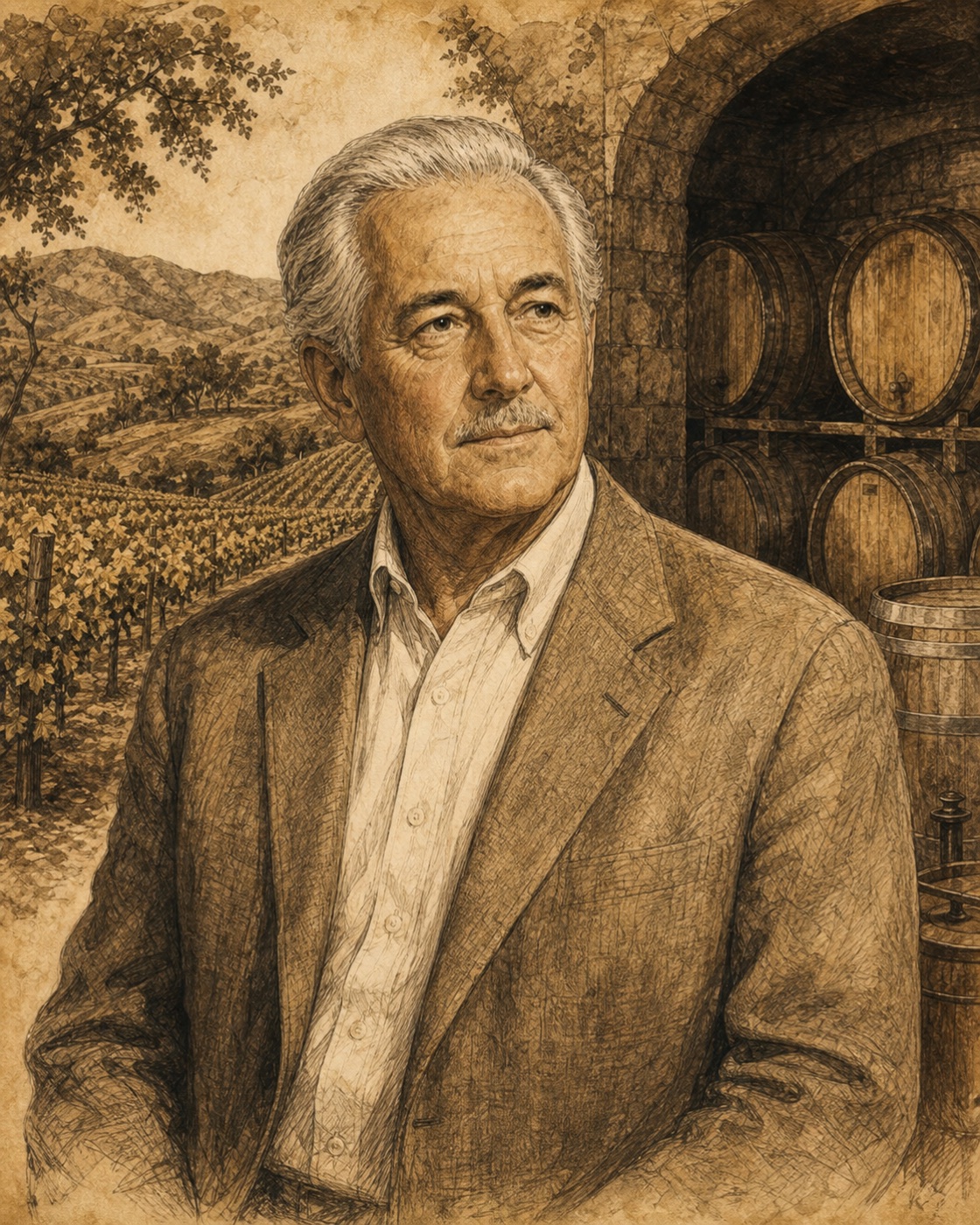
Warren Winiarski founded Stag’s Leap Wine Cellars in 1970 after apprenticeships with Lee Stewart and Robert Mondavi. His 1973 S.L.V. Cabernet placed first among reds at the 1976 Paris tasting, focusing world attention on Napa Valley.
Beyond the famous result, he helped articulate the Stags Leap District’s combination of aromatic lift, fine tannin, and ‘iron fist in a velvet glove’ structure. Vineyard definition, not one competition, is the durable lesson.
Beyond one bottle
Why the work mattered
The 1976 result helped international audiences take California Cabernet seriously. Winiarski’s more enduring lesson is that a region’s potential can become legible through a specific vineyard and careful choices. His academic beginning, apprenticeship and work outside Napa also complicate the usual story of a ready-made wine entrepreneur.
What they changed
S.L.V. as proof of place
A young vineyard showed that Napa Cabernet could stand in blind comparison with established Bordeaux.
District identity
Winiarski helped translate recurring sensory shape into an American viticultural area.
Cultural preservation
His later philanthropy supported wine history, land conservation, and archival work.
Follow the work
Wineries and working relationships
The chronology distinguishes the vineyard purchase from the winery opening. Stag’s Leap Wine Cellars is not the separate Stags’ Leap Winery.
Souverain Cellars
From 1964
Apprentice winemakerWorked with Lee Stewart after moving to Napa.
Robert Mondavi Winery
1966–1968
Early winemaking employeePart of the new winery’s formative team.
Ivancie Cellars, Colorado
From 1968; before his own estate
WinemakerAn often omitted stage using California grapes in a Colorado venture.
Stag’s Leap Wine Cellars
Vineyard acquired 1970; winery 1973
Founder and proprietorEstablished with Barbara and partners; the 1973 Cabernet won its Paris flight.
History reviewed . Roles and ownership may have changed.
Representative bottles
Where to meet the idea
- Stag’s Leap Wine Cellars S.L.V.
The vineyard-designated Cabernet behind the 1973 historical result.
- CASK 23
A selection from S.L.V. and FAY that explores blending two neighbouring vineyard personalities.
Study the signature
Turn the biography into a tasting.
Begin with Stag’s Leap Wine Cellars S.L.V., then place it beside CASK 23 when the opportunity allows. The point is not to crown a winner; it is to notice which choices remain legible across price, age, vineyard, and vintage.
Follow three linked ideas as you taste: s.l.v. as proof of place, district identity, cultural preservation. Write down the evidence you can actually perceive, then return to the producer’s history and ask which part of the story the glass supports—and which part belongs to reputation.
The Judgment of Paris did not prove California ‘beat France’ forever. It was one tasting, with specific wines, tasters, serving conditions, and scoring.