
The village-and-vineyard restorer
Telmo Rodríguez
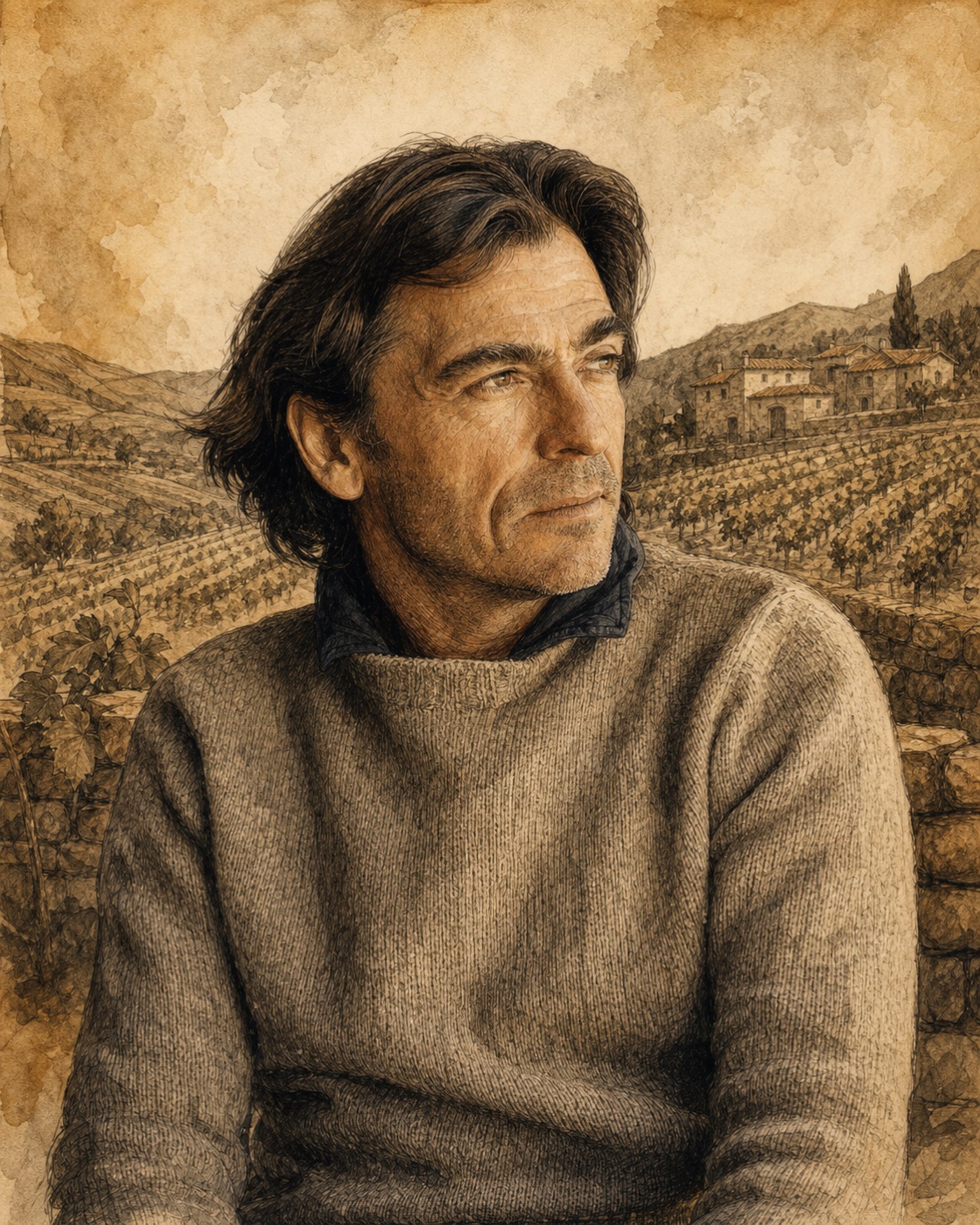
Before the reputation
How they found wine
Rodríguez came from the family behind Remelluri in Rioja, then looked beyond the inherited estate after training in Bordeaux. With Pablo Eguzkiza he began an independent project in 1994 around old Garnacha vines in Sada, Navarra. Choosing a local variety at a time when international grapes attracted attention was an early statement of direction.
Their travels became the method: find surviving vineyards, learn why older growers planted and trained them that way, and work out how to keep them productive. Some attempts were abandoned. Others, such as Lanzaga, Pegaso and the Bibei sites, took years to develop. The story is less a rapid tour of fashionable regions than repeated returns to difficult places.
After training in Bordeaux and work at his family’s Rioja estate, Telmo Rodríguez created a company with Pablo Eguzkiza in the 1990s to seek old vineyards across Spain. Their projects range from accessible regional wines to painstaking restorations of steep or abandoned historic sites.
The company now works with dozens of varieties and hundreds of parcels, emphasizing bush vines, local material, village identity, and landscapes that industrial viticulture left behind. Rodríguez helped move modern Spanish ambition away from new oak and broad regional branding toward the recovery of named places.
Beyond one bottle
Why the work mattered
Rodríguez and Eguzkiza helped make vineyard restoration a modern fine-wine ambition. Their work joins accessible regional bottles to painstaking site projects, giving a business reason to preserve old vines and local varieties. The contribution is shared with growers and communities; the landscapes they describe were made by earlier generations, not discovered without history.
What they changed
The itinerant grower model
One team worked across regions while treating local grapes and inherited vineyards as the starting point.
Forgotten vineyards restored
Terraces, bush vines, and historic sites returned to production as cultural as well as agricultural assets.
Village before luxury category
Place names and farming communities organize quality more meaningfully than polish alone.
Follow the work
Wineries and working relationships
The producer chronology supplies the project roster; it is not a legal ownership register. Early foreign training and every short-lived collaboration are not fully documented here.
Remelluri
Early career and later return
Family estate involvementDistinct from the independent company formed with Eguzkiza.
Compañía de Vinos Telmo Rodríguez
1994
Co-founder with Pablo EguzkizaUmbrella for the following regional projects, not a separate employer for each bottle.
Sada / Alma · Arribes del Duero · Aragón / Somontano
1994–1997 starts
Early regional collaborationsEarly work including Garnacha and Juan García; some projects were later abandoned.
Rueda — Basa · Málaga — Molino Real / Old Mountain
From 1996
Regional projectsWhite-wine projects with different varieties and conditions.
Bodega Lanzaga / Rioja · Toro · Ribera del Duero / Matallana
From 1998
Regional wine and vineyard projectsLanzaga’s winery followed in 2007; the projects developed over multiple harvests.
Pegaso / Cebreros · Valdeorras / Bibei
Cebreros from 1999; Bibei return 2002
Vineyard restoration and wine projectsRestored vineyards and older cellar buildings; site names are not all separate companies.
History reviewed . Roles and ownership may have changed.
Representative bottles
Where to meet the idea
- Las Beatas
A restored Rioja vineyard and the most concentrated statement of the company’s historical-site project.
- Matallana
An old-vine Ribera del Duero wine that reframes the region around a particular landscape.
- Gaba do Xil Mencía
An accessible Valdeorras red connecting the larger mission to everyday drinking.
Study the signature
Turn the biography into a tasting.
Begin with Las Beatas, then place it beside Matallana when the opportunity allows. The point is not to crown a winner; it is to notice which choices remain legible across price, age, vineyard, and vintage.
Follow three linked ideas as you taste: the itinerant grower model, forgotten vineyards restored, village before luxury category. Write down the evidence you can actually perceive, then return to the producer’s history and ask which part of the story the glass supports—and which part belongs to reputation.
Restoration language can romanticize hard rural labour. Vineyard recovery depends on workers, communities, land access, and viable economics, not vision alone.