
The Japanese Pinot seeker
Takahiko Soga
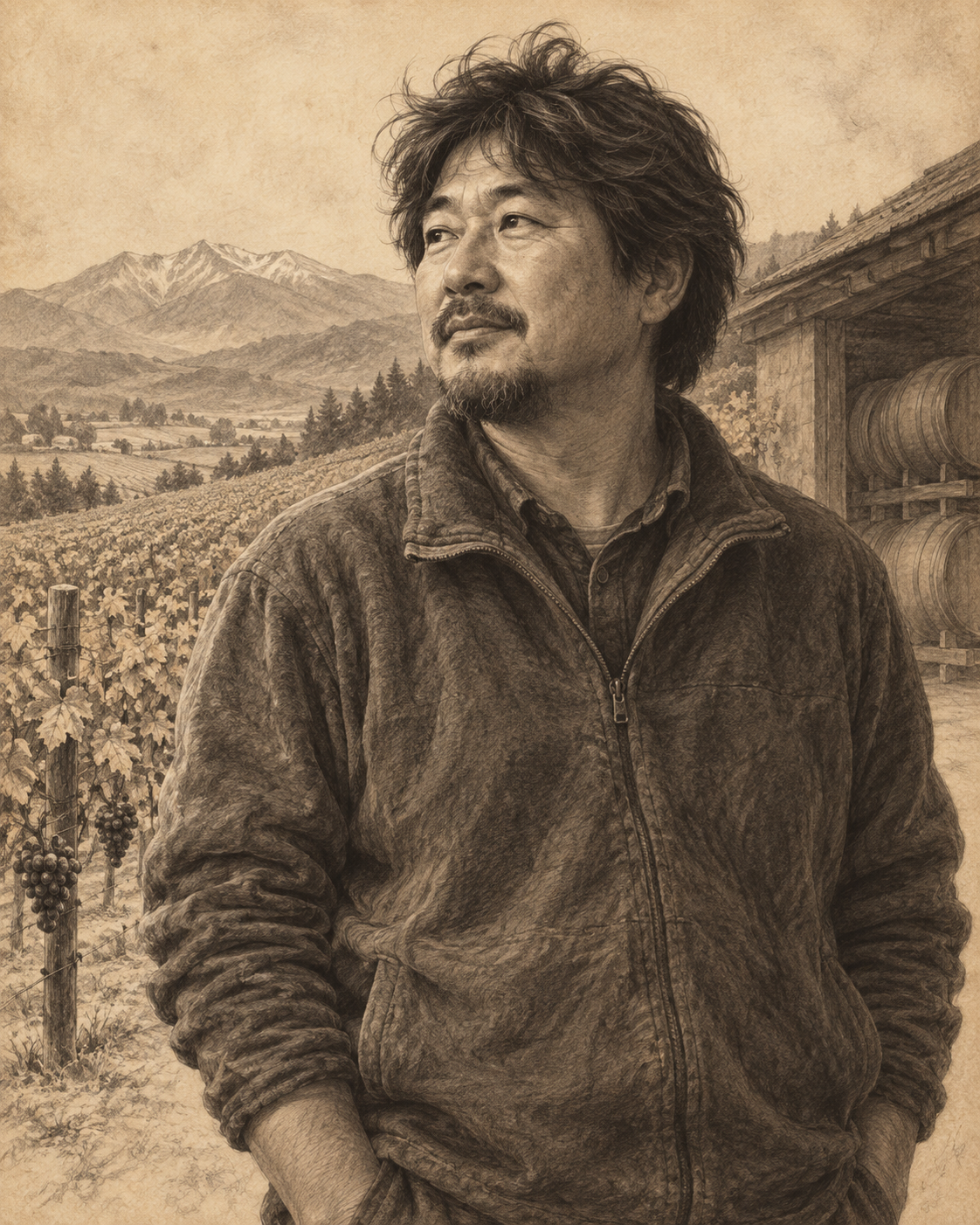
Before the reputation
How they found wine
Soga grew up in the family behind Obuse Winery in Nagano, then studied microbiology. A roughly decade-long period at Coco Farm gave him practical experience and opportunities to taste and travel. That combination of scientific training and exposure to other producers preceded his own vineyard.
He chose Yoichi in northern Japan as the place to pursue Pinot Noir with savoury complexity and an affinity for Japanese food. The decision narrowed his focus rather than expanding into a large range of international varieties. His own estate vineyard and fruit bought from neighbouring growers remain distinct categories on the labels.
Takahiko Soga established Domaine Takahiko in Yoichi in 2010, placing Pinot Noir and a Japanese sense of food and flavour at the centre of a very small estate.
His importance is an expanding idea of where serious Japanese wine can come from. The wines invite attention to Hokkaido’s conditions rather than a search for the closest imitation of Burgundy.
Beyond one bottle
Why the work mattered
Soga has helped draw international attention to a small Hokkaido wine landscape and to a food-centred ambition for Japanese Pinot Noir. His example also makes the grower relationship visible: estate fruit and purchased fruit are named differently. Influence here means opening a credible path and a conversation, not proving that one producer transformed the whole Japanese industry.
What they changed
A northern Japanese focus
Yoichi supplies a specific growing environment for the Pinot Noir project.
Food as a starting point
Savoury character and how a wine works at the table matter alongside fruit intensity.
Labels that distinguish fruit sources
Domaine Takahiko and Takahiko Soga identify different relationships to the vineyard.
Follow the work
Wineries and working relationships
The documented professional sequence is Coco Farm followed by his own business. Coco Toaru is a separate Coco Farm–10R collaboration and is not listed as Soga’s estate.
Obuse Winery
Before independent career
Family upbringingHis family background is documented; it is not being turned into an unsupported formal job title.
Coco Farm & Winery
Approximately a decade before 2010
Winemaking workAn important professional and tasting education before founding his own domaine.
Domaine Takahiko / Takahiko Soga
From 2010
Founder, grower and winemakerEstate Nana-Tsu-Mori wines and purchased-fruit Yoichi-Nobori bottlings have deliberately different label identities.
History reviewed . Roles and ownership may have changed.
Representative bottles
Where to meet the idea
- Domaine Takahiko Nana-Tsu-Mori Pinot Noir
The estate-vineyard reference; study texture and savoury notes without assuming every bottle must show them.
- Takahiko Soga Yoichi-Nobori
A purchased-fruit range, not a single fixed blend. Check the cuvée and vintage before choosing a comparison.
Study the signature
Turn the biography into a tasting.
Begin with Domaine Takahiko Nana-Tsu-Mori Pinot Noir, then place it beside Takahiko Soga Yoichi-Nobori when the opportunity allows. The point is not to crown a winner; it is to notice which choices remain legible across price, age, vineyard, and vintage.
Follow three linked ideas as you taste: a northern japanese focus, food as a starting point, labels that distinguish fruit sources. Write down the evidence you can actually perceive, then return to the producer’s history and ask which part of the story the glass supports—and which part belongs to reputation.
Availability is very limited. Yoichi-Nobori is a range and its labels matter; do not substitute a different producer’s Hokkaido wine and call it Soga’s work.