
The returning Ningxia pioneer
Emma Gao
Before the reputation
How they found wine
Gao’s father saw potential in Ningxia and encouraged her to study winemaking in France. Bordeaux offered formal education, cellar placements and a way to build expertise that the family could eventually use at home. She also met Courtade through that French wine world.
Returning did not immediately mean stepping into a finished prestigious estate. Her path included work in China and wine sales before the family’s small Silver Heights venture began producing wine in 2007. The origin story is therefore a combination of a parent’s ambition, professional training and the practical work of building a market for a new producer.
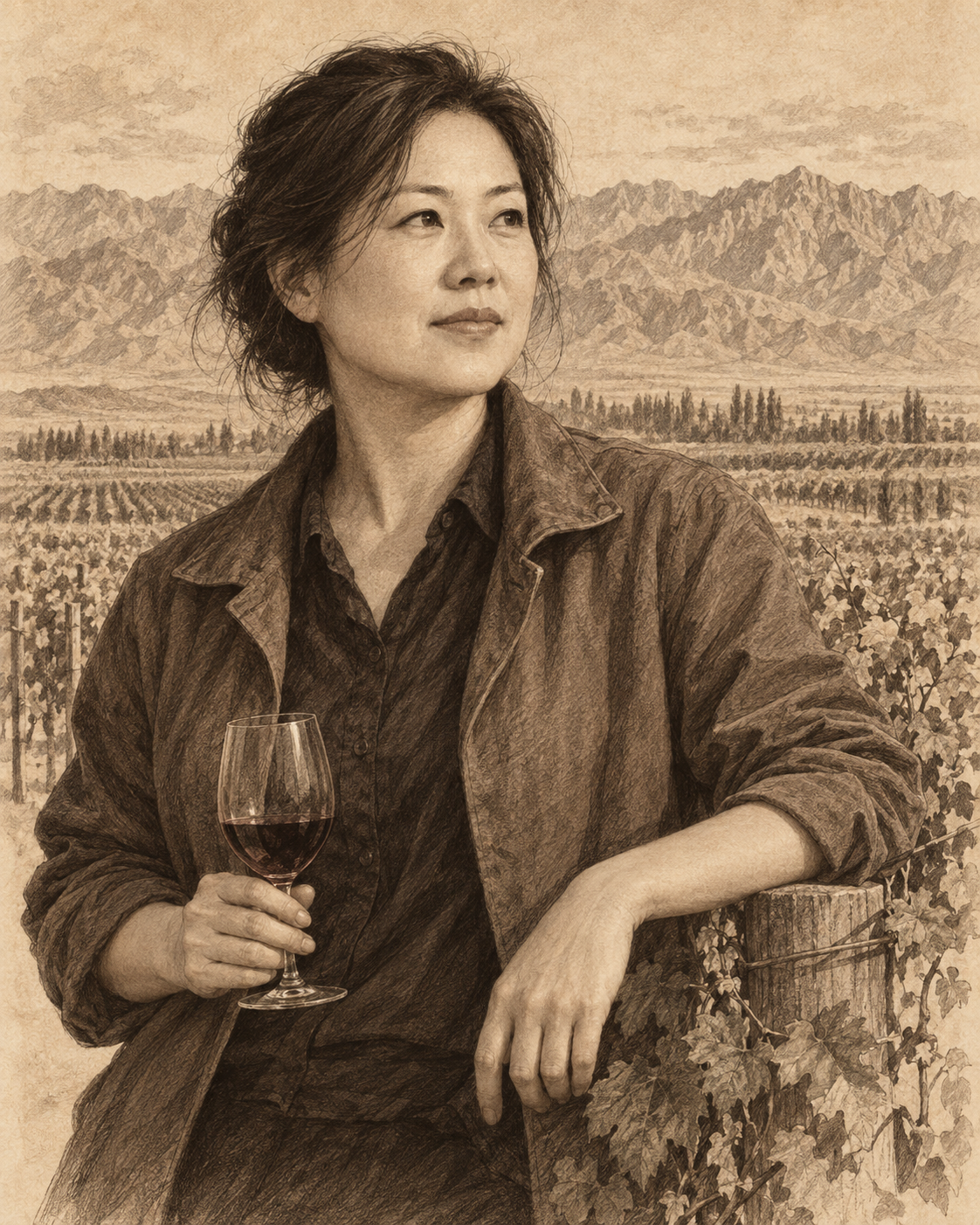
Emma Gao, also known as Gao Yuan, helped establish Silver Heights as an internationally noticed family producer in Ningxia. French training became a starting point for work in northwestern China, rather than the final destination of her career.
The estate’s story includes her father Gao Lin and husband Thierry Courtade as well as Emma’s winemaking. Small family production offered a different picture of Chinese wine from the assumption that only large industrial enterprises mattered.
Beyond one bottle
Why the work mattered
Gao helped make a small Chinese family winery legible to international fine-wine audiences. That broadened expectations about Ningxia’s capacity for individual, carefully made wines. The change depended on local farming and adaptation as well as Bordeaux experience: importing knowledge can be useful without making a Chinese vineyard a copy of a French appellation.
What they changed
A family-scale Chinese producer
Silver Heights offered a visible alternative to assuming Chinese wine meant only large-volume brands.
Training brought home
French cellar education was applied within a different landscape and growing season.
A new regional reference
The estate helped give international drinkers a concrete Ningxia name to investigate.
Follow the work
Wineries and working relationships
The history distinguishes documented French placements from the family estate and records an unnamed Chinese employer honestly. It does not claim a complete employment archive.
Château Gerbaud · Calon Ségur · Château Gloria
Early professional career
Bordeaux training and cellar placementsBiographical accounts identify these French placements; they were not estates she owned.
Lamarque laboratory · Domaine d’Eyssac
French training years
Laboratory and winery workReported early experience, with a less complete public chronology than the Silver Heights career.
Xinjiang winery · Shanghai wine sales
Before Silver Heights
Wine-industry work after returning to ChinaThe public accounts do not consistently name the Xinjiang employer, so no winery name is invented.
Silver Heights
First wines in 2007
Co-founder and winemaker with family partnersBuilt the Ningxia project with her father and husband; later generations are part of the producer’s own account.
History reviewed . Roles and ownership may have changed.
Representative bottles
Where to meet the idea
- Silver Heights The Summit
A flagship red blend through which to study the estate’s early international reputation.
- Silver Heights Emma’s Reserve
A more selective red bottling; compare structure and maturation rather than treating the name as a score.
Study the signature
Turn the biography into a tasting.
Begin with Silver Heights The Summit, then place it beside Silver Heights Emma’s Reserve when the opportunity allows. The point is not to crown a winner; it is to notice which choices remain legible across price, age, vineyard, and vintage.
Follow three linked ideas as you taste: a family-scale chinese producer, training brought home, a new regional reference. Write down the evidence you can actually perceive, then return to the producer’s history and ask which part of the story the glass supports—and which part belongs to reputation.
One estate cannot represent all Chinese wine. Exact blends and farming claims must be checked for the vintage rather than inferred from a regional reputation.