
The qvevri technician
Gogi Dakishvili
Before the reputation
How they found wine
Dakishvili remembers joining harvest celebrations and his grandfather’s wine pressing as a small child. His father was also a winemaker. Wine therefore began as family participation before he pursued professional training in Odessa and later additional study in California.
The transition from family practice to responsibility for larger cellars exposed him to different scales and techniques. His career moved through Teliani and Teliani Valley, other Georgian wineries and the Vinoterra/Schuchmann operation. Family production remained important alongside that employed and consulting work, rather than appearing only after he left the commercial industry.
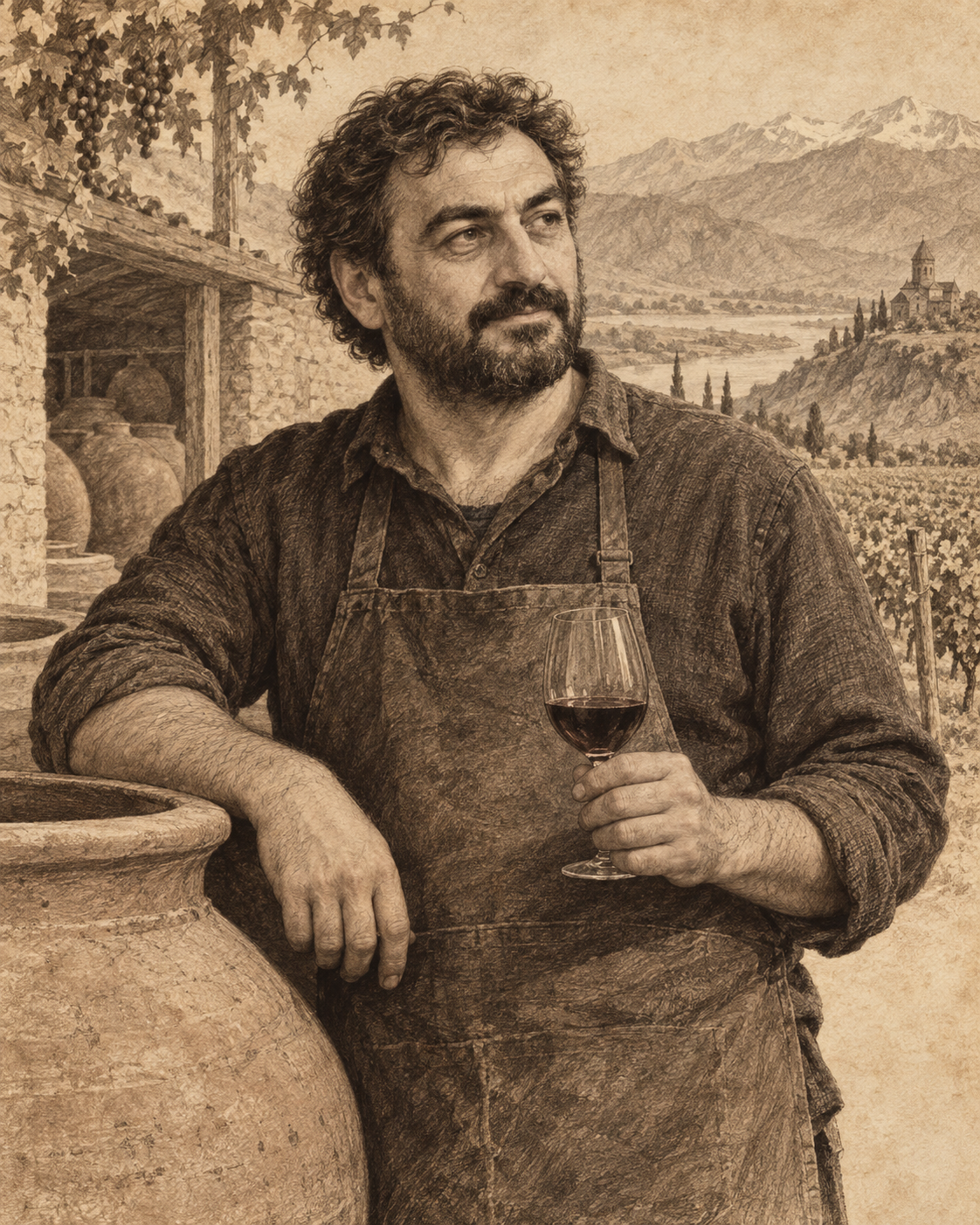
Giorgi, usually called Gogi, Dakishvili connects formal oenology with Georgia’s qvevri tradition. His career spans larger commercial wineries and small family projects, making the usual split between technical and traditional winemaking particularly unhelpful.
Orgo and Dakishvili Family wines offer both red and amber-wine examples. His work is part of a living Georgian tradition with many practitioners, not the invention of an ancient vessel.
Beyond one bottle
Why the work mattered
Dakishvili helped connect qvevri wine with exacting contemporary cellar practice and export audiences. His range makes a useful distinction visible: vessel, skin contact, grape and fermentation management are separate choices. White grapes can produce fresh pale wine or tannic amber wine; a buried clay vessel does not require every Georgian wine to share one colour or flavour.
What they changed
Continuity with technical attention
Traditional vessels still require careful fruit handling, fermentation monitoring and cleaning.
Several styles from local grapes
Kisi, Rkatsiteli and Saperavi show why Georgian wine cannot be reduced to an orange-wine category.
Family and commercial knowledge
Work across scales lets practical experience circulate between larger estates and small projects.
Follow the work
Wineries and working relationships
The record combines Dakishvili’s own retrospective with producer and importer accounts. Overlapping dates reflect simultaneous work; the California training is education, not a claimed winery job.
Teliani state winery · Teliani Valley
Mid-1990s–2009 across the two operations
Winery employee, then winemaking leadershipHis interview distinguishes the state factory from the later company.
Tsinandali · Mildiani
Earlier career; full dates not supplied
Winemaking appointmentsBoth are named in his interview’s career history.
Vinoterra / Schuchmann
Work overlapping later Teliani years; from the 2000s
Winemaker and consultantA commercial setting for both European-style and qvevri wines.
Orgo / Teleda
Later independent career
Family winemaking projectPublic producer accounts describe collaboration with his son Temur.
Dakishvili Family · Vita Vinea
Later family work
Family collaboratorTemur’s Vita Vinea operation is distinct; family assistance is not evidence that Gogi alone owns or runs it.
History reviewed . Roles and ownership may have changed.
Representative bottles
Where to meet the idea
- Orgo Saperavi
A red-grape example that keeps qvevri discussion from becoming exclusively about amber wine.
- Dakishvili Family Kisi Amber
A white grape with skin-contact texture; compare with a pale Kisi or Rkatsiteli.
- Dakishvili Family Rkatsiteli
Check the specific bottling’s method: the family has made both modern-style and qvevri wines.
Study the signature
Turn the biography into a tasting.
Begin with Orgo Saperavi, then place it beside Dakishvili Family Kisi Amber when the opportunity allows. The point is not to crown a winner; it is to notice which choices remain legible across price, age, vineyard, and vintage.
Follow three linked ideas as you taste: continuity with technical attention, several styles from local grapes, family and commercial knowledge. Write down the evidence you can actually perceive, then return to the producer’s history and ask which part of the story the glass supports—and which part belongs to reputation.
Qvevri is a vessel, not a guarantee of zero additions, organic farming or microbiological stability. Check the particular producer and vintage.