
The vintage listener
Serge Hochar
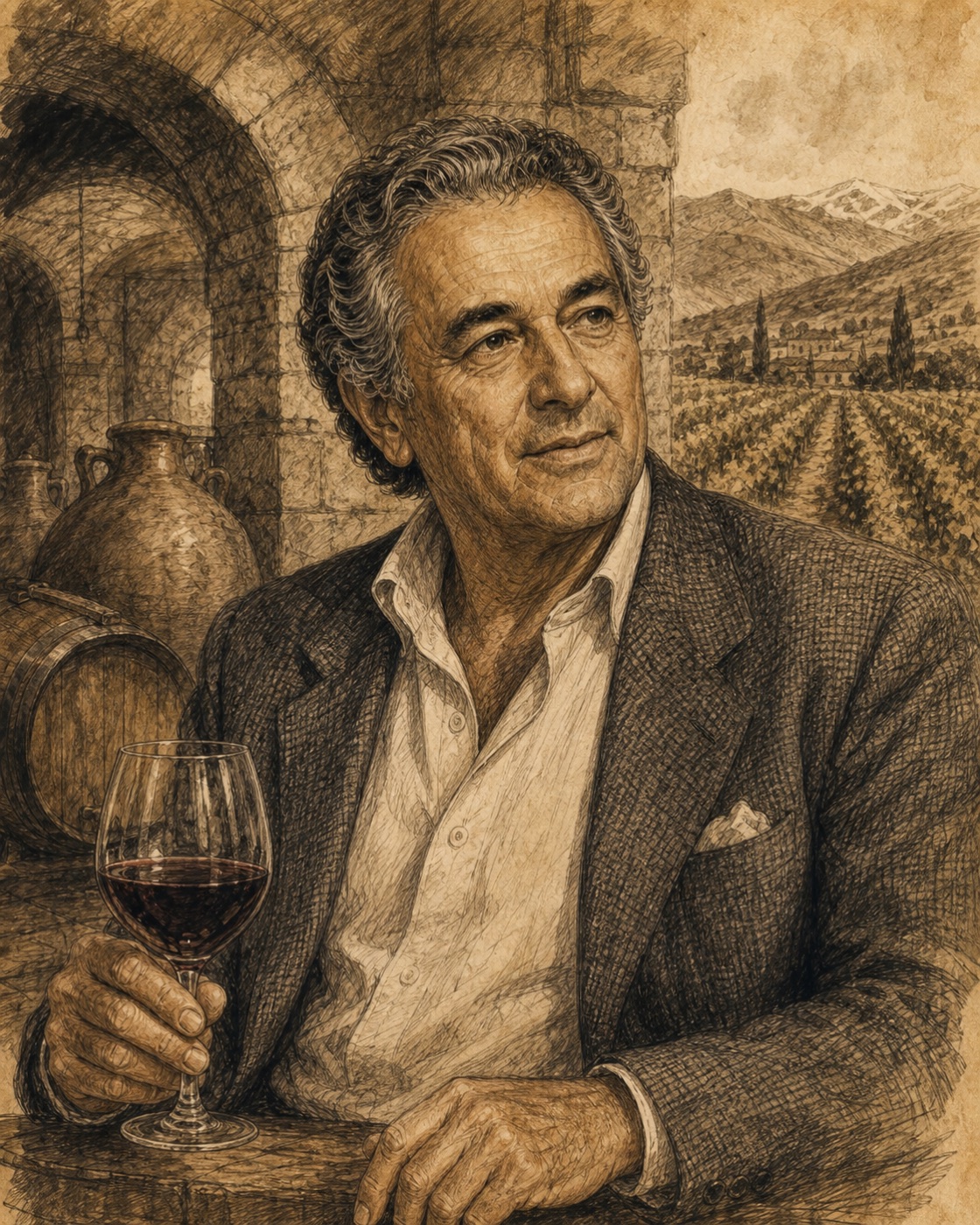
Before the reputation
How they found wine
Serge Hochar grew up with a winery already in the family: his father Gaston had founded Château Musar in 1930. He studied engineering before studying wine in Bordeaux, bringing formal training into a business whose vineyards and cultural setting were Lebanese. Taking responsibility for the wines in 1959 was the decisive move from family inheritance to his own life’s work.
Civil war later made a harvest depend on roads, timing and people’s safety as much as ripeness. His reputation grew from continuing the work through those conditions and from explaining wines that did not behave like standardized products. That is a stronger story than treating volatility or an unusual bottle as automatic proof of genius.
Serge Hochar became Château Musar’s winemaker in 1959 after studying oenology in Bordeaux. He developed a deliberately patient, low-intervention style from high-altitude Bekaa Valley vineyards, allowing vintage variation, ambient fermentation, long maturation, and bottle age to remain visible.
Musar kept harvesting through most of Lebanon’s civil war, missing only 1976. Hochar’s persistence—and his refusal to make the wines taste identical—helped give Lebanese wine a global reference point without pretending that history or place was tidy.
Beyond one bottle
Why the work mattered
Hochar gave Lebanese wine an international advocate and defended a style that allowed vintage and bottle development to remain visible. His wider contribution was to make drinkers consider place outside the usual European hierarchy. The winery’s continuity also depended on his brother Ronald, the next generation, growers and cellar staff.
What they changed
Variation as information
Instead of sanding every vintage into sameness, Musar lets weather, fermentation, blending, and bottle development remain legible.
Release after patience
Extended cellar and bottle maturation asks the producer, not only the buyer, to carry the cost of time.
Lebanon in the conversation
Musar gave many international drinkers their first serious encounter with the Bekaa Valley’s modern wines.
Follow the work
Wineries and working relationships
The documented professional centre is Musar. Its red, white, Hochar and Jeune ranges are wines within that house, not a roster of separate winery employers.
Château Musar
1959–2014
Family winemaker and international ambassadorVineyards in the Bekaa supplied a winery at Ghazir; these are different locations in one operation.
Bordeaux / Léoville Barton connection
Training years; precise placement dates unresolved
Study and formative exposureHochar describes the Barton family connection and Bordeaux education. This is not evidence that he was the château’s head winemaker.
History reviewed . Roles and ownership may have changed.
Representative bottles
Where to meet the idea
- Château Musar Red
The flagship blend and the clearest entry into Hochar’s ideas about vintage personality, development, and imperfection.
- Château Musar White
Obaideh and Merwah make an ageworthy white that resists familiar international categories.
- Hochar Père et Fils Red
A separate single-vineyard blend released younger; useful for distinguishing house resemblance from identical winemaking.
Study the signature
Turn the biography into a tasting.
Begin with Château Musar Red, then place it beside Château Musar White when the opportunity allows. The point is not to crown a winner; it is to notice which choices remain legible across price, age, vineyard, and vintage.
Follow three linked ideas as you taste: variation as information, release after patience, lebanon in the conversation. Write down the evidence you can actually perceive, then return to the producer’s history and ask which part of the story the glass supports—and which part belongs to reputation.
War stories can romanticise danger and erase the labour of people who kept vineyards and cellars functioning. Human cost is context, not a flavour descriptor.