
The ambassador
Robert Mondavi
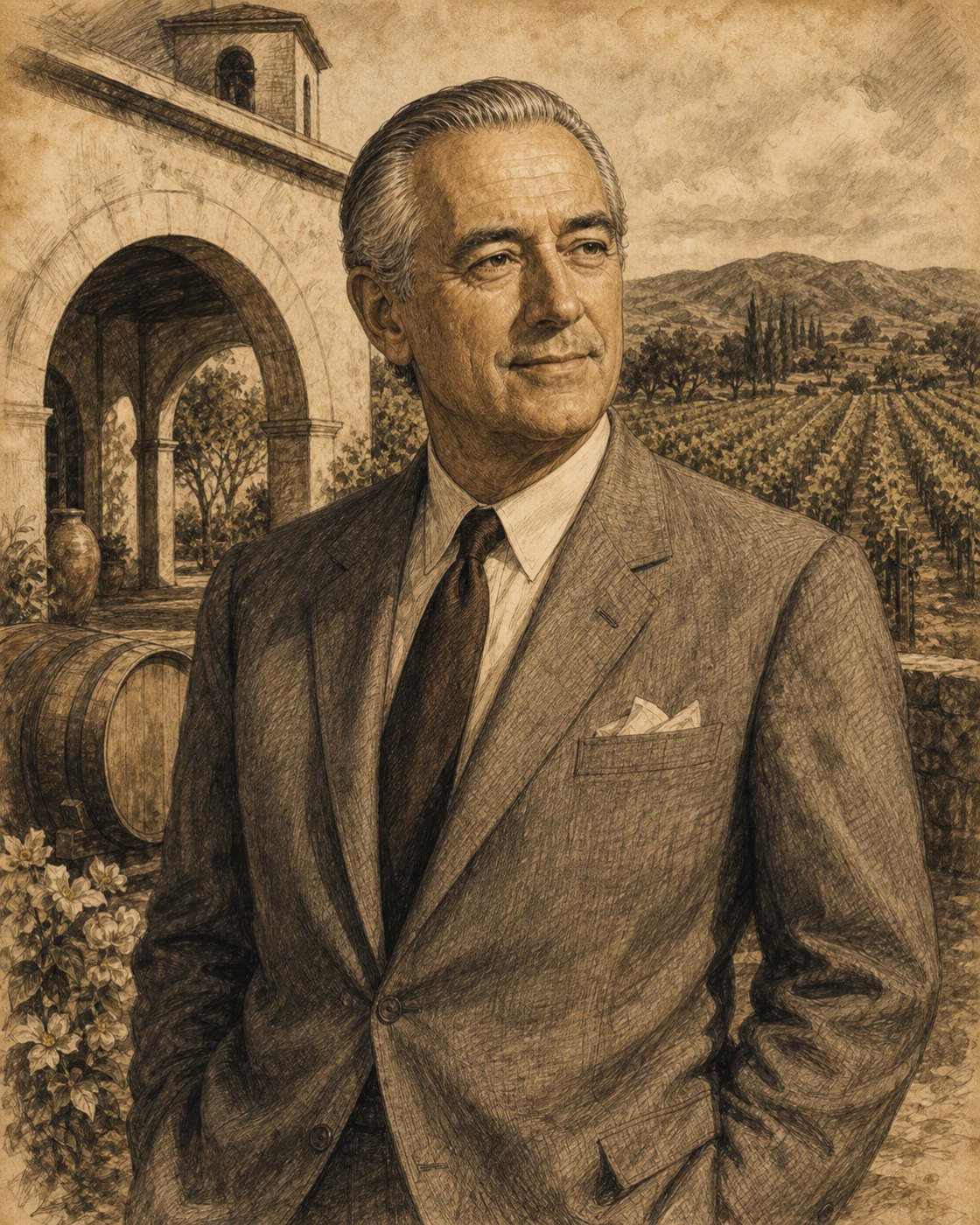
Before the reputation
How they found wine
Mondavi’s wine education began in an immigrant family rather than in a tasting examination. His parents came from Italy, and his father’s business included supplying California grapes to households making wine during Prohibition. Growing up around Lodi connected wine with meals, work and family before it became a luxury proposition.
The family bought Charles Krug in 1943. After years there and a break with his brother Peter, Robert established his own Oakville winery in 1966, already in his fifties. The important pivot was from inheriting a family enterprise to building a public argument for California wine through quality, hospitality and collaboration.
Robert Mondavi opened his Oakville winery in 1966 with To Kalon Vineyard at its centre. His influence came from treating wine quality, architecture, food, art, hospitality, and public education as parts of the same project: convincing drinkers that California belonged at the fine-wine table.
He popularised the name Fumé Blanc for a dry, often oak-shaped Sauvignon Blanc and later partnered with Baron Philippe de Rothschild to create Opus One. Both moves translated European reference points into a Californian proposition.
Beyond one bottle
Why the work mattered
Mondavi helped make the winery itself a place of education and cultural participation. His influence also crossed price levels: ambitious Napa Cabernet and accessible Woodbridge both served a vision of wine in American life. International ventures widened recognition, but ownership and promotion must not be confused with personally making every wine.
What they changed
Fumé Blanc
A new name reframed Sauvignon Blanc for American drinkers and encouraged a drier, more serious style.
Wine as hospitality
Concerts, food, architecture, tours, and education made the winery a cultural destination, not only a production site.
Napa on the world stage
International collaboration and relentless promotion helped turn regional confidence into global recognition.
Follow the work
Wineries and working relationships
This career distinguishes Robert’s own founding roles from the corporate portfolio. It does not attribute later Constellation ownership or every family member’s independent winery to him.
Charles Krug
1943–1965
Family managementWorked in the family operation before creating his own winery.
Robert Mondavi Winery
1966
FounderBuilt the Oakville estate and its hospitality and education programme.
Opus One
Partnership developed in the 1970s
Co-founder with Baron Philippe de RothschildFranco-American venture with its own technical team.
Woodbridge
1979
FounderLodi-based project for everyday varietal wine.
Vichon · Byron
Corporate expansion period
Company ventures / ownershipPart of the wider Mondavi business; distinct from a personal winemaker appointment.
Luce della Vite · Caliterra · Seña · Ornellaia
1990s–early 2000s; different ownership periods
Partnerships / company investmentsItalian and Chilean ventures extended the company’s reach. His name on a partnership is not proof of sole cellar authorship.
Continuum Estate
2005
Family co-founderFinal family venture with Tim and Marcia; Tim led the winegrowing work.
Arrowood · La Famiglia · Arboleda
1990s–early 2000s
Company ownership / brand and partnership connectionsAdditional branches of the corporate portfolio; not personal winemaker posts.
History reviewed . Roles and ownership may have changed.
Representative bottles
Where to meet the idea
- Robert Mondavi Winery Reserve Cabernet Sauvignon
A direct route into the estate’s To Kalon-centred Cabernet ambition.
- I Block Fumé Blanc
Old-vine Sauvignon Blanc that makes the Fumé Blanc idea more than a marketing anecdote.
- Opus One
The Franco-American partnership wine; ask where collaboration ends and a new house style begins.
Study the signature
Turn the biography into a tasting.
Begin with Robert Mondavi Winery Reserve Cabernet Sauvignon, then place it beside I Block Fumé Blanc when the opportunity allows. The point is not to crown a winner; it is to notice which choices remain legible across price, age, vineyard, and vintage.
Follow three linked ideas as you taste: fumé blanc, wine as hospitality, napa on the world stage. Write down the evidence you can actually perceive, then return to the producer’s history and ask which part of the story the glass supports—and which part belongs to reputation.
Mondavi was a founder and promoter, not the lone hand behind every wine. Geneviève Janssens, Zelma Long, Warren Winiarski, Tim Mondavi, vineyard crews, and others carried the technical work.