
The stubborn blender
Max Schubert
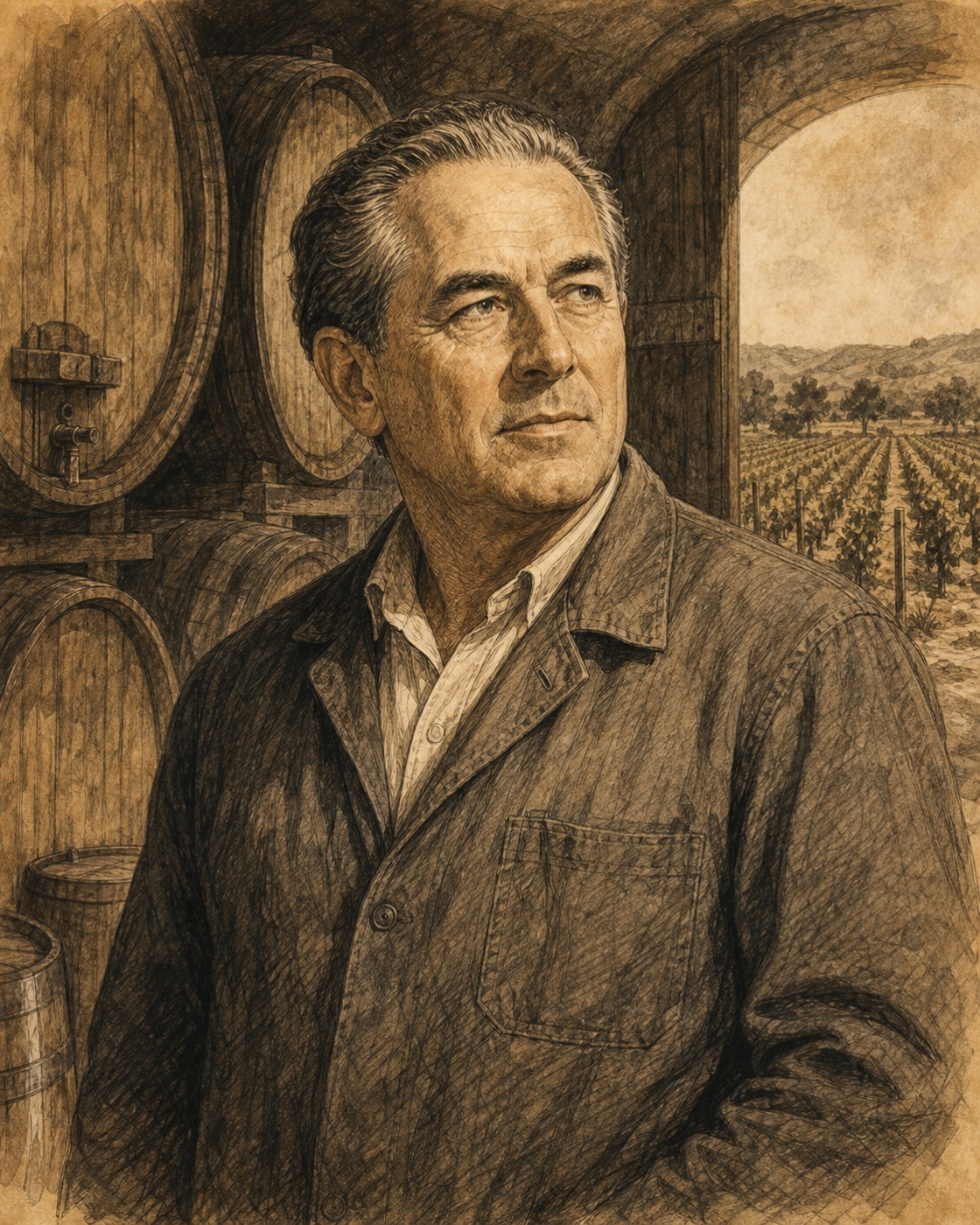
Before the reputation
How they found wine
Schubert came from a German-speaking family near the Barossa, with a blacksmith father and no grand château waiting for him. As a teenager he entered Penfolds doing ordinary winery jobs. Work with chemist John Farsch, apprenticeship under Alfred Vesey and instruction from Ray Beckwith made chemistry and blending part of his education on the job.
A European trip in 1950 changed his ambition. Mature Bordeaux showed what a dry red could become with time. Back in Australia he pursued that longevity using local fruit, especially Shiraz. The resulting Grange experiments were a departure from the fortified-wine market in which he had learned his trade.
Max Schubert became Penfolds’ first chief winemaker in 1948. After visiting Europe, he set out to make an Australian red capable of ageing for decades—not a Bordeaux copy, but a synthesis of ripe Shiraz, blending across vineyards, small barrels, and time in bottle.
The first experimental Grange was made in 1951. When management rejected the style, Schubert continued a small run of hidden vintages before the improving wines won the project back. Grange eventually made the multi-region blend itself a statement of identity.
Beyond one bottle
Why the work mattered
Grange helped change the question from whether Australia could copy Europe to what an Australian fine wine could be. Multi-region blending, Shiraz and a long ageing horizon became a coherent proposition. That achievement rested on technical colleagues and winery resources as well as Schubert’s willingness to persist after rejection.
What they changed
Multi-region fine wine
Fruit could be selected for a consistent style across districts rather than tied to one vineyard boundary.
Shiraz built for time
Ripe fruit, extraction, American oak, and long bottle maturation were engineered as one ageing system.
The Bin family
Numbered cellar lots became a durable Penfolds language for distinct blends, grapes, and expressions.
Follow the work
Wineries and working relationships
Nuriootpa and Magill are workplaces within Penfolds, not separate employers. European study visits are not represented as winery employment.
Penfolds — Nuriootpa
Early 1930s
Junior worker and chemistry assistantLearned production from the ground up, including the prevention of spoilage.
Penfolds — Magill and national production
Transferred 1933; chief 1948–1975
Winemaker; chief winemakerDeveloped Grange, Bin 389 and a durable blending philosophy within the same company.
History reviewed . Roles and ownership may have changed.
Representative bottles
Where to meet the idea
- Penfolds Grange
The defining wine. Compare a young and mature release if possible; its real argument is made across decades.
- Penfolds Bin 389 Cabernet Shiraz
Created in 1960, it shows the Australian Cabernet–Shiraz blend and part of Grange’s barrel lineage at a different scale.
Study the signature
Turn the biography into a tasting.
Begin with Penfolds Grange, then place it beside Penfolds Bin 389 Cabernet Shiraz when the opportunity allows. The point is not to crown a winner; it is to notice which choices remain legible across price, age, vineyard, and vintage.
Follow three linked ideas as you taste: multi-region fine wine, shiraz built for time, the bin family. Write down the evidence you can actually perceive, then return to the producer’s history and ask which part of the story the glass supports—and which part belongs to reputation.
The secret-vintage story is irresistible, but perseverance alone did not make Grange. Vineyard sourcing, cellar teams, corporate resources, later winemakers, and patient cellaring sustain it.