
The intuitive parcel hunter
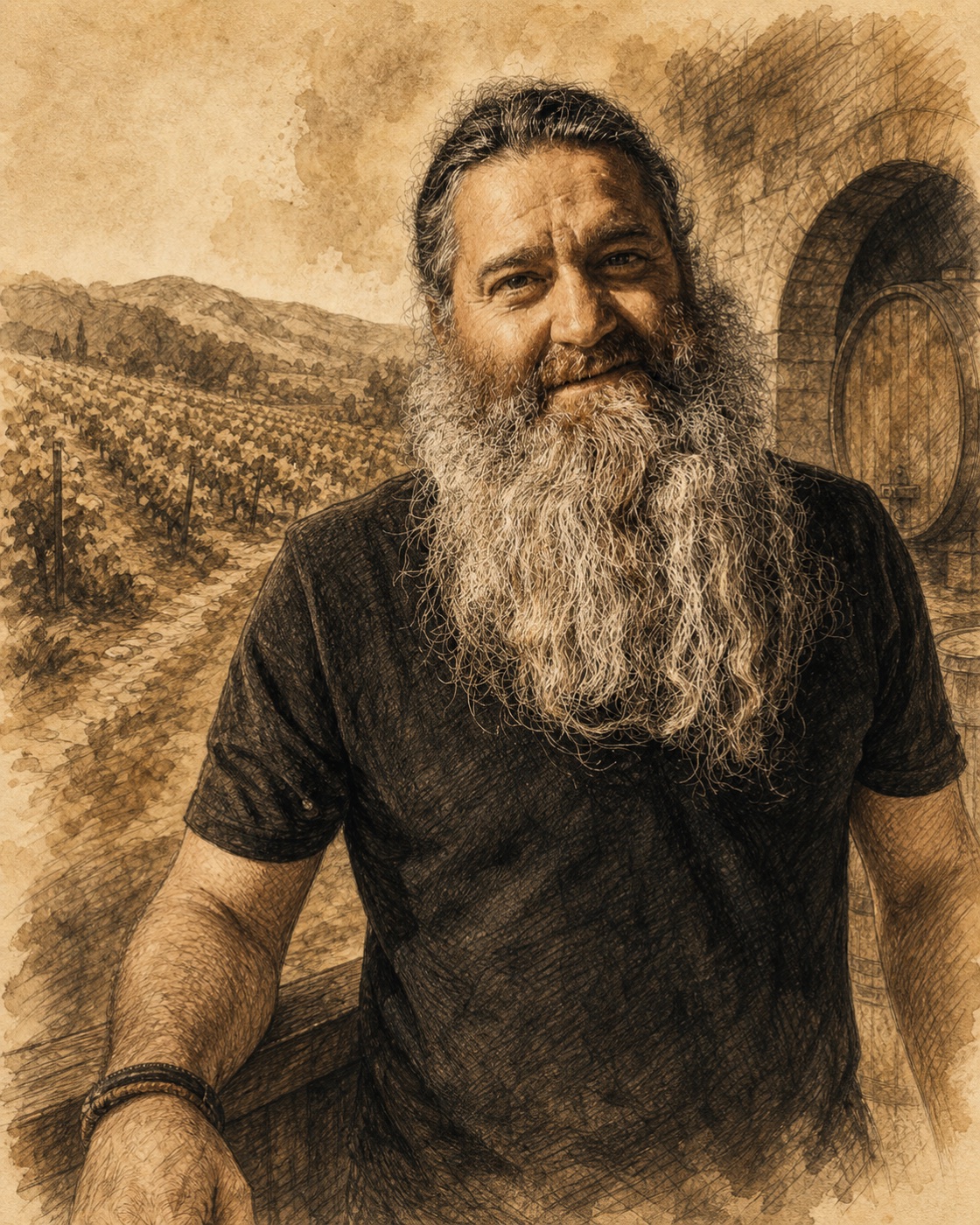
Raúl Pérez
Before the reputation
How they found wine
Pérez grew up in Valtuille de Abajo in a family already making wine at Castro Ventosa. Entering that business as a young man gave him intimate knowledge of Bierzo’s vineyards before international attention arrived. The later independent work grew out of that local familiarity and a habit of collaboration, rather than a discovery of empty or unused wine country.
Ultreia became the best-known expression of his own project in the early 2000s. La Vizcaína and work with other growers then made the story increasingly difficult to reduce to one winery. His career is a network of sites, labels and shared experiments, with old vines and local varieties providing the recurring thread.
Raúl Pérez began at his family’s Castro Ventosa winery in Bierzo and developed an increasingly personal body of work across northwest Spain. Old vines, small parcels, local varieties, whole clusters, long macerations, and a deliberately light hand in the cellar became recurring tools rather than a fixed recipe.
Through Ultreia, La Vizcaína, and collaborations beyond Bierzo, Pérez helped shift Mencía away from a simple equation with dark colour and new oak. His wines made village, slope, vine age, and aromatic delicacy central to the modern conversation about Atlantic Spain.
Beyond one bottle
Why the work mattered
Pérez helped turn attention toward the differences between small northwestern Spanish sites and toward the growers caring for them. His influence travels through collaborations as much as ownership. That makes the heroic lone-winemaker version especially misleading: the range of wines exists because many people supply land, farming, local knowledge and cellar work.
What they changed
Mencía with perfume and transparency
Whole clusters and restrained extraction helped reveal floral, savoury, and mineral dimensions.
The parcel as a working unit
Tiny old-vine sites became distinct wines and a map for Bierzo’s internal differences.
Experiment as observation
Vessels, maceration, flor, and oxygen are adjusted in response to fruit rather than defended as doctrine.
Follow the work
Wineries and working relationships
No reliable complete roster exists in these sources; even the profile describes difficulty tracking every label. Dates and roles are given only at the supported level of precision.
Castro Ventosa
Early career from young adulthood; later involvement
Family winemaker / partnerHis formative Bierzo base.
Raúl Pérez Bodegas y Viñedos — Ultreia · La Vizcaína · Sketch
Independent work from the early 2000s
Founder / project winemakerSeparate labels and vineyard projects should not all be counted as independent physical wineries.
Bodegas Estefanía — Tilenus
Historical appointment; exact dates not established
Technical directorSeparate Bierzo production role.
Peique
Early vintages; undated here
Early winemaking collaboratorWorked with the family’s developing project.
Guímaro — El Pecado and La Penitencia
Ribeira Sacra partnership
CollaboratorWines made with another producer, not evidence that he owns all of Guímaro.
Niepoort · Eben Sadie
Douro and South African projects; undated here
International collaboratorsNamed partnerships in the merchant’s producer account.
History reviewed . Roles and ownership may have changed.
Representative bottles
Where to meet the idea
- Ultreia Saint Jacques
An accessible Bierzo red that introduces Pérez’s fragrant, fluid treatment of Mencía.
- La Vizcaína La Vitoriana
An old-vine parcel wine for studying finesse and site within the La Vizcaína range.
- Ultreia de Valtuille
A flagship village wine that concentrates old vines and Pérez’s Bierzo perspective.
Study the signature
Turn the biography into a tasting.
Begin with Ultreia Saint Jacques, then place it beside La Vizcaína La Vitoriana when the opportunity allows. The point is not to crown a winner; it is to notice which choices remain legible across price, age, vineyard, and vintage.
Follow three linked ideas as you taste: mencía with perfume and transparency, the parcel as a working unit, experiment as observation. Write down the evidence you can actually perceive, then return to the producer’s history and ask which part of the story the glass supports—and which part belongs to reputation.
Pérez makes and collaborates on many changing micro-cuvées. Confirm producer, site, vintage, and role before generalizing from a label.