
The Nahe cartographer
Helmut Dönnhoff
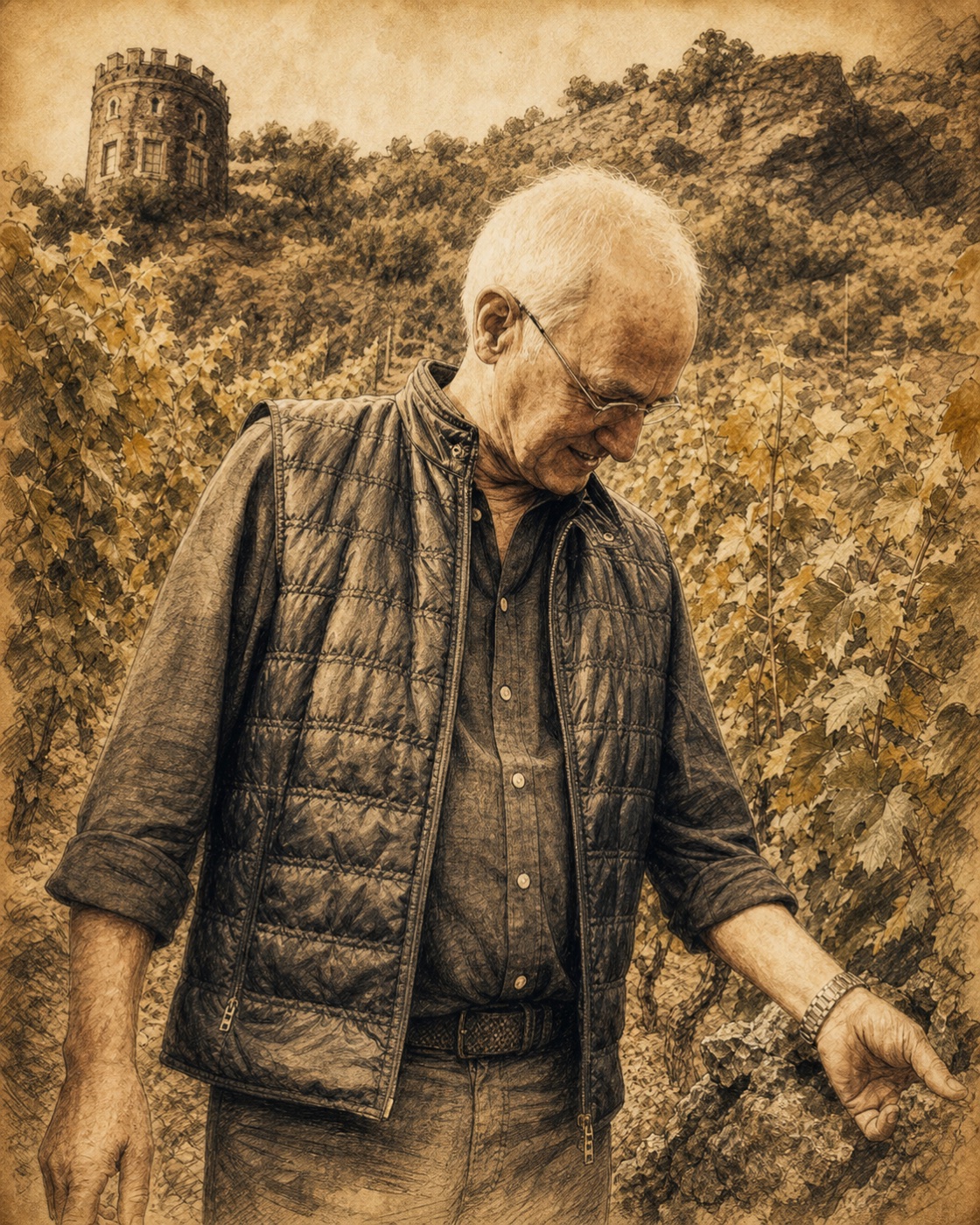
Before the reputation
How they found wine
Dönnhoff’s route into wine began on the family estate in Oberhausen an der Nahe. His grandfather had already emphasized Riesling and vineyard-labelled bottlings, while his father developed the cellar and the Oberhäuser Brücke site. He trained at home and studied winegrowing before taking responsibility for both vineyard and cellar in 1971.
That inheritance was an agricultural foundation rather than the global reputation the estate later acquired. His career developed by refining wines and building a portfolio of contrasting Nahe sites. The interesting turning point is sustained commitment to the family’s region: its diversity could be made clearer through individual wines instead of being hidden behind a broad German Riesling category.
Helmut Dönnhoff began directing his family estate in the early 1970s and helped move the Nahe from insider territory to an essential Riesling region. By building a portfolio across sharply different volcanic, slate, sandstone, and porphyry sites, he taught drinkers to read a small region as a geological mosaic.
The wines span dry Grosses Gewächs, Prädikat styles, and noble-sweet selections, usually joined by clarity and poise rather than a single sweetness level. His son Cornelius now leads the estate, making continuity and generational transfer part of the modern Dönnhoff story.
Beyond one bottle
Why the work mattered
Dönnhoff helped make the Nahe’s varied sites intelligible to an international audience. His influence is an extended example of consistency across dry and sweeter Rieslings, not a claim that he invented vineyard bottling. The family’s later generation carries the work onward, making continuity a team achievement across time.
What they changed
The Nahe as a map of sites
Named vineyards and contrasting soils gave the region a fine-grained identity of its own.
Precision across sweetness
Dry, delicately sweet, and botrytised wines share a focus on acidity, transparency, and balance.
Succession without rupture
The transition to Cornelius shows a house style becoming team and family knowledge.
Follow the work
Wineries and working relationships
The documented career is centred on the family winery. Brücke, Hermannshöhle and other named sites are vineyards, not a list of employers or consulting clients.
Weingut Dönnhoff
Vineyard and cellar responsibility from 1971
Family winemaker and proprietorBuilt on his father’s and grandfather’s work; succession to Cornelius is part of the estate’s later story.
History reviewed . Roles and ownership may have changed.
Representative bottles
Where to meet the idea
- Dönnhoff Hermannshöhle Riesling GG
A dry grand-cru reference combining density with exacting Nahe structure.
- Dönnhoff Oberhäuser Brücke Riesling Spätlese
A monopole site where sweetness and acidity make a particularly clear dialogue.
- Dönnhoff Riesling Tonschiefer
A more accessible dry introduction to the estate’s emphasis on line and mineral impression.
Study the signature
Turn the biography into a tasting.
Begin with Dönnhoff Hermannshöhle Riesling GG, then place it beside Dönnhoff Oberhäuser Brücke Riesling Spätlese when the opportunity allows. The point is not to crown a winner; it is to notice which choices remain legible across price, age, vineyard, and vintage.
Follow three linked ideas as you taste: the nahe as a map of sites, precision across sweetness, succession without rupture. Write down the evidence you can actually perceive, then return to the producer’s history and ask which part of the story the glass supports—and which part belongs to reputation.
Helmut’s name anchors the reputation, but Cornelius directs the current estate. Credit present vintages to the working team and generation.