
The scientific mentor
André Tchelistcheff
Before the reputation
How they found wine
Tchelistcheff’s path to Napa began with displacement. Born in Russia, he survived revolution and civil war, then rebuilt his life through agricultural and scientific study in Europe. Fermentation and microbiology became useful ways to connect laboratory knowledge with the uncertainty of an actual harvest.
Georges de Latour recruited him in France for Beaulieu Vineyard in 1938. California offered a young fine-wine industry with enormous room for improvement. His working life then expanded from one employer to teaching and consulting: growers could bring a problem to someone who understood both the organisms in the cellar and the decisions in the vineyard.
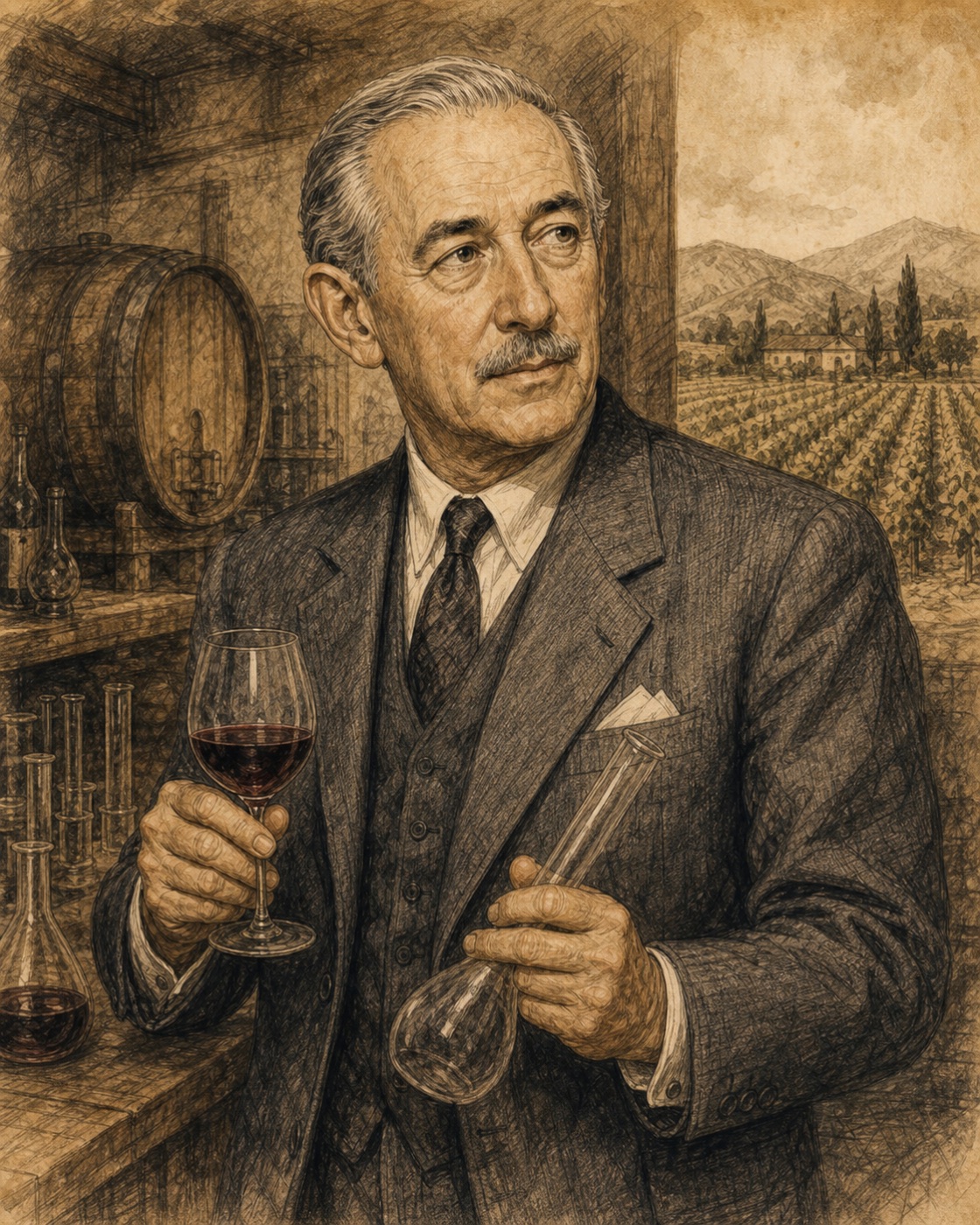
Russian-born and trained in France, André Tchelistcheff arrived at Beaulieu Vineyard in 1938. He brought a disciplined scientific approach to a California industry rebuilding after Prohibition, then spread that approach through decades of consulting and mentorship.
At BV he helped establish Georges de Latour Private Reserve as a benchmark Napa Cabernet. His influence extended beyond one bottle: temperature management, cellar hygiene, malolactic fermentation, frost protection, and close observation became part of a more dependable fine-wine culture.
Beyond one bottle
Why the work mattered
His lasting change was making expertise travel. Better fermentation control and fault prevention became practices that colleagues could learn and repeat. The spread from Napa into Washington and other regions mattered more than a claim to have personally invented every technique. His clients employed their own winemakers, who turned advice into wine.
What they changed
Control without sterility
Cleaner cellars and cooler fermentations reduced faults while preserving the character of ripe California fruit.
Malolactic understanding
Managing the conversion of sharper malic acid to softer lactic acid made texture and stability more intentional.
A culture of mentorship
His consulting connected producers across California, Oregon, and Washington and made technical knowledge portable.
Follow the work
Wineries and working relationships
Consulting involved many more estates than a single employment résumé. This is a documented roster from the linked oral history and obituary, not a certified complete client list.
Beaulieu Vineyard
Joined 1938; returned as adviser in 1990
Winemaker and later adviserHis principal employer and the home of Georges de Latour Private Reserve; published accounts differ on the exact retirement transition.
Simi · Jordan · Buena Vista
Later career; overlapping appointments
ConsultantHis oral history describes maintaining these separate consulting relationships.
Chateau Ste. Michelle · Columbia Crest
Later career; exact periods vary
ConsultantExtended California technical experience into Washington fine wine.
Robert Mondavi · Louis Martini · Charles Krug · Franciscan · Niebaum-Coppola · Ornellaia
Dates not specified in the cited career summary
Consultant / technical adviserNamed in his obituary as recipients of advice; this is not a list of estates he owned or ran.
Heitz Cellars · Field Stone · Rubissow · Erath · Sequoia Grove
Historical engagements; dates not specified
Consultant / adviserAdditional named relationships in the career record.
Conn Creek
1991
Technical adviserAdvice on the Anthology Bordeaux-blend programme.
Quilceda Creek
Founding and development period
Family mentor and adviserEncouraged his nephew Alex Golitzin; distinct from owning or running the winery.
History reviewed . Roles and ownership may have changed.
Representative bottles
Where to meet the idea
- BV Georges de Latour Private Reserve Cabernet Sauvignon
The flagship most directly associated with his work; older bottles show Napa Cabernet trading fruit for savoury complexity.
- Classic-era BV Cabernet
A well-stored mature vintage can demonstrate balance, moderate alcohol, American oak, and ‘Rutherford dust’ better than a trophy score.
Study the signature
Turn the biography into a tasting.
Begin with BV Georges de Latour Private Reserve Cabernet Sauvignon, then place it beside Classic-era BV Cabernet when the opportunity allows. The point is not to crown a winner; it is to notice which choices remain legible across price, age, vineyard, and vintage.
Follow three linked ideas as you taste: control without sterility, malolactic understanding, a culture of mentorship. Write down the evidence you can actually perceive, then return to the producer’s history and ask which part of the story the glass supports—and which part belongs to reputation.
No single consultant modernised California alone. Vineyard workers, laboratory staff, growers, cellar crews, and a network of producers turned techniques into practice.