
The Australian table-wine craftsman
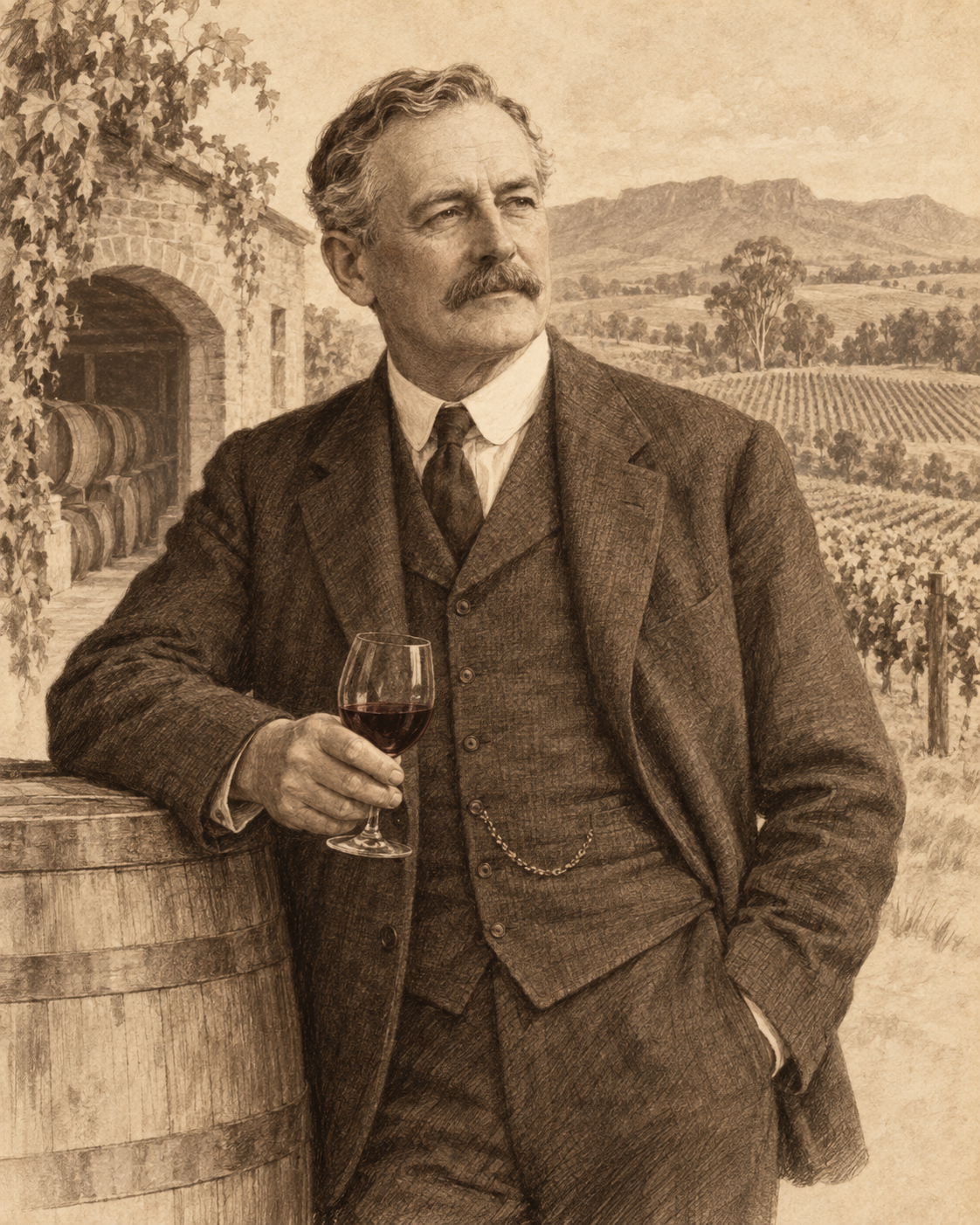
Maurice O’Shea
Before the reputation
How they found wine
O’Shea grew up with an Irish-born wine-and-spirit merchant father and a French mother. Education in France led him through agricultural and viticultural study, analytical chemistry and teaching. He returned to Australia in 1920 at his mother’s request, bringing formal scientific training into a very different wine economy.
The family acquired the Hunter property that became Mount Pleasant in 1921. Making dry wine there was a practical commitment, not just an academic interest. Existing vines, new planting and the need to keep a business alive shaped the work. McWilliam’s later investment provided support while he continued making the wines.
Maurice O’Shea built Mount Pleasant into an important Australian dry-wine reference during an era when fortified wine dominated much of the trade. His work combined vineyard judgement, blending and the ambition to make wines that developed in bottle.
His reputation belongs to a small working cellar and a network of growers and supporters. It also survives through modern Mount Pleasant wines, which are successors and tributes rather than bottles he personally made.
Beyond one bottle
Why the work mattered
O’Shea helped establish a serious Australian tradition of dry wines intended for the table and cellar. His use of blending invites learners to separate quality from a modern assumption that the smallest origin statement is always best. Scientific education and practical judgement worked together; neither a romantic primitive-cellar story nor a single heroic bottle fully explains the achievement.
What they changed
Dry wine in a fortified-wine era
Mount Pleasant maintained an ambition for table wines with development potential.
Blending as judgement
Combining appropriate material was a creative quality decision, not automatically a loss of identity.
A continuing Hunter benchmark
The estate gave later producers a tangible example of Australian wine worth cellaring.
Follow the work
Wineries and working relationships
The documented winery career centres on Mount Pleasant across a change of ownership. His earlier French teaching and scientific work are part of his education and profession, not invented winery appointments.
Mount Pleasant
1921–1956
Family founder and winemakerThe family acquired the property and developed the estate around existing and newly planted vines.
Mount Pleasant under McWilliam’s ownership
1930s–1956
Continuing winemakerMcWilliam’s progressively invested in and acquired the estate; this was continuity at Mount Pleasant rather than an unrelated winery job.
History reviewed . Roles and ownership may have changed.
Representative bottles
Where to meet the idea
- Mount Pleasant Maurice O’Shea Shiraz
A posthumous tribute wine: useful for exploring the estate’s modern interpretation of his legacy.
- Mount Pleasant Old Paddock & Old Hill Shiraz
Connects the tasting to vineyards central to Mount Pleasant’s history; the current winemaking team deserves its own credit.
Study the signature
Turn the biography into a tasting.
Begin with Mount Pleasant Maurice O’Shea Shiraz, then place it beside Mount Pleasant Old Paddock & Old Hill Shiraz when the opportunity allows. The point is not to crown a winner; it is to notice which choices remain legible across price, age, vineyard, and vintage.
Follow three linked ideas as you taste: dry wine in a fortified-wine era, blending as judgement, a continuing hunter benchmark. Write down the evidence you can actually perceive, then return to the producer’s history and ask which part of the story the glass supports—and which part belongs to reputation.
A commemorative name is not evidence of authorship. Historic Australian blending and labelling practices also differ from current geographical rules.