
The scientifically curious naturalist
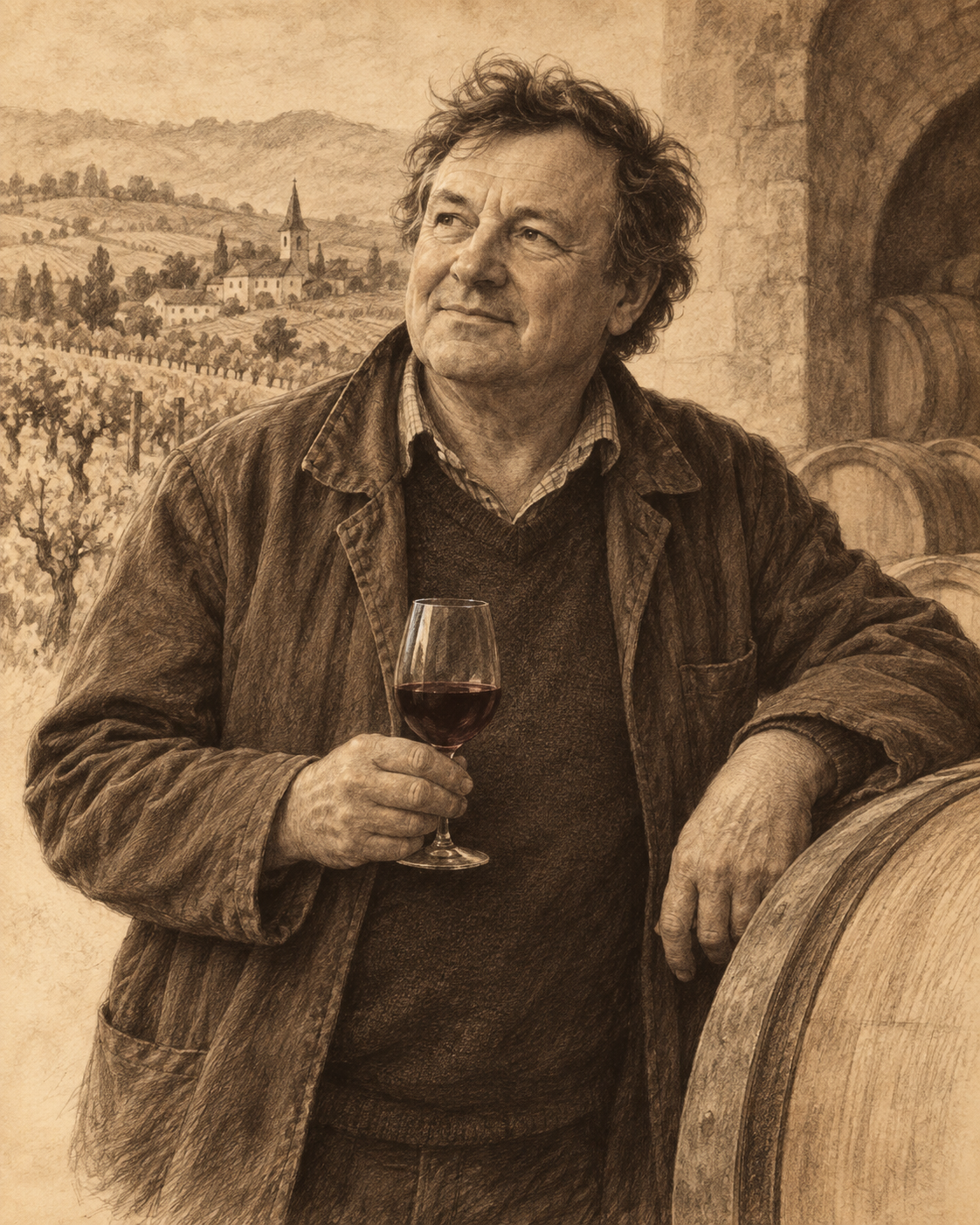
Marcel Lapierre
Before the reputation
How they found wine
Lapierre took over his family’s seven hectares in 1973. This was an inherited working farm, not an instant countercultural manifesto: his father Camille had developed the business through sharecropping, vineyard ownership and bottling. Marcel initially worked within the cellar practices familiar to his generation.
Meeting researcher and winemaker Jules Chauvet in 1981 changed his direction. The move toward organic farming and fermentations without routine additions grew from technical curiosity and close observation. Marie, whom he met during the 1980 harvest, became an essential commercial and practical partner as this approach found an audience.
Marcel Lapierre became a central figure in the revival of carefully farmed, lightly handled Beaujolais. His work with Gamay helped persuade drinkers to approach Morgon as wine with depth and ageing potential.
His partnership with Marie Lapierre and the later work of their children matter to that story. A bottle carrying the family name today belongs to a continuing domaine, not to Marcel’s own final harvest.
Beyond one bottle
Why the work mattered
Lapierre demonstrated that a low-input cellar still needed excellent fruit, attention and knowledge of fermentation. His example helped make Beaujolais a reference point for the natural-wine movement. The influence was a working method and a community of producers, not a guarantee that every unsulfured wine would be sound or every conventional wine inferior.
What they changed
Fruit before correction
Farming and selection became the first means of avoiding problems later in the cellar.
Knowledge behind restraint
Chauvet’s scientific approach challenged the idea that leaving things out meant abandoning technical understanding.
Morgon with seriousness
The domaine helped shift attention from disposable young Beaujolais toward site, texture and ageing.
Follow the work
Wineries and working relationships
The sourced estate career centres on the family domaine and Château Cambon. Chauvet was an influential mentor; that relationship is not being converted into an undocumented employment appointment.
Domaine Marcel Lapierre
1973–2010
Family grower and winemakerTook over the family holding; Marie helped build the business and Mathieu joined before Marcel’s death. Camille joined the next generation afterward.
Château Cambon
From 1995
Co-owner and collaboratorMarcel and Marie joined the Chanudet family in this Beaujolais property. Jean-Claude Chanudet’s separate Chamonard connection does not make Lapierre its owner.
History reviewed . Roles and ownership may have changed.
Representative bottles
Where to meet the idea
- Domaine Marcel Lapierre Morgon
The family’s central Gamay wine; use a recent release to study the continuing approach.
- Château Cambon Beaujolais
A separate estate connection, useful for comparing regional Beaujolais with Morgon without treating either appellation as a quality verdict.
Study the signature
Turn the biography into a tasting.
Begin with Domaine Marcel Lapierre Morgon, then place it beside Château Cambon Beaujolais when the opportunity allows. The point is not to crown a winner; it is to notice which choices remain legible across price, age, vineyard, and vintage.
Follow three linked ideas as you taste: fruit before correction, knowledge behind restraint, morgon with seriousness. Write down the evidence you can actually perceive, then return to the producer’s history and ask which part of the story the glass supports—and which part belongs to reputation.
Natural wine has no single universal production recipe. Do not infer an exact sulfur addition or certification for a particular bottle from the movement’s name.