
The Italian technical bridge
Giacomo Tachis
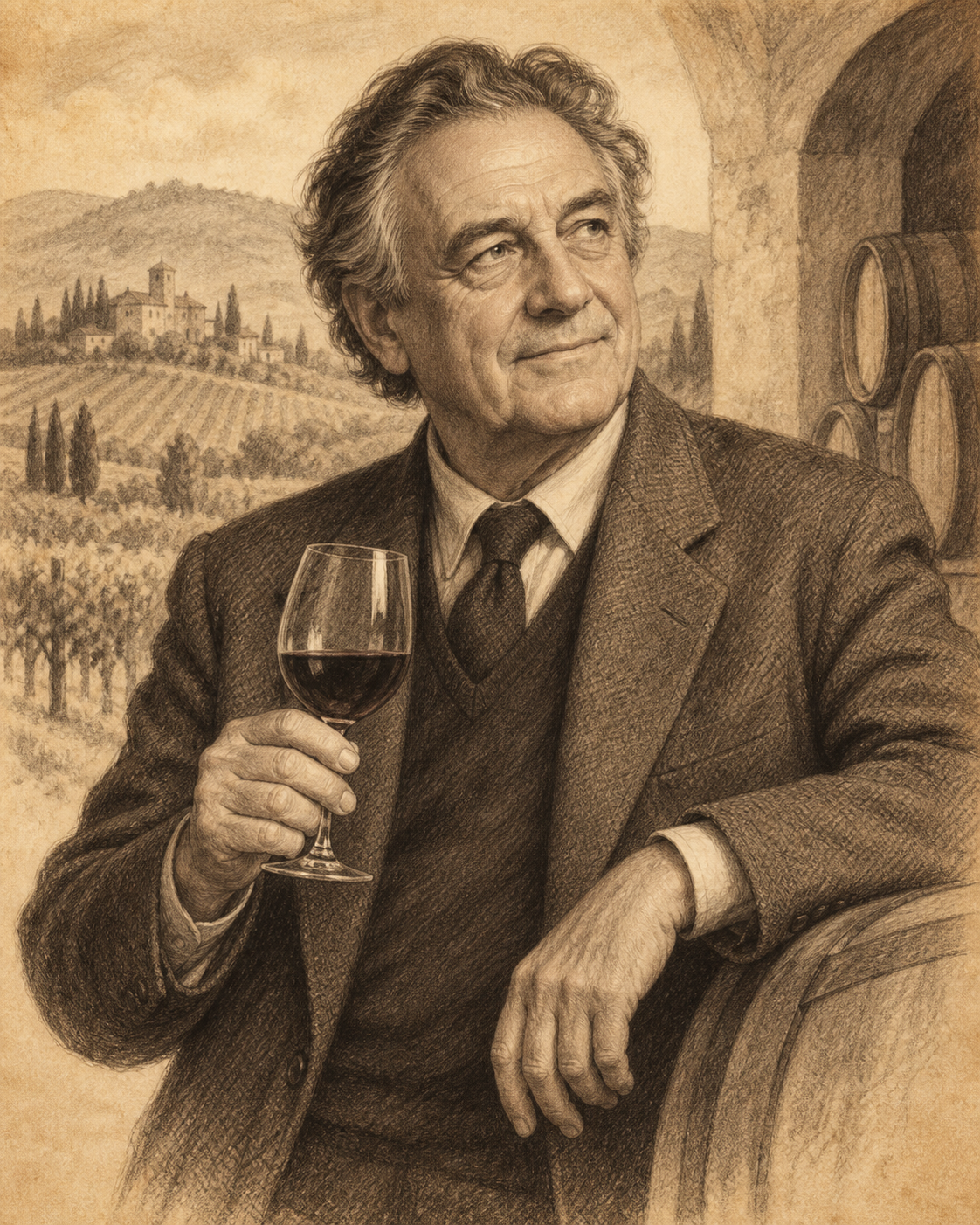
Before the reputation
How they found wine
Tachis came from Poirino in Piedmont and studied oenology at Alba. His route into wine was technical education and paid cellar work, rather than ownership of a grand Tuscan estate. Joining Antinori in 1961 gave him a much larger setting in which to apply that training.
He developed into a technical director who could connect fermentation, maturation and blending with an estate’s commercial ambitions. After his main Antinori career, consulting allowed him to work with very different regional raw materials. Sardinian Carignano and local island traditions became as important to the breadth of his career as internationally familiar Cabernet.
Giacomo Tachis helped Italian producers connect vineyard ambition with more dependable cellar practice. He is closely associated with the rise of Sassicaia, Tignanello and Solaia, though each was the work of owners, growers and cellar teams as well as an oenologist.
His later consulting extended well beyond Tuscany. Work in Sardinia and Sicily makes the familiar “Super Tuscan” label an incomplete description of his influence.
Beyond one bottle
Why the work mattered
Tachis helped producers make ambitious dry wines with greater control and consistency, then spread that expertise through consulting. His career complicates a simple tradition-versus-modernity argument: international varieties and small oak barrels were part of the story, but so were regional grapes and collaborations with local cooperatives. The important change was the range of serious wines Italy could offer.
What they changed
Technical reliability
Fermentation and maturation decisions became part of a deliberate quality programme.
New Tuscan possibilities
Collaborative projects questioned whether established categories captured the best wines a site could produce.
Island grapes on a larger stage
His work with Sardinian producers connected regional varieties with national and international attention.
Follow the work
Wineries and working relationships
Public accounts name these principal employers and consultancies, but do not provide a full dated contract register. Individual cuvées are listed as wines, not additional wineries.
Antinori
1961–early 1990s
Oenologist and technical directorA long employed career including work associated with Tignanello and Solaia.
Tenuta San Guido
Sassicaia development and later advice
Technical collaborator and consultantWorked within the partnership behind Sassicaia; he was not the estate’s founder.
Argiano · Castello dei Rampolla · Querciabella
Later career
ConsultantNamed Tuscan advisory connections in the published career profile.
Umani Ronchi
Later career
ConsultantA Marche connection extending his work beyond Tuscany.
Donnafugata · Corvo / Duca di Salaparuta · Abbazia Santa Anastasia
Later career
ConsultantDocumented Sicilian collaborations, distinct from ownership.
Argiolas · Cantina di Santadi
Later career
ConsultantSardinian work included the producers of Turriga and Terre Brune; Santadi records a collaboration lasting about three decades.
Tenuta San Leonardo
From 1984
Consulting oenologistAdvised Carlo Guerrieri Gonzaga at the Trentino estate, extending his career north of Tuscany.
History reviewed . Roles and ownership may have changed.
Representative bottles
Where to meet the idea
- Antinori Tignanello
A Sangiovese-led reference for discussing changes to Tuscan blends and classifications.
- Tenuta San Guido Sassicaia
A Cabernet-based coastal wine; credit the Incisa family and the wider team alongside Tachis.
- Santadi Terre Brune
A Carignano-led Sardinian counterpoint that broadens the story beyond Tuscany.
Study the signature
Turn the biography into a tasting.
Begin with Antinori Tignanello, then place it beside Tenuta San Guido Sassicaia when the opportunity allows. The point is not to crown a winner; it is to notice which choices remain legible across price, age, vineyard, and vintage.
Follow three linked ideas as you taste: technical reliability, new tuscan possibilities, island grapes on a larger stage. Write down the evidence you can actually perceive, then return to the producer’s history and ask which part of the story the glass supports—and which part belongs to reputation.
Being involved in a landmark wine is not the same as inventing it alone. Current releases also reflect the work of later winemakers.