
The Baga experimenter
Luís Pato
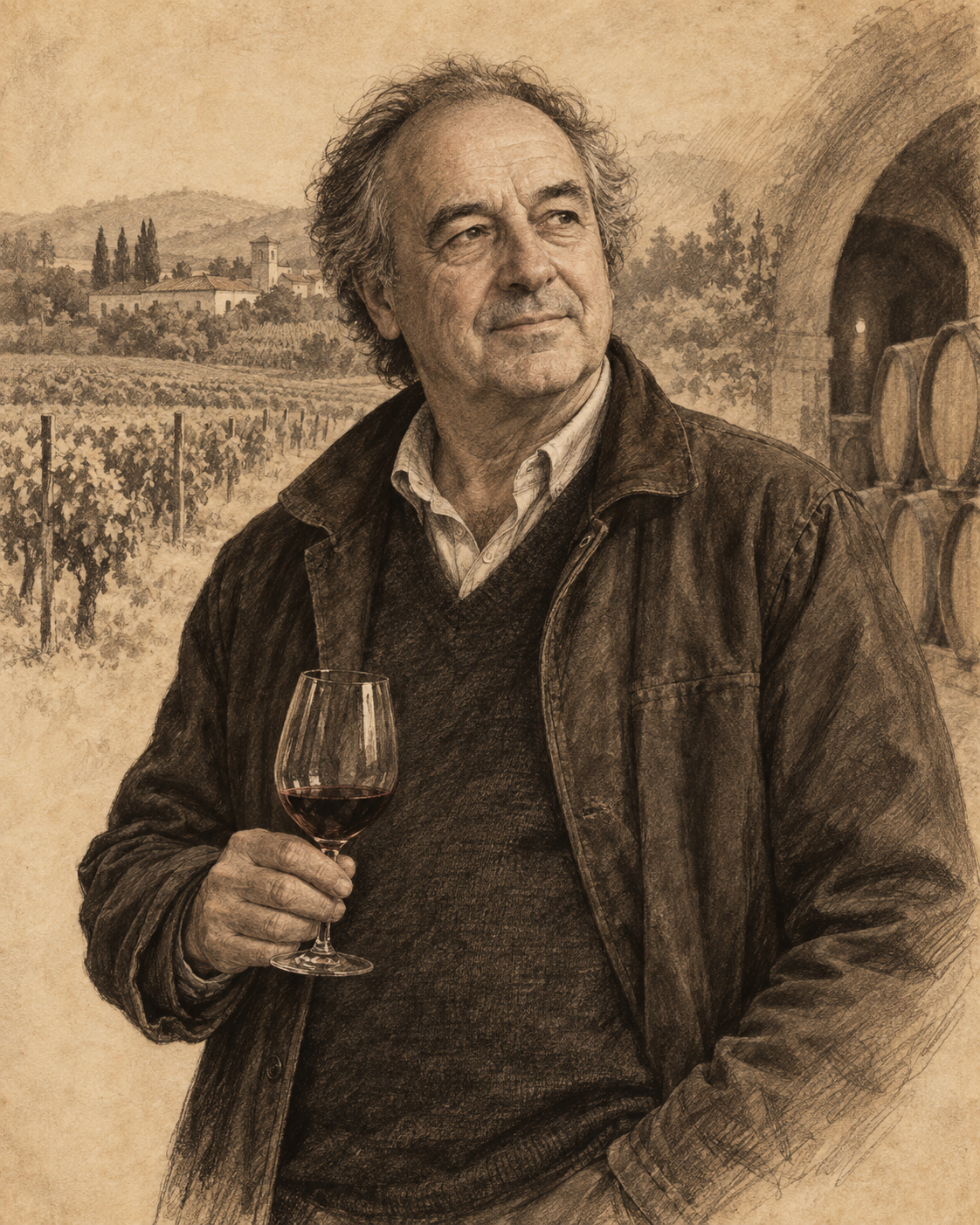
Before the reputation
How they found wine
Pato came to the family wine business with training as a chemical engineer. His father João had already established a reputation in Bairrada; Luís’s first wine in 1980 gave him a practical setting for applying a questioning, experimental approach rather than simply repeating inherited cellar routines.
Baga became the central problem and opportunity. A variety capable of firm tannin and marked acidity required decisions about crop, site and ripeness. Pato explored ways to use the same regional resources for different styles, including earlier-picked fruit for sparkling wine and later harvesting for red wine.
Luís Pato made Baga a vehicle for experimentation in Bairrada. His work connected an often demanding local red grape with vineyard selection, different harvest decisions and wines that could ask for patience.
White and sparkling wines are part of the picture too. Treating him only as a maker of powerful red wine misses how broadly he has investigated the region’s grapes.
Beyond one bottle
Why the work mattered
Pato helped make Baga’s possibilities visible beyond a narrow regional reputation. His experiments encouraged discussion of vineyard origin and harvest strategy rather than treating the grape as inevitably austere. The influence is not that engineering supplies one perfect recipe: it is that a difficult variety can reward precise questions, repeated trials and willingness to make more than one style.
What they changed
Baga with a vineyard address
Named parcels make site selection part of the conversation about a regional grape.
Different harvests, different wines
Earlier and later picking can direct fruit toward sparkling or red-wine aims.
Local whites taken seriously
Bairrada’s white varieties broaden the region beyond the reputation of its red wines.
Follow the work
Wineries and working relationships
The public record supports the family estate and the João Pato collaboration. Family relationships alone are not evidence that Luís held a winemaking job at a relative’s independent winery.
Luís Pato / Quinta do Ribeirinho
First own wine in 1980; subsequent career
Family proprietor and winemakerThe family business and estate underpin his Baga, white and sparkling-wine experiments.
João Pato / Duckman
From 2018
Family collaboration with Maria João PatoA separate playful label within the family story; it should not be confused with Filipa Pato & William Wouters.
FLP with Filipa Pato
2005
Father–daughter wine collaborationThe producer timeline records a joint cryoextraction project. This collaboration does not make Filipa’s entire independent estate part of her father’s business.
History reviewed . Roles and ownership may have changed.
Representative bottles
Where to meet the idea
- Luís Pato Vinha Pan
A named-vineyard Baga, useful for observing tannin alongside freshness.
- Luís Pato Vinhas Velhas Branco
A white counterpoint that prevents the lesson becoming only about red-wine extraction.
- Quinta do Ribeirinho Pé Franco
The ungrafted-vine Baga project; rarity does not by itself explain flavour.
Study the signature
Turn the biography into a tasting.
Begin with Luís Pato Vinha Pan, then place it beside Luís Pato Vinhas Velhas Branco when the opportunity allows. The point is not to crown a winner; it is to notice which choices remain legible across price, age, vineyard, and vintage.
Follow three linked ideas as you taste: baga with a vineyard address, different harvests, different wines, local whites taken seriously. Write down the evidence you can actually perceive, then return to the producer’s history and ask which part of the story the glass supports—and which part belongs to reputation.
Ungrafted vines, old vines and a famous vineyard are contextual facts, not guaranteed tasting notes. Filipa Pato’s independent business should not be folded into her father’s employment history.