
The cellar insurgent
Elio Altare
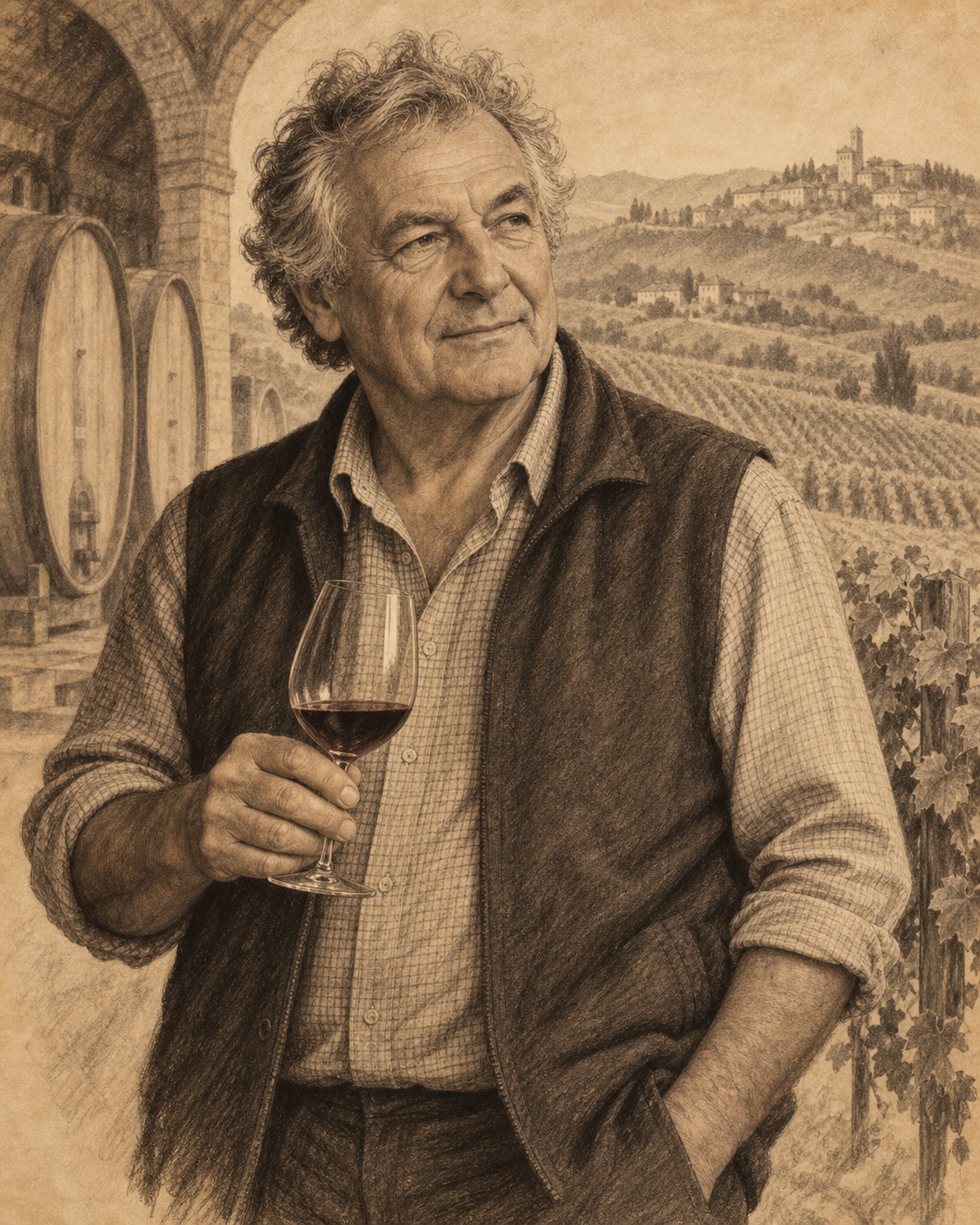
Before the reputation
How they found wine
The Altare family farm at La Morra produced more than wine, and selling grapes did not automatically provide a comfortable living. A 1976 visit to Burgundy showed Elio small growers earning a different level of recognition and value for their own bottles. He returned questioning both farming and cellar habits.
The experiments provoked a serious family rupture. Removing fruit to improve the remaining crop looked wasteful to his father, while replacing traditional large casks challenged a lifetime of work. The famous chainsaw episode belongs in that difficult economic and personal context, rather than as a cheerful slogan about progress.
Elio Altare became one of the best-known advocates of a different approach to Barolo: lower yields, shorter extraction and small French oak barrels. The changes were tied to the viability of a family farm, not simply a preference for fashionable equipment.
His career also includes restoring steep coastal vineyards at Campogrande in the Cinque Terre. That second landscape exposes a different side of a man often reduced to a Barolo controversy.
Beyond one bottle
Why the work mattered
Altare helped make Barolo’s production choices a public debate. Growers could reconsider yields, extraction, oak and how soon a wine became approachable. The resulting arguments sharpened attention to method, but did not prove that one vessel size or maceration schedule was universally correct. His later coastal work also connected ambitious wine with the preservation of labour-intensive vineyard terraces.
What they changed
Crop level as a quality choice
Green harvesting deliberately sacrificed potential volume to alter the remaining crop.
Extraction under scrutiny
Shorter maceration and different vessels challenged expectations of how young Nebbiolo should feel.
Terrace preservation
Campogrande placed vineyard recovery in a fragile coastal landscape alongside the better-known Barolo story.
Follow the work
Wineries and working relationships
The sourced winery map contains the La Morra estate and Campogrande. Other Barolo growers influenced by him are not being listed as employers or properties he owned.
Elio Altare estate
Family career; major changes from the late 1970s
Family grower, winemaker and proprietorThe La Morra property became the centre of his experiments; daughter Silvia is part of its subsequent leadership.
Campogrande
From 2005
Co-founder and vineyard-restoration partnerWorked with Antonio Bonanni in the Cinque Terre; the family account describes replanting terraces and producing local white, red and sweet wines.
History reviewed . Roles and ownership may have changed.
Representative bottles
Where to meet the idea
- Elio Altare Barolo
A starting point for the estate’s approach to Nebbiolo texture and ageing.
- Elio Altare Barolo Arborina
A more specific vineyard comparison, rather than an automatic upgrade based on price.
- Campogrande Cinque Terre Bianco
A coastal white that shows how different his second major project is from Piedmont.
Study the signature
Turn the biography into a tasting.
Begin with Elio Altare Barolo, then place it beside Elio Altare Barolo Arborina when the opportunity allows. The point is not to crown a winner; it is to notice which choices remain legible across price, age, vineyard, and vintage.
Follow three linked ideas as you taste: crop level as a quality choice, extraction under scrutiny, terrace preservation. Write down the evidence you can actually perceive, then return to the producer’s history and ask which part of the story the glass supports—and which part belongs to reputation.
Modernist and traditionalist are broad historical labels. Practices evolve, and a barrel choice alone does not establish how a wine will taste.