
The restless collaborator
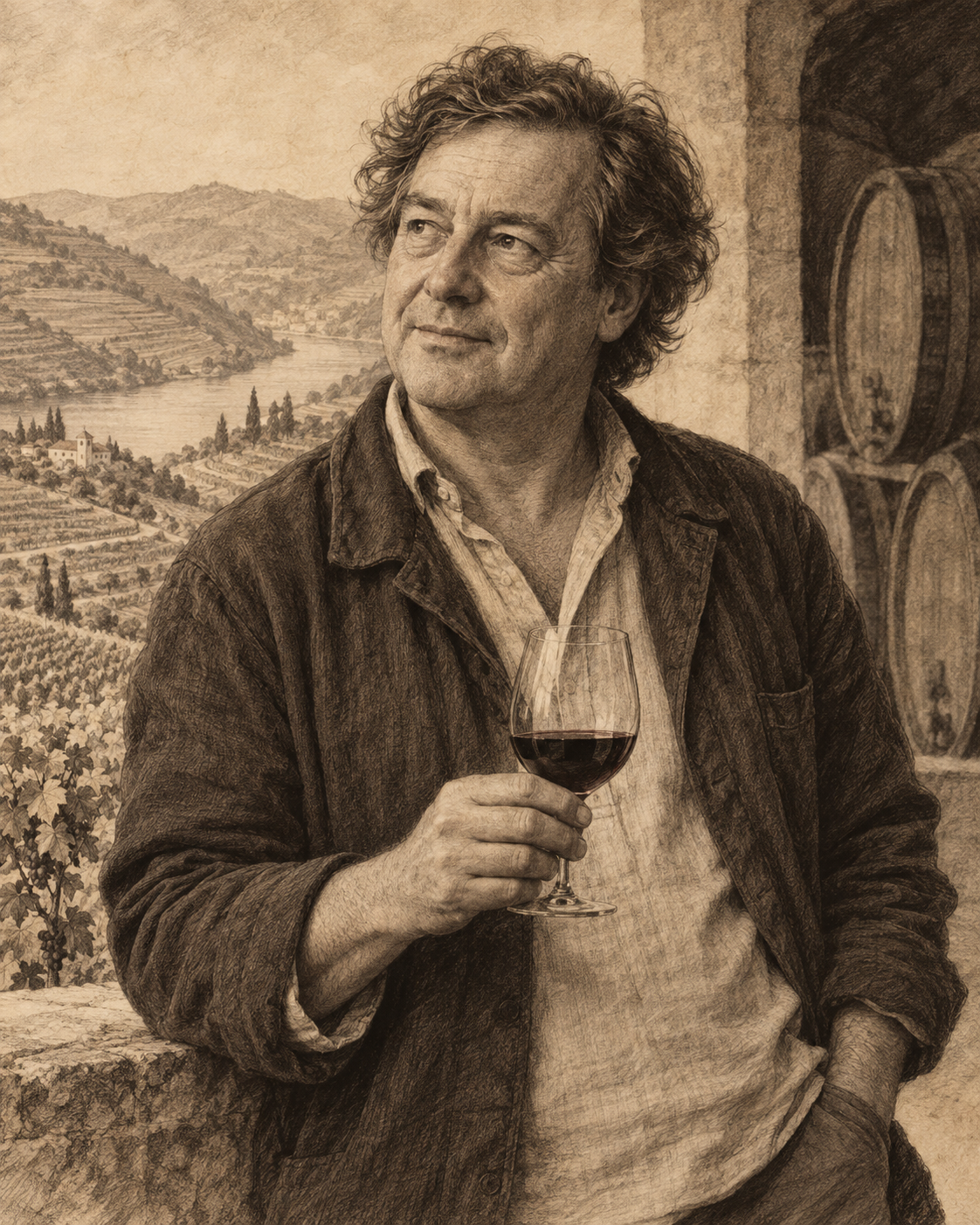
Dirk Niepoort
Before the reputation
How they found wine
Niepoort joined his father Rolf in the family Port business in 1987. Tasting widely had made him curious about what Douro vineyards could do beyond fortified wine. Buying vineyards gave the merchant house a closer connection to farming and material for experiments.
An early red called Robustus preceded the first commercial Redoma vintage in 1991. It was not an overnight replacement of Port with table wine. The two activities developed alongside one another, and the questions expanded from the Douro to other regions, often through friendships with growers rather than a single centrally imposed formula.
Dirk Niepoort helped take a historic Port merchant into ambitious dry wine while retaining its fortified-wine identity. Redoma became an important part of the Douro’s expanding table-wine story.
His subsequent projects reach Bairrada, the Dão, Germany and beyond. Collaboration is central: these wines often reflect another grower’s land and expertise as much as his appetite for trying something new.
Beyond one bottle
Why the work mattered
Niepoort helped widen expectations of Portuguese dry wine, including styles that prize freshness and restraint in a region associated with power. His partnerships also circulated ideas between growers and countries. The influence lies in opening possibilities and markets, rather than proving that lighter wine is inherently better or that Portugal needed an outsider’s permission to value its vineyards.
What they changed
Port and dry wine together
The same regional inheritance could support distinct production aims and drinking occasions.
A broader Portuguese map
Projects in the Dão and Bairrada drew attention to old vineyards and local varieties beyond the Douro.
Collaboration as research
Joint wines let different growers test ideas without pretending one palate owned all the expertise.
Follow the work
Wineries and working relationships
These named estates and partnerships are documented publicly. The network also includes short experiments and bottlings; it is not possible to infer a complete consulting register from a wine catalogue.
Niepoort · Quinta de Nápoles · Quinta do Carril · Vale de Mendiz
Joined in 1987; later estate expansion
Family producer and estate developerThe house’s Douro network supports both dry wines and Port.
Quinta da Lomba · Quinta da Pellada
2010s
Dão estate project; early host-cellar collaborationEarly Dão wines were made at Álvaro de Castro’s Quinta da Pellada before production moved to Lomba.
Quinta de Baixo
Acquired in 2012
Proprietor and winemaking projectEstablished a substantial Bairrada base; earlier regional collaborations preceded ownership.
Fio Wines / Lothar Kettern
From 2012
Mosel partnership with family and local growersA German venture involving his sons and the Kettern family, not a Portuguese vineyard transplanted abroad.
Muhr-van der Niepoort
2002–2019
Co-founder and former partner with Dorli MuhrDorli later acquired his share and continued under her own name.
Equipo Navazos / Navazos-Niepoort
Later international collaboration
Joint wine projectAn Andalusian Palomino wine connects his work with unfortified wine matured under flor.
Casa de Vilar / Wanabi · Alentejo collaborations
Later career
Partner across named projectsThe producer records work with Regina Pessoa and collaborations involving Anna Jorgensen, Vítor Claro and Susana Esteban.
History reviewed . Roles and ownership may have changed.
Representative bottles
Where to meet the idea
- Niepoort Redoma Tinto
The enduring Douro dry-wine reference in his career.
- Niepoort Charme
A contrasting Douro red whose ambition can be discussed through texture and freshness.
- Niepoort Colheita Port
A reminder that long wood maturation and fortified wine remain central to the house.
Study the signature
Turn the biography into a tasting.
Begin with Niepoort Redoma Tinto, then place it beside Niepoort Charme when the opportunity allows. The point is not to crown a winner; it is to notice which choices remain legible across price, age, vineyard, and vintage.
Follow three linked ideas as you taste: port and dry wine together, a broader portuguese map, collaboration as research. Write down the evidence you can actually perceive, then return to the producer’s history and ask which part of the story the glass supports—and which part belongs to reputation.
Partner labels and owned estates are different relationships. This career map does not imply that he personally makes every current wine in the portfolio.