
The master blender of slopes
Jean-Louis Chave
Before the reputation
How they found wine
Chave inherited a family connection to the northern Rhône stretching across generations, but his own preparation included an MBA and study in the United States. At UC Davis he studied sensory analysis and winemaking before returning to France in the early 1990s. The combination gave him both an inherited memory of vineyards and experience outside the family’s way of doing things.
Alongside Hermitage, restoring the steep land of Saint-Joseph became a major commitment. The work involved rebuilding terraces and recovering difficult sites, not simply launching another label. His origin story therefore includes a return: education elsewhere helped him choose a demanding local agricultural project with a much longer horizon than a single vintage.
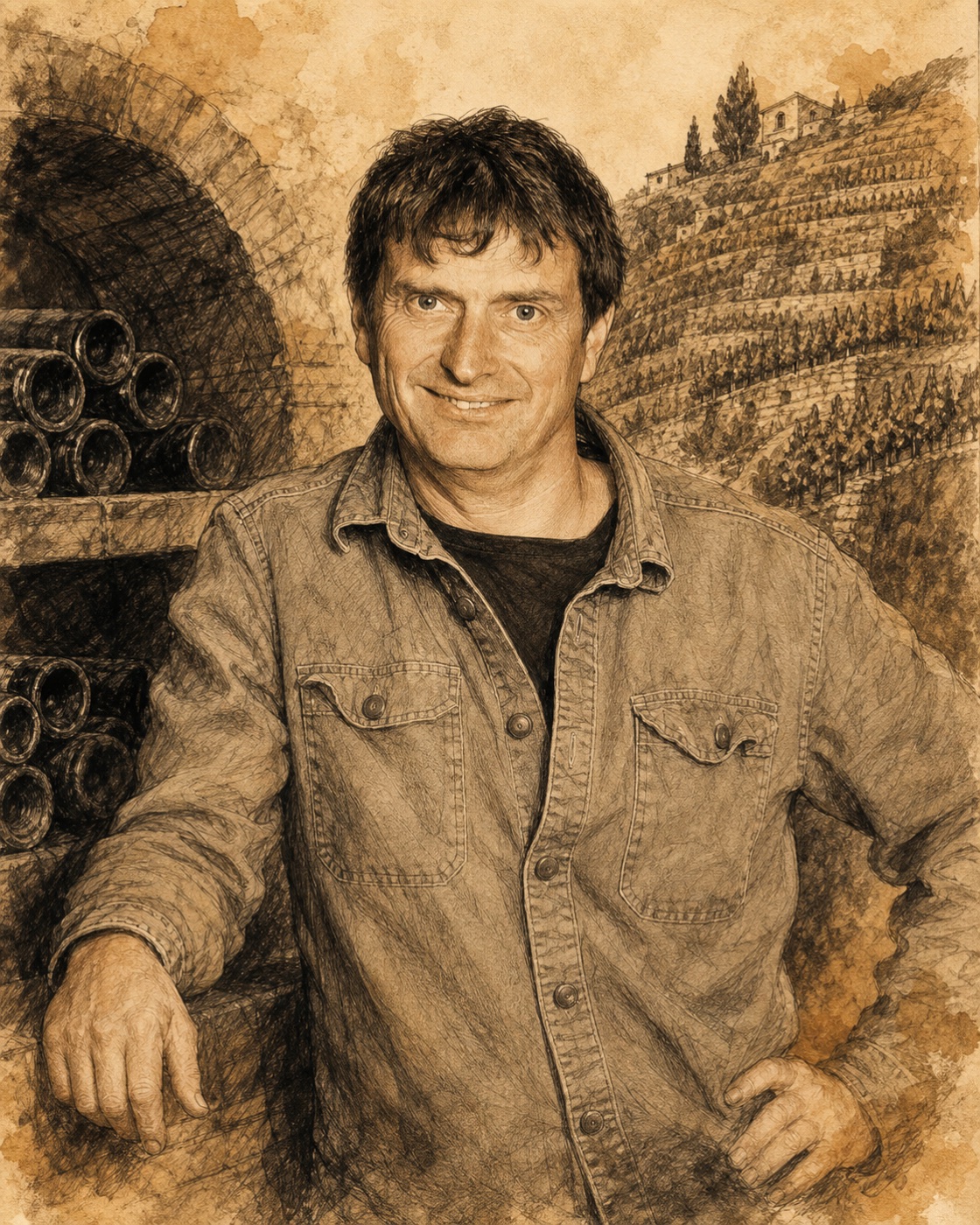
Jean-Louis Chave joined his father, Gérard, at the family domaine in 1993, extending a lineage in the northern Rhône that reaches back to 1481. His Hermitage is assembled from multiple lieux-dits, treating the hill not as one uniform vineyard but as complementary geological and exposure pieces.
Alongside the domaine wines, the Jean-Louis Chave Sélection range widened access to the family’s regional thinking. Restoration of steep Saint-Joseph vineyards also made him an advocate for old terraces, massal material, and the patient agricultural work behind a famous appellation name.
Beyond one bottle
Why the work mattered
Chave keeps the blended identity of Hermitage visible while helping restore attention to Saint-Joseph’s historic slopes. The contribution is stewardship and physical vineyard recovery rather than a new cellar invention. It asks drinkers to value the labour and landscape behind a name, including sites that do not carry Hermitage’s prestige.
What they changed
Blending as terroir interpretation
Hermitage lieux-dits are assembled so granite, loess, clay, exposure, and vine age form a complete hill.
Reclaiming Saint-Joseph slopes
Terrace restoration linked regional revival to demanding physical work and historic sites.
A second, accessible range
Sélection bottlings teach the domaine’s regional logic without pretending to be the same wines.
Follow the work
Wineries and working relationships
Hermitage parcels and Saint-Joseph’s Clos Florentin are vineyard connections within the family work, not independent employers. No complete overseas winery-placement list is established here.
Domaine Jean-Louis Chave
Joined 1993
Family grower / winemakerHermitage and Saint-Joseph farming and production alongside the family’s inherited work.
Jean-Louis Chave Sélection
Founded 1996
Founder / merchant-wine projectA distinct sourcing and production model from estate-grown domaine bottlings.
History reviewed . Roles and ownership may have changed.
Representative bottles
Where to meet the idea
- Domaine Jean-Louis Chave Hermitage Rouge
The Syrah benchmark built by blending parcels across the Hermitage hill.
- Domaine Jean-Louis Chave Hermitage Blanc
Marsanne and Roussanne show the family’s equal seriousness about the hill’s long-lived white form.
- Jean-Louis Chave Sélection Saint-Joseph Offerus
A more available route into the northern Rhône and the Chave approach to Syrah.
Study the signature
Turn the biography into a tasting.
Begin with Domaine Jean-Louis Chave Hermitage Rouge, then place it beside Domaine Jean-Louis Chave Hermitage Blanc when the opportunity allows. The point is not to crown a winner; it is to notice which choices remain legible across price, age, vineyard, and vintage.
Follow three linked ideas as you taste: blending as terroir interpretation, reclaiming saint-joseph slopes, a second, accessible range. Write down the evidence you can actually perceive, then return to the producer’s history and ask which part of the story the glass supports—and which part belongs to reputation.
Centuries of family history can obscure present collaborators. Jean-Louis works inside a living domaine, not as an isolated descendant-genius.