
The quiet Merlot master
Jean-Claude Berrouet
Before the reputation
How they found wine
Berrouet’s early wine memories include his grandfather’s Bordeaux wine shop, where helping fill bottles was a childhood reward. Formal study followed: he qualified in enology in 1962 and joined the Moueix business in the 1960s. That route placed a young technical professional inside an already established network of estates.
His long Pétrus career was only one part of the job. Trotanoy, Magdelaine and later Dominus required judgement across different sites and conditions. Buying Vieux Château Saint-André gave him a more intimate family project alongside those famous names. The career’s central tension is between an internationally celebrated professional reputation and a deliberately quiet approach to authorship.
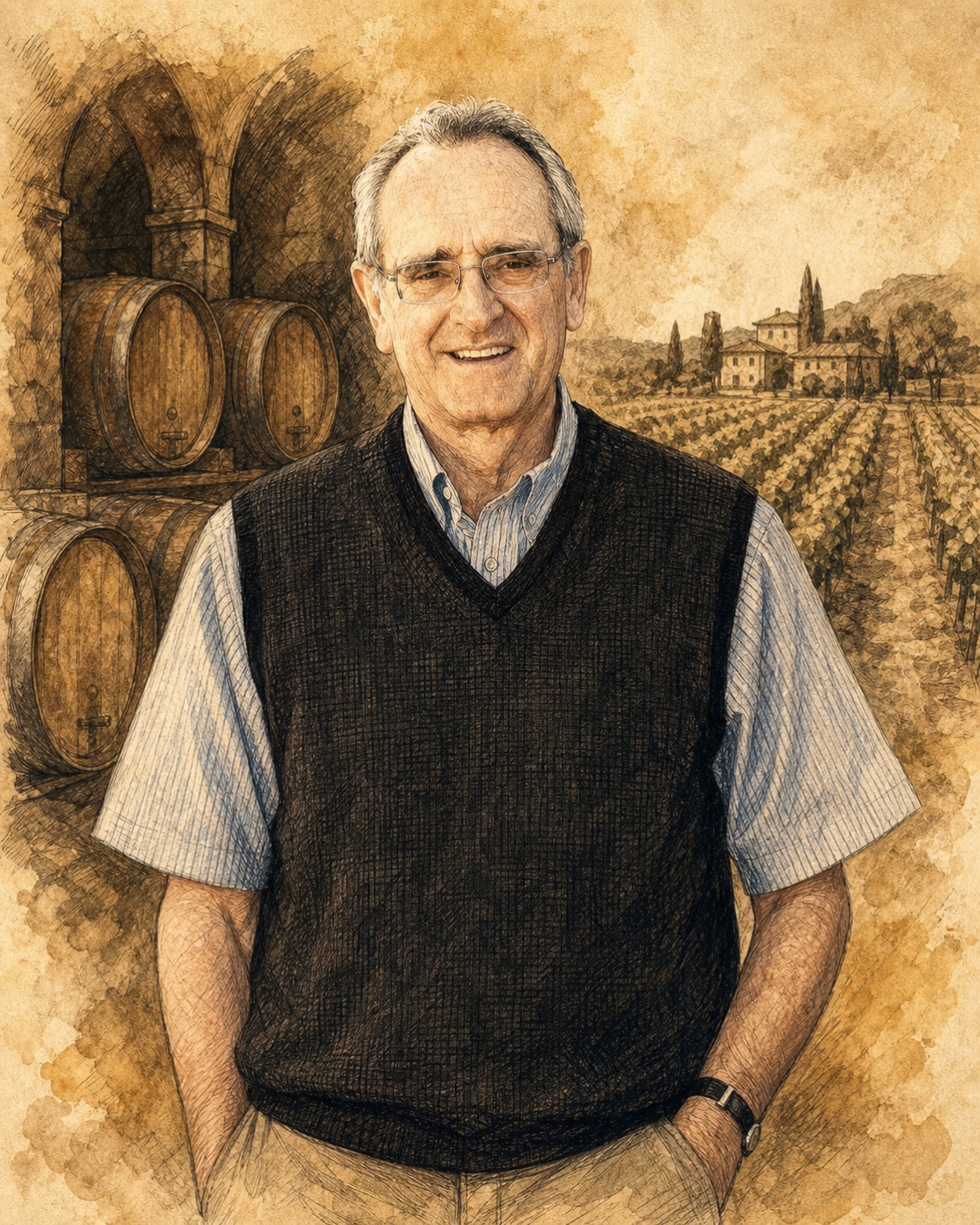
Jean-Claude Berrouet joined Établissements Jean-Pierre Moueix in 1964 and became the technical mind behind decades of Right Bank wines, most famously Pétrus. His long tenure prized measured extraction, aromatic clarity, and the supple depth of Merlot rather than cellar spectacle.
He also helped shape Dominus in Napa Valley, translating a restrained Bordeaux sensibility to a different climate, and remained active through family properties and advisory work after leaving his full-time Moueix role. His influence is easiest to see in wines that gain authority without shouting.
Beyond one bottle
Why the work mattered
Berrouet’s influence is a defence of proportion and site identity in Merlot-led wines, passed on through colleagues, family and consulting. It offers a counterexample to the assumption that greater extraction must mean greater quality. His philosophy still involves technical decisions; modesty is not an absence of skill or intervention.
What they changed
Merlot without caricature
Depth, perfume, and longevity displaced the idea that softness is the grape’s only virtue.
Gentle extraction as precision
Tannin management pursued detail and persistence rather than maximal force.
A Bordeaux–Napa bridge
Dominus showed how an intellectual framework could travel while site and climate remained distinct.
Follow the work
Wineries and working relationships
This records named Moueix responsibilities, family properties and a documented Californian consultancy. His international consulting extended further; it is not a complete client register. Comparisons with neighbouring wines do not establish employment.
Établissements Jean-Pierre Moueix — Pétrus, Trotanoy, Magdelaine
From 1964; retirement transition 2007–2008
Technical director / winemakerOversight across an estate portfolio, not only Pétrus.
Dominus Estate
From the early 1980s
Technical / winemaking collaboratorWorked with Christian Moueix on the Napa project.
Vieux Château Saint-André
Acquired 1979
Family proprietor and winemakerPersonal Montagne Saint-Émilion estate, later developed with his sons.
Château Samion
Family background and later family portfolio
Family winery connectionDistinct from his employer’s Pomerol estates.
Twomey
Appointed 2012
Consulting winemakerWorked with Daniel Baron on Merlot.
History reviewed . Roles and ownership may have changed.
Representative bottles
Where to meet the idea
- Pétrus
The celebrated Pomerol whose long Berrouet era made Merlot’s depth and longevity globally visible.
- Vieux Château Certan
A neighbouring Pomerol comparison, not a Berrouet employment credit; Cabernet Franc and Cabernet Sauvignon complicate the Merlot story.
- Dominus
The Napa counterpart for studying restraint, Cabernet structure, and cross-Atlantic adaptation.
Study the signature
Turn the biography into a tasting.
Begin with Pétrus, then place it beside Vieux Château Certan when the opportunity allows. The point is not to crown a winner; it is to notice which choices remain legible across price, age, vineyard, and vintage.
Follow three linked ideas as you taste: merlot without caricature, gentle extraction as precision, a bordeaux–napa bridge. Write down the evidence you can actually perceive, then return to the producer’s history and ask which part of the story the glass supports—and which part belongs to reputation.
No single cellar figure solely authors estates as complex as Pétrus or Dominus. Ownership, vineyards, teams, and successive generations matter.