
The Scharzhofberg custodian
Egon Müller IV
Before the reputation
How they found wine
Müller grew up with a celebrated family Riesling estate and trained at Geisenheim before assuming management in 1991. He is the fourth Egon but belongs to a longer family succession; the number in his name is not the number of generations of the business. His father remained involved until his death in 2001.
The challenge was to take responsibility for a highly distinctive style rather than replace it for the sake of novelty. Partnerships in Slovakia and Australia later created a useful contrast with the Saar: the same professional could engage with dry Riesling in different climates while preserving Scharzhof’s own identity. A family inheritance became a basis for comparison, not a closed world.
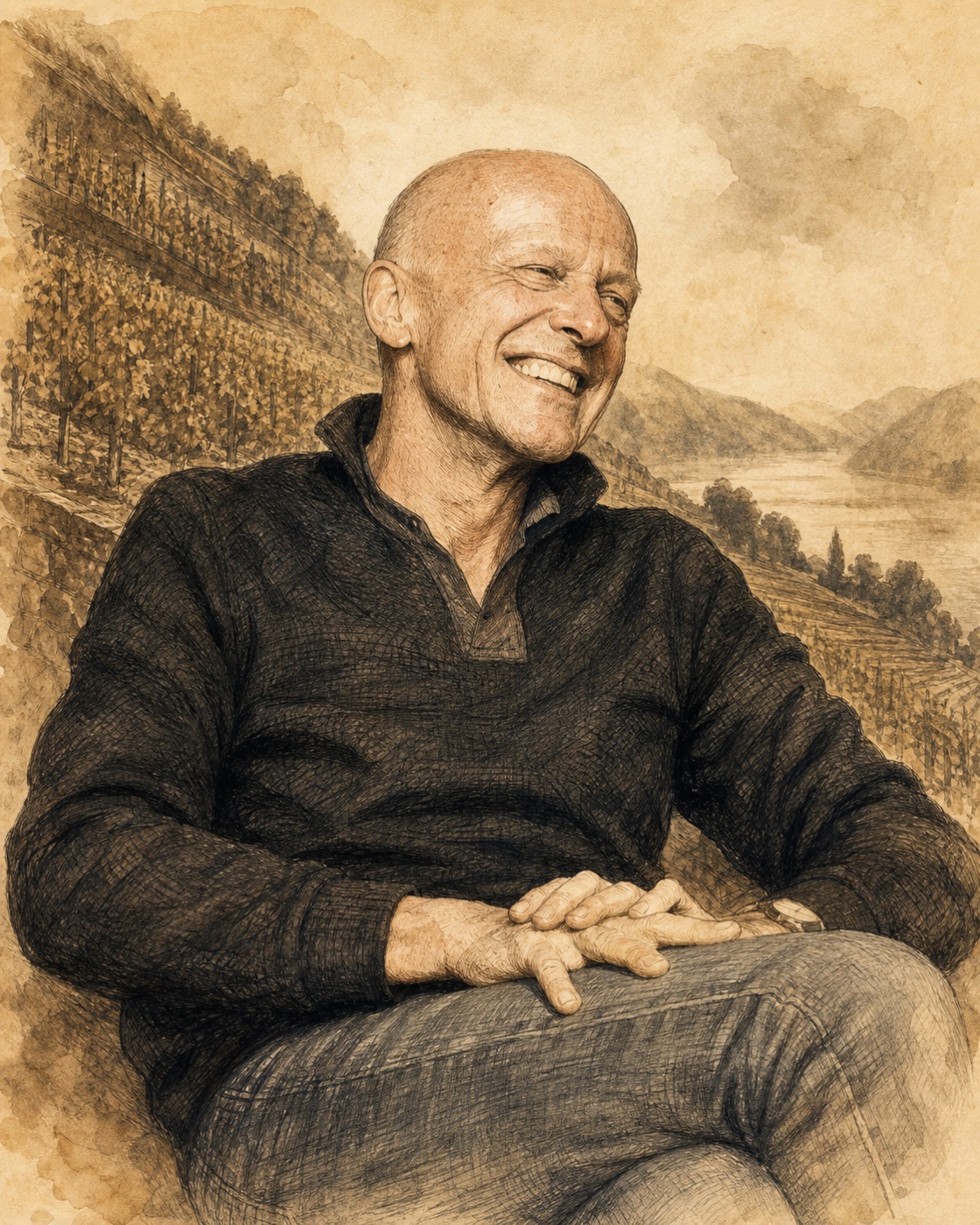
Egon Müller IV took responsibility for the family estate in 1991, continuing a line centered on the Scharzhofberg, a cool, steep Saar vineyard with an extraordinary reputation for Riesling. The estate’s wines range from dry and off-dry expressions to Kabinett, Spätlese, Auslese, and minute quantities selected by noble rot.
His work protects a style built on low yields, selective harvesting, and startling tension between sweetness, acidity, extract, and mineral impression. The estate demonstrates that sweetness level is not a quality ladder: precision and site can remain legible at many must weights.
Beyond one bottle
Why the work mattered
His influence is principally the preservation of a demanding benchmark for Riesling and the demonstration that expertise can travel through partnerships. The international wines do not reproduce the Saar, and their dry styles should not be confused with every Scharzhof bottling. Continuity can matter to an industry without being described as invention.
What they changed
One vineyard as a lifetime study
Repeated attention to Scharzhofberg turns vintage variation into knowledge rather than inconsistency.
Sweetness held by structure
Acidity and extract make residual sugar one component of shape, not the whole identity.
Selection at extreme resolution
Multiple passes through the vineyard sort ripeness and botrytis into distinct, tiny lots.
Follow the work
Wineries and working relationships
Lists the named estate and international partnerships. Family ownership arrangements are distinct from personal day-to-day winemaking duties.
Egon Müller–Scharzhof
Management from 1991
Family manager / proprietorPrincipal Saar estate, with a long family history.
Le Gallais
Family interest acquired 1954, before his management
Family estate / operating connectionWiltinger Braune Kupp connection; inherited involvement, not his original acquisition.
Château Belá, Slovakia
Later international venture; dates not asserted
Partner / collaborating winemakerWorks with Miroslav Petrech, whose own cellar responsibility matters.
Kanta, Adelaide Hills
Australian project; dates not asserted
Collaborating winemakerPartnership with Michael Andrewartha, focused on dry Riesling.
History reviewed . Roles and ownership may have changed.
Representative bottles
Where to meet the idea
- Scharzhofberger Riesling Kabinett
A light-footed expression where low alcohol, sweetness, acidity, and slate tension meet.
- Scharzhofberger Riesling Spätlese
More ripeness and depth without abandoning the vineyard’s cool line.
- Scharzhofberger Riesling Trockenbeerenauslese
An exceptionally rare limit case in concentration, botrytis selection, and price.
Study the signature
Turn the biography into a tasting.
Begin with Scharzhofberger Riesling Kabinett, then place it beside Scharzhofberger Riesling Spätlese when the opportunity allows. The point is not to crown a winner; it is to notice which choices remain legible across price, age, vineyard, and vintage.
Follow three linked ideas as you taste: one vineyard as a lifetime study, sweetness held by structure, selection at extreme resolution. Write down the evidence you can actually perceive, then return to the producer’s history and ask which part of the story the glass supports—and which part belongs to reputation.
Auction prices and rare predicates dominate headlines, but the estate’s achievement is broader. Do not make rarity the measure of Scharzhofberg.