
The chosen Burgundian
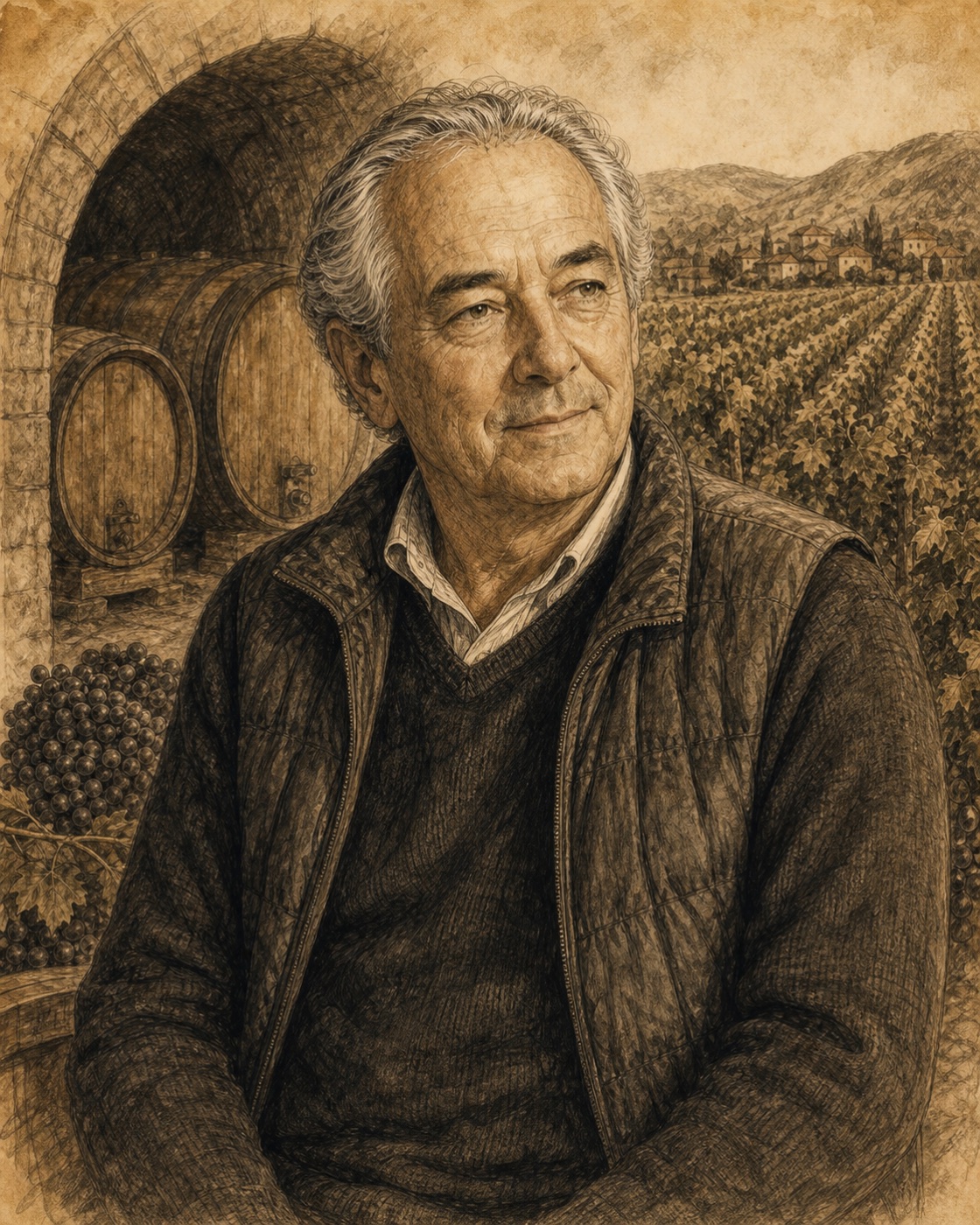
Jacques Seysses
Before the reputation
How they found wine
Seysses came to wine from outside Burgundy’s farming families. His father’s enthusiasm for food and fine bottles introduced him to growers early, but his initial work was in the family biscuit business. At twenty-five he left business life to learn winemaking with Gérard Potel at La Pousse d’Or during the 1966 and 1967 harvests.
He bought Domaine Graillet in Morey-Saint-Denis in 1968 and renamed it Dujac, a contraction of ‘du Jacques’. The move combined access to capital with a genuine apprenticeship. Building a domaine then meant improving the wines and finding customers, not simply placing a new name over an already famous bottle.
Jacques Seysses left his family business, trained at Domaine de la Pousse d’Or, and bought a small Morey-Saint-Denis estate in 1968. Renamed Domaine Dujac—‘du Jacques’—it became known for perfume, texture, whole-cluster fermentation, and thoughtful use of new oak.
With Rosalind Seysses and later their children, he built a family domaine where adaptation rather than dogma governed technique. Vineyard acquisitions and early moves toward integrated and organic practice expanded the original five-hectare project.
Beyond one bottle
Why the work mattered
Dujac became an influential example of an outsider building a Burgundian estate around site, whole-bunch fermentation and patient development. Its success widened the conversation about stems and perfume rather than settling one correct Pinot Noir method. The later Triennes partnership showed that the same curiosity could travel beyond Burgundy.
What they changed
Whole clusters with finesse
Stems became a structural and aromatic tool rather than a rule applied regardless of vintage.
A domaine built by vocation
His outsider path helped model how careful learning and long stewardship can establish legitimacy.
Generational continuity
Dujac made succession part of the work, not an abrupt change of signature.
Follow the work
Wineries and working relationships
Dujac’s 1968 founding date follows the domaine’s own account. Its later family and négociant activities should not all be attributed personally to Jacques.
La Pousse d’Or
Harvests 1966 and 1967
Apprentice with Gérard PotelPractical preparation before buying his own estate.
Domaine Dujac, formerly Graillet
1968
FounderDeveloped with Rosalind Seysses and later the next generation.
Domaine de Triennes
1989
Co-founder / partnerProvence project with Aubert de Villaine and Michel Macaux.
History reviewed . Roles and ownership may have changed.
Representative bottles
Where to meet the idea
- Dujac Clos de la Roche
A flagship grand cru for examining whole-cluster perfume, structure, and ageing.
- Morey-Saint-Denis or Morey-Saint-Denis 1er Cru
More accessible hierarchy levels that still show the domaine’s handling and village identity.
Study the signature
Turn the biography into a tasting.
Begin with Dujac Clos de la Roche, then place it beside Morey-Saint-Denis or Morey-Saint-Denis 1er Cru when the opportunity allows. The point is not to crown a winner; it is to notice which choices remain legible across price, age, vineyard, and vintage.
Follow three linked ideas as you taste: whole clusters with finesse, a domaine built by vocation, generational continuity. Write down the evidence you can actually perceive, then return to the producer’s history and ask which part of the story the glass supports—and which part belongs to reputation.
Dujac’s style is a family and team achievement. Reducing it to ‘whole cluster’ ignores farming, selection, élevage, and vintage judgment.