
The tradition provocateur
Angelo Gaja
Before the reputation
How they found wine
Angelo Gaja inherited an established Barbaresco business, not an empty landscape. His father Giovanni and grandmother Clotilde Rey had already built a culture of demanding standards. Joining the family firm in 1961, he encountered the tension that would define his career: how far could a producer change methods without losing the identity that made the wines worth making?
Travel and comparison with international fine wine encouraged experiments in vineyard management, barrel use and varieties. Expansion into Tuscany and later Etna made the argument larger than one cellar. The family name became a bridge between Piedmont’s Nebbiolo tradition and new projects with different grapes, climates and partners.
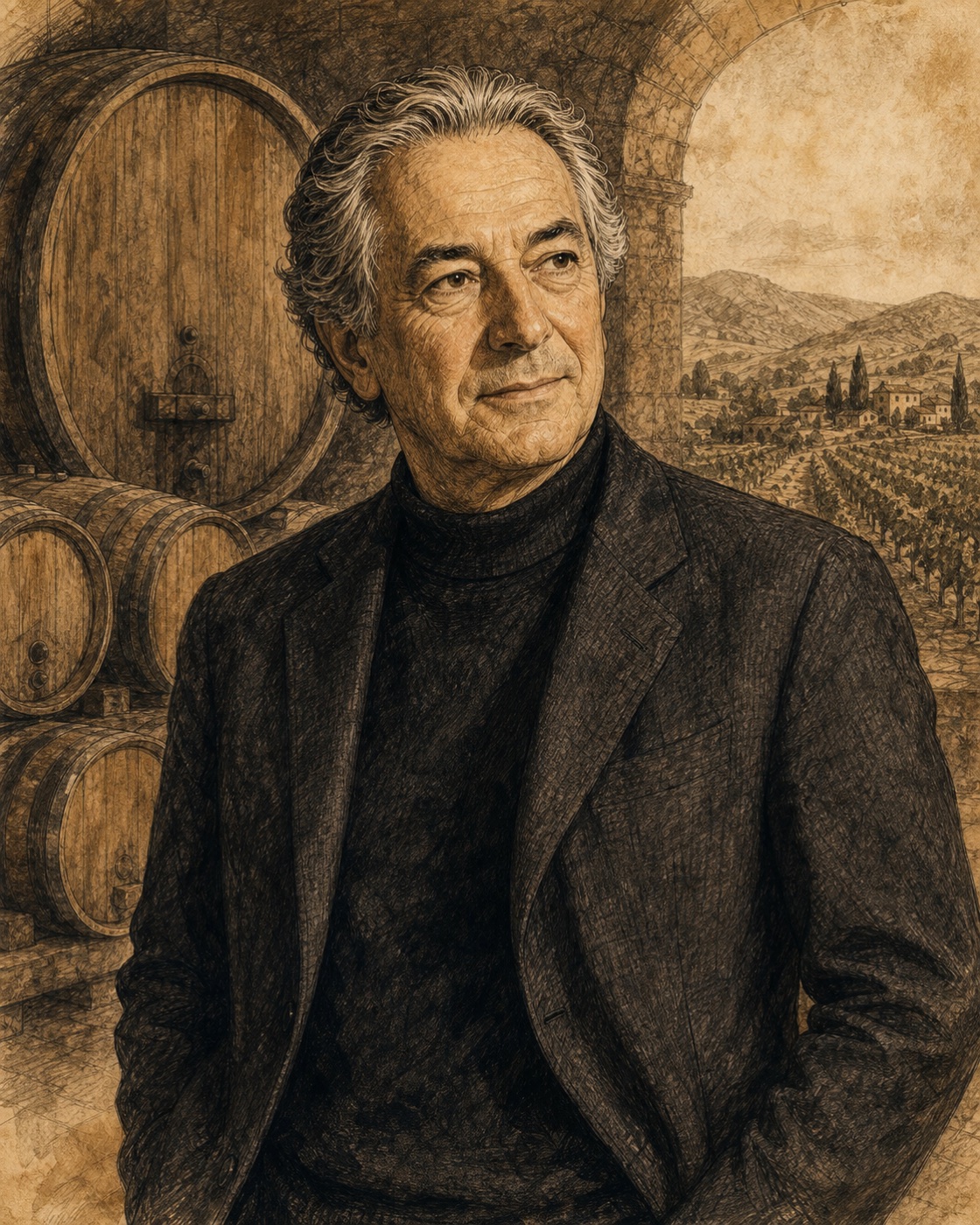
Angelo Gaja joined his family’s Barbaresco estate in 1961 and pushed Piedmontese wine into international fine-wine conversation. He paired lower yields and estate bottling with temperature control, small French oak, longer corks, single-vineyard wines, and relentless global communication.
Some choices angered traditionalists, including international varieties and the temporary declassification of famous Nebbiolo wines. Yet the objective was not to abandon Barbaresco; it was to make the world pay attention to its capacity.
Beyond one bottle
Why the work mattered
Gaja helped raise the international ambition and visibility of Italian estate wine. His importance was not inventing quality in Barbaresco, which had a long history, but challenging what growers could attempt and what buyers would take seriously. The later estates show that the same family’s standards need not mean an identical recipe everywhere.
What they changed
Barbaresco as an icon
Estate-grown Nebbiolo and single-vineyard bottlings raised the denomination’s visibility and price ceiling.
Selective modernisation
Barriques and temperature control entered a dialogue with long maceration, large casks, and indigenous grapes.
Expansion with a thesis
Projects in Montalcino, Bolgheri, and Etna applied the family’s precision to different Italian places.
Follow the work
Wineries and working relationships
Lists the principal family estate ventures. Family members and resident winemaking teams share responsibility; this is not a claim that Angelo personally made every wine.
Gaja, Barbaresco / Barolo
Joined 1961
Family proprietorHome of the family’s Piedmont wines; individual vineyard labels are not separate employers.
Pieve Santa Restituta
1994
Acquiring proprietorMontalcino estate and the family’s first expansion outside its Piedmont base.
Ca’ Marcanda
1996
Founder / proprietorBolgheri venture focused on a different Tuscan landscape and grape palette.
Idda
From 2017
Joint-venture founder with Alberto GraciEtna collaboration with a local producer; distinct from ownership of Graci’s entire winery.
History reviewed . Roles and ownership may have changed.
Representative bottles
Where to meet the idea
- Gaja Barbaresco
The estate’s foundational argument for Nebbiolo and Barbaresco as a complete fine wine.
- Sorì San Lorenzo, Sorì Tildìn, or Costa Russi
Single-vineyard wines that make parcel distinction—and market hierarchy—easy to discuss.
Study the signature
Turn the biography into a tasting.
Begin with Gaja Barbaresco, then place it beside Sorì San Lorenzo, Sorì Tildìn, or Costa Russi when the opportunity allows. The point is not to crown a winner; it is to notice which choices remain legible across price, age, vineyard, and vintage.
Follow three linked ideas as you taste: barbaresco as an icon, selective modernisation, expansion with a thesis. Write down the evidence you can actually perceive, then return to the producer’s history and ask which part of the story the glass supports—and which part belongs to reputation.
The ‘modernist versus traditionalist’ story is too tidy. Gaja’s methods and classifications have changed over time, while many supposedly traditional peers also evolved.