
The Sauvignon dissenter
Didier Dagueneau
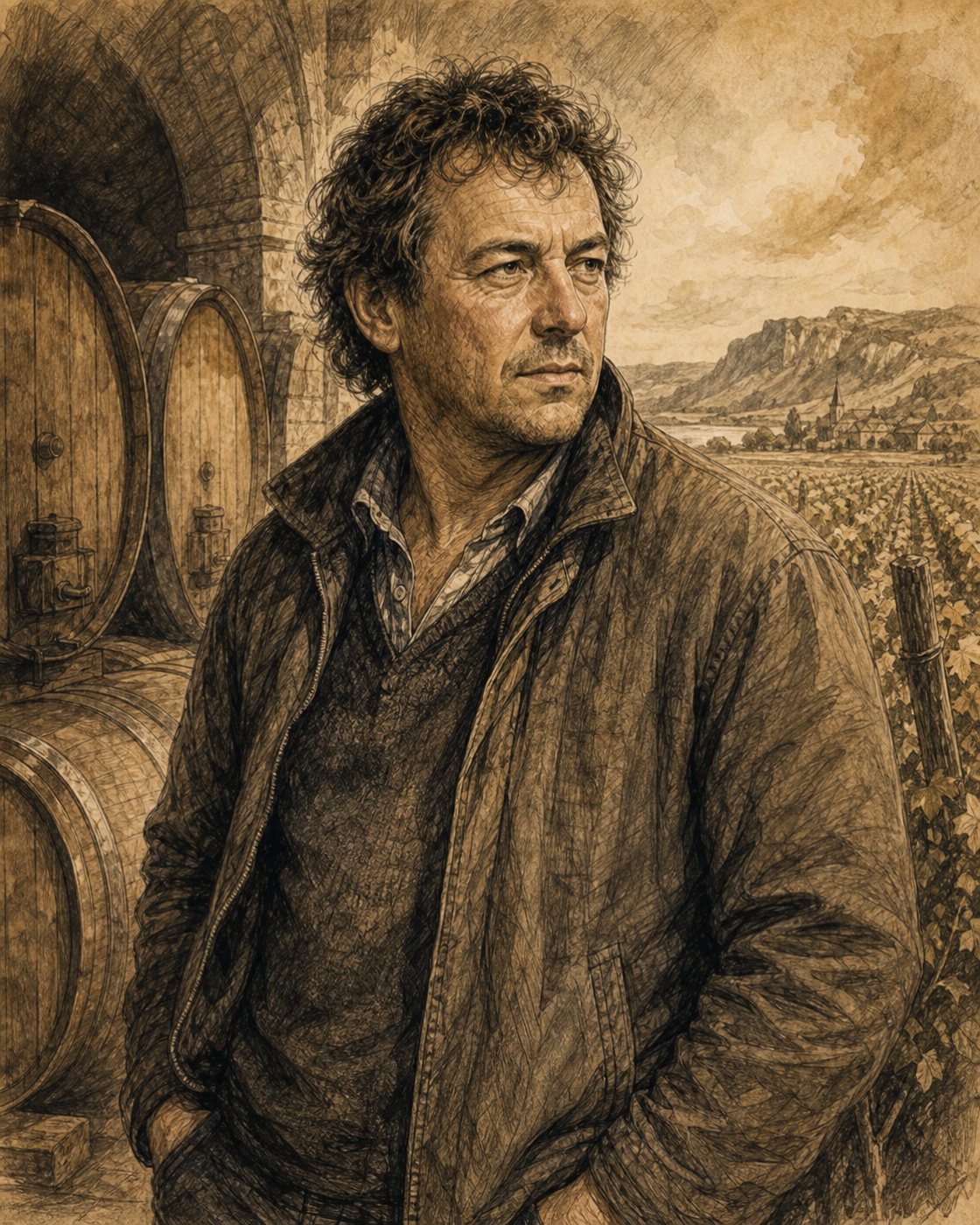
Before the reputation
How they found wine
Dagueneau did not arrive at his own domaine by a conventional degree-to-cellar route. He came from a Loire winegrowing family but spent part of his early adult life racing motorcycles before establishing his own production in Saint-Andelain in the early 1980s. That background became part of the public image of an impatient outsider within his own region.
The substance behind the image was labour: demanding vineyard work, low yields and increasingly specific bottlings of Sauvignon Blanc. He treated a familiar grape as material for ambitious, ageworthy wine. Work in Jurançon later gave that same restless curiosity a different setting and the very different Petit Manseng grape.
Didier Dagueneau founded his Pouilly-Fumé estate in 1982 and refused to accept that Sauvignon Blanc had to be simple or short-lived. Low yields, obsessive vineyard work, parcel selection, and distinctive barrels produced dense, ageworthy wines with a cult following.
He was outspoken and experimental, yet his most durable argument was in the bottle: Sauvignon Blanc could carry site, texture, and long development without relying on obvious varietal aroma.
Beyond one bottle
Why the work mattered
His wines challenged the idea that Sauvignon Blanc should always be a simple, immediately aromatic drink. Vineyard-specific bottlings and ambitious prices forced attention onto site and texture. He amplified an existing Loire tradition through unusually exacting work; the motorcycle image does not explain quality on its own.
What they changed
Ageworthy Sauvignon Blanc
Concentration, lees work, and disciplined élevage expanded expectations for Pouilly-Fumé.
Parcel hierarchy
Cuvées such as Silex and Pur Sang gave different soils and sites distinct identities.
Productive dissent
His refusal to flatter the appellation forced attention back onto farming and standards.
Follow the work
Wineries and working relationships
Later wines are the work of successor teams. Silex and Pur Sang are cuvées, not employers; the list does not assert an exhaustive account of informal collaborations.
Domaine Didier Dagueneau
Early 1980s–2008
Founder / grower-winemakerSaint-Andelain base for his Pouilly-Fumé and other Loire bottlings.
Les Jardins de Babylone
2000s
Co-founder / collaboratorJurançon project with Guy Pautrat; distinct from the Loire domaine’s vineyard sites.
History reviewed . Roles and ownership may have changed.
Representative bottles
Where to meet the idea
- Silex
The flagship, associated with flinty soils, powerful texture, and long ageing.
- Pur Sang
A contrasting Sauvignon Blanc that is often a clearer practical entry into the domaine’s style.
Study the signature
Turn the biography into a tasting.
Begin with Silex, then place it beside Pur Sang when the opportunity allows. The point is not to crown a winner; it is to notice which choices remain legible across price, age, vineyard, and vintage.
Follow three linked ideas as you taste: ageworthy sauvignon blanc, parcel hierarchy, productive dissent. Write down the evidence you can actually perceive, then return to the producer’s history and ask which part of the story the glass supports—and which part belongs to reputation.
‘Flinty’ aroma is not powdered silex entering the wine. Treat rock-to-flavour claims cautiously and describe the sensation before the geology.