
The modern oenologist
Émile Peynaud
Before the reputation
How they found wine
Peynaud entered the Bordeaux trade at fifteen at Maison Calvet. His early work with Jean Ribéreau-Gayon involved analysing wines before purchase: the laboratory answered a practical merchant’s question about what was in the barrel. That connection between measurement and judgement remained central to his career.
He completed a doctorate in 1946 and joined the University of Bordeaux, building a route between research, teaching and advice to producers. Rather than inheriting one vineyard and perfecting its house style, he spent his career confronting recurring production problems across estates. The decisive origin story is a young trade employee becoming a scientist whose classroom extended into working cellars.
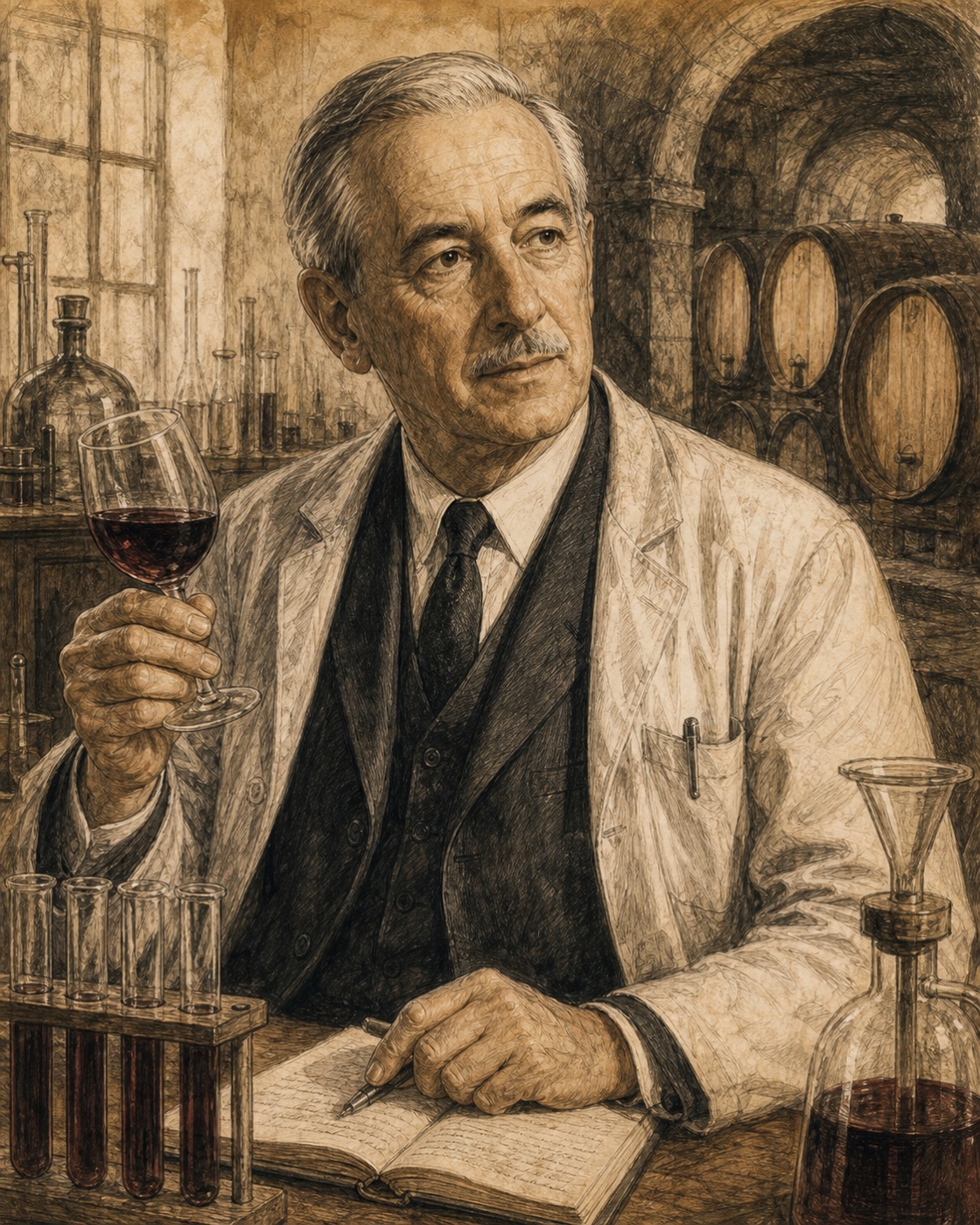
Émile Peynaud joined laboratory science to the decisions of harvest and cellar, explaining why fermentation, oxygen, temperature, and microbial activity changed wine. As a Bordeaux professor and consultant, he trained generations to replace vague habit with observation and trials.
His advice included picking physiologically ripe fruit, rejecting unsound grapes, controlling fermentation temperatures, and managing malolactic fermentation. He also treated tasting as a discipline that could be taught rather than a performance of instinct.
Beyond one bottle
Why the work mattered
Peynaud helped replace acceptance of avoidable faults with an expectation of sound, clean wine. His influence lay in explaining ripeness, fermentation and tasting systematically and spreading that knowledge through students and consulting. This was a network of research and practical adoption; it should not be mistaken for one person inventing modern winemaking from nothing.
What they changed
Diagnosis before remedy
Laboratory analysis and sensory observation helped identify causes instead of merely treating symptoms.
Riper, cleaner Bordeaux
Harvest timing, selection, temperature control, and oxygen management supported more consistent red wine.
Tasting as method
Structured comparison became part of professional education and decision-making.
Follow the work
Wineries and working relationships
Peynaud advised dozens of properties at once and worked internationally. These named clients supplement his institutional career; no complete private consultancy register is available in the linked sources.
Maison Calvet
From age fifteen
Trade employee and wine-analysis workWorked with Jean Ribéreau-Gayon on analysis supporting wine purchases.
University of Bordeaux
From 1946
Researcher, teacher and consultantAn institutional base for work with many producers, not itself a commercial wine estate.
Château Margaux · Léoville Las Cases · Lagrange · Pontet-Canet
Still advising these estates in 1990
Consulting oenologistNamed clients in his obituary, with their own estate teams.
Marqués de Cáceres
Founding era around 1970
Adviser to founder Enrique FornerHelped bring Bordeaux production ideas to the new Rioja project.
Prieuré-Lichine
Alexis Lichine ownership era; exact years unspecified
Technical adviserAdvised on vat selection alongside Patrick Léon.
History reviewed . Roles and ownership may have changed.
Representative bottles
Where to meet the idea
- Mature post-war Bordeaux
His influence crosses estates, so a comparative flight is more instructive than one label.
- Château Margaux or Léoville Las Cases from his consulting era
Representative contexts for studying ripeness, selection, and controlled élevage.
Study the signature
Turn the biography into a tasting.
Begin with Mature post-war Bordeaux, then place it beside Château Margaux or Léoville Las Cases from his consulting era when the opportunity allows. The point is not to crown a winner; it is to notice which choices remain legible across price, age, vineyard, and vintage.
Follow three linked ideas as you taste: diagnosis before remedy, riper, cleaner bordeaux, tasting as method. Write down the evidence you can actually perceive, then return to the producer’s history and ask which part of the story the glass supports—and which part belongs to reputation.
‘Father of modern oenology’ is a shorthand. Peynaud worked inside a broad research culture, and modernisation could sometimes narrow stylistic diversity as well as reduce faults.