
The Teroldego revivalist
Elisabetta Foradori
Before the reputation
How they found wine
Foradori’s father died while she was a child, leaving the family estate facing a difficult succession. She took responsibility in 1984 after training, still very young. Teroldego was an inherited local resource, but its reputation did not automatically give the business a secure future. Her early work sought a style that could make buyers take the grape seriously.
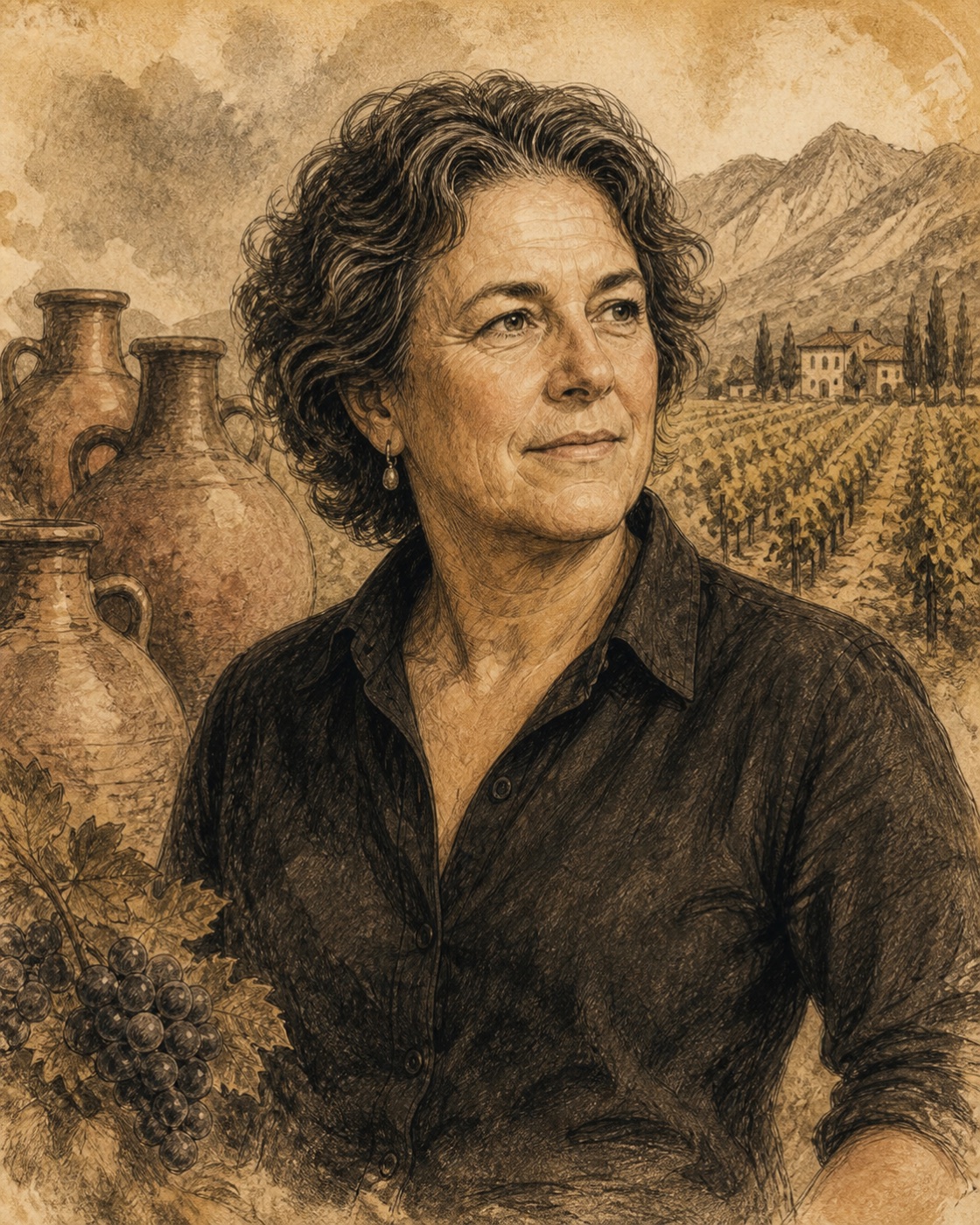
She later reconsidered aspects of that success. In a first-person interview she describes two phases: establishing the estate’s viability, then moving toward biodynamic farming from around 2000. Clay vessels and more detailed vineyard expression belong to that continuing reassessment. The story is not one unchanging philosophy discovered at nineteen, but a grower willing to revise her own approach.
Elisabetta Foradori took responsibility for her family estate while still very young and made the local Teroldego grape the center of a searching career. Selection within the vineyards and the flagship Granato helped recover quality and genetic diversity at a moment when clonal standardization threatened to narrow the variety.
The estate later moved toward biodynamic farming, detailed parcel work in Campo Rotaliano, and fermentation or ageing in clay tinajas. With the next generation now deeply involved, Foradori’s legacy connects grape recovery, living soils, vessels, and family succession rather than a single signature technique.
Beyond one bottle
Why the work mattered
Foradori helped recover the ambition and diversity within Teroldego, then connected that work to a broader agricultural system. Her influence extends through Ampeleia and the people she has worked with, including Marco Tait. Biodynamic claims should be distinguished from the documented decisions and from what a tasting can actually establish.
What they changed
Teroldego recovered from within
Massal selection and old material protected diversity while raising the grape’s fine-wine ambition.
Tinaja as a transparent vessel
Clay offered gentle extraction and oxygen exchange without adding barrel flavour.
Biodynamics as a farm system
Soil, animals, preparations, biodiversity, and observation became linked parts of estate practice.
Follow the work
Wineries and working relationships
Foradori and Ampeleia are distinct projects. Granato, Morei and Fontanasanta are wine or site names; they should not inflate the winery count.
Foradori
Took over 1984
Family proprietor and winemakerTrentino estate, later shared with the next generation.
Ampeleia
Founded 2002
Co-founder / guiding collaboratorMaremma venture with Giovanni Podini and Thomas Widmann; Marco Tait has led the practical winery work from its beginning.
History reviewed . Roles and ownership may have changed.
Representative bottles
Where to meet the idea
- Foradori Granato
The ageworthy Teroldego flagship that announced the grape’s serious potential.
- Foradori Morei Teroldego
A clay-raised parcel wine whose name points to the vineyard’s dark soils.
- Foradori Fontanasanta Nosiola
A local white variety that broadens the estate story beyond Teroldego.
Study the signature
Turn the biography into a tasting.
Begin with Foradori Granato, then place it beside Foradori Morei Teroldego when the opportunity allows. The point is not to crown a winner; it is to notice which choices remain legible across price, age, vineyard, and vintage.
Follow three linked ideas as you taste: teroldego recovered from within, tinaja as a transparent vessel, biodynamics as a farm system. Write down the evidence you can actually perceive, then return to the producer’s history and ask which part of the story the glass supports—and which part belongs to reputation.
Do not attribute every current wine solely to Elisabetta; Foradori is now a multigenerational agricultural and cellar team.