
The cellar problem-solver
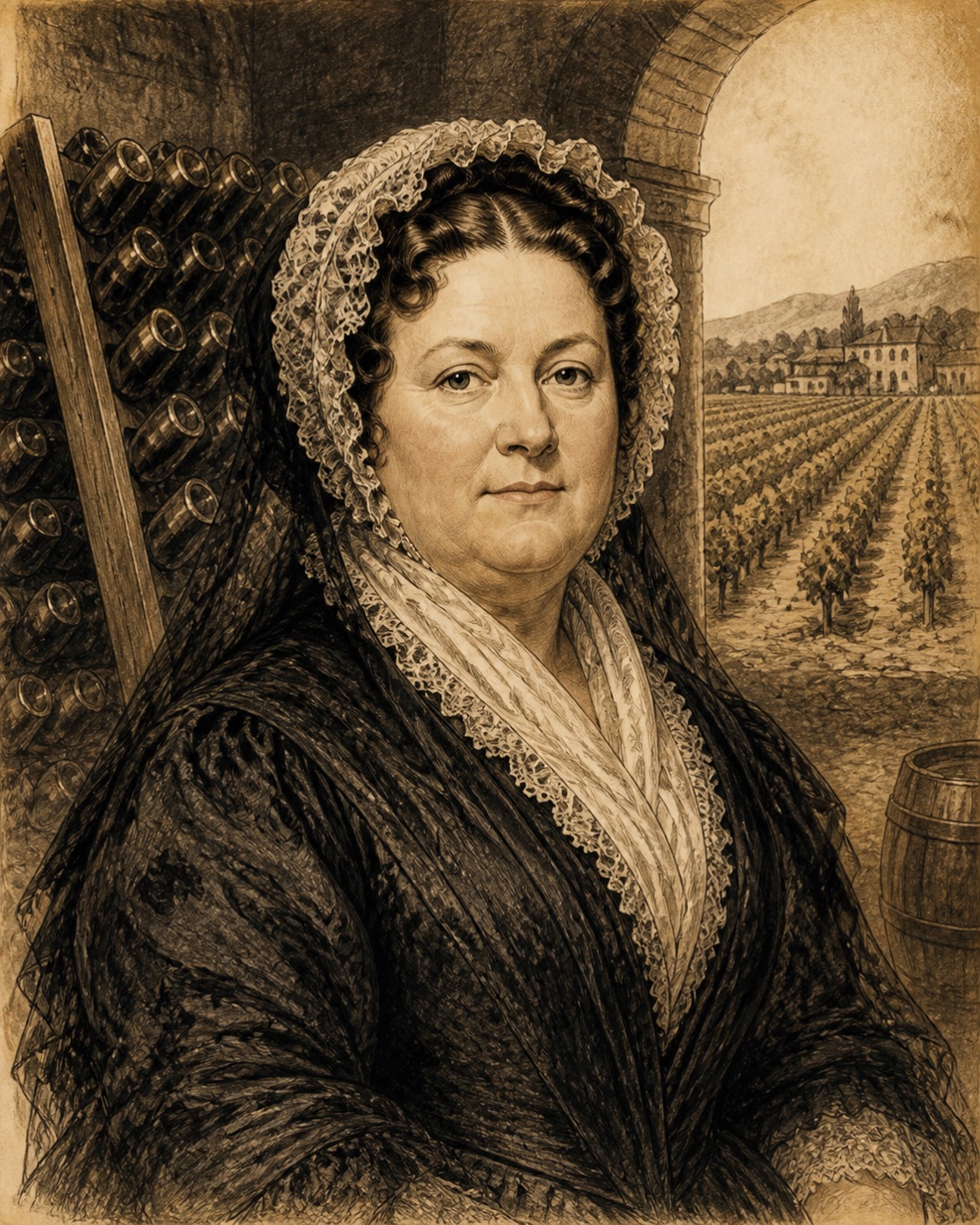
Barbe-Nicole Clicquot
Before the reputation
How they found wine
Barbe-Nicole Ponsardin grew up in Reims in a prosperous textile-trading family. Her 1798 marriage to François Clicquot joined two business families; wine was one activity within the Clicquot enterprise. She did not enter the story as a trained cellar technician. When François died in 1805, she chose to keep the wine business going, securing her father-in-law’s backing in a trade where women rarely held that authority.
Her challenge was brutally practical: make a reliable product and get it to customers during European wars. The familiar widow’s name on the label records that business decision. Her partnership with cellar workers and agents matters as much as the image of a solitary inventor.
Widowed at 27, Barbe-Nicole Ponsardin Clicquot took control of her husband’s wine business in 1805 and built it into an international Champagne house. Her achievement was commercial as well as technical: she pursued difficult export markets while wars and blockades made trade perilous.
The house credits her with the first known vintage Champagne in 1810, the riddling table in 1816, and the first blended rosé Champagne in 1818. Riddling concentrated spent yeast in the neck so it could be removed, making clear sparkling wine reproducible at scale.
Beyond one bottle
Why the work mattered
Her influence connected a cellar bottleneck to a business opportunity. Concentrating yeast sediment made disgorgement more efficient; clearer wine could reach more customers without the same labour burden. The resulting model linked technical consistency, export distribution and an identifiable house. Credit for riddling belongs in a collaborative history, not a claim that she invented sparkling wine.
What they changed
Riddling as a system
A slanted, perforated table let bottles be turned and gradually inverted so sediment collected near the closure before disgorgement.
Vintage and blending choices
She treated year, reserve stocks, red-wine blending, and house style as deliberate tools rather than incidental outcomes.
A global luxury house
Technical clarity, memorable packaging, and determined exports helped define the modern Champagne business.
Follow the work
Wineries and working relationships
The documented winery career is concentrated in the Clicquot business. La Grande Dame is a later commemorative cuvée, not another estate she founded.
Clicquot family wine business / Veuve Clicquot
Marriage in 1798; took control in 1805
Family business participant; proprietor after widowhoodBuilt the Champagne operation with cellar and commercial colleagues; the later house name preserves her role as widow-proprietor.
History reviewed . Roles and ownership may have changed.
Representative bottles
Where to meet the idea
- Veuve Clicquot Yellow Label
The non-vintage house style: Pinot Noir structure, reserve-wine continuity, and the practical legacy of blending.
- Veuve Clicquot Vintage
A useful contrast when the house decides one harvest has a story worth isolating.
- La Grande Dame
The prestige cuvée created in her honour; compare its refinement and Pinot-led shape with Yellow Label.
Study the signature
Turn the biography into a tasting.
Begin with Veuve Clicquot Yellow Label, then place it beside Veuve Clicquot Vintage when the opportunity allows. The point is not to crown a winner; it is to notice which choices remain legible across price, age, vineyard, and vintage.
Follow three linked ideas as you taste: riddling as a system, vintage and blending choices, a global luxury house. Write down the evidence you can actually perceive, then return to the producer’s history and ask which part of the story the glass supports—and which part belongs to reputation.
Popular accounts turn one person into the sole inventor of a process. The milestones matter, but Champagne developed through growers, cellar workers, merchants, glassmakers, and earlier experiments.