
A national ban with exceptions
Commercial production collapsed, yet sacramental and medicinal permits, household production, grape shipping, and illegal markets prevented a simple dry-versus-wet story.
1919–1980 · United States
National Prohibition dismantled legal wine commerce but left exceptions and workarounds; repeal began a long scientific, agricultural, cultural, and entrepreneurial rebuilding.
The period in context
The Eighteenth Amendment and National Prohibition Act prohibited manufacture, sale, and transport of intoxicating liquor nationally. The reality was complicated by sacramental, medicinal, and household exceptions, illegal trade, enforcement differences, and a booming market for grapes shipped to home winemakers.
Repeal in 1933 did not restore lost wineries, skills, equipment, distribution, or consumer culture overnight. Universities, agricultural extension, immigrant knowledge, surviving firms, new producers, growers, marketers, restaurants, and changing tastes rebuilt the system across several states.
Historical geography
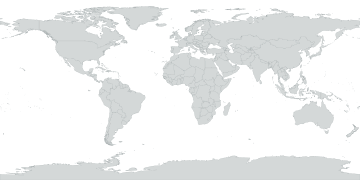
The markers locate the principal places discussed here. Modern country borders are orientation aids, not period boundaries.
 1234
1234The working system
Commercial production collapsed, yet sacramental and medicinal permits, household production, grape shipping, and illegal markets prevented a simple dry-versus-wet story.
Growers favoured thick-skinned grapes able to travel by rail to distant home winemakers, often at the expense of varieties prized for fine table wine.
UC Davis and other institutions joined viticulture and enology, tested varieties and clones, improved sound production, and trained a new technical workforce.
California led in scale and visibility, but New York, Missouri, Virginia, Oregon, Washington, and other states developed their own postwar paths.
Dated sequence
The Eighteenth Amendment is ratified.
National Prohibition takes effect under the enforcement structure of the Volstead Act.
The Twenty-first Amendment is ratified, repealing national Prohibition and returning major authority to states.
UC Davis establishes its modern Department of Viticulture and Enology on the Davis campus.
Technical improvement, new wineries, changing food culture, and national marketing expand demand for American table wine.
The Paris blind tasting gives California wines a widely publicised symbol of international competitiveness.
Actors
Maintained table-wine traditions and a legal grape market through the dry years.
Mobilised political opposition to Prohibition, including the Women’s Organization for National Prohibition Reform.
Built post-repeal research, teaching, sensory science, and extension capacity.
Examples of immigrant commerce, postwar entrepreneurship, education, and national marketing—not a single-handed revival.
Geography
Largest production centre and home to prominent research, vineyards, brands, and the most visible fine-wine revival.
Large immigrant consumer markets supplied by rail-shipped grapes during Prohibition.
Important pre-Prohibition and revival regions with native, hybrid, and vinifera histories.
Examples of the postwar geographic expansion beyond California.
Reading the record honestly
What survives in the glass
Modern American wine grew from rupture and reinvention: layered state laws, university science, national distribution, immigration, entrepreneurship, and an expanding idea of wine at the table.
Words to know
Keep digging
Sources are selected for primary evidence, institutional context, or scholarly synthesis. Historical interpretation remains open to revision.