
Climate adaptation
Growers alter sites, varieties, rootstocks, canopies, water strategy, harvest dates, fire planning, and insurance—within uneven legal and financial limits.
1980–today · A connected wine world
Climate, labour, science, low-intervention movements, revived vessels, logistics, law, data, and consumer culture now change one another in real time.
The period in context
The contemporary wine world is not a clean contest between tradition and technology. Temperature control, analytical chemistry, cultured and ambient fermentations, precision viticulture, concrete, amphorae, alternative packaging, mechanisation, hand work, global brands, and tiny growers coexist and borrow from one another.
Climate change shifts heat accumulation, harvest timing, water pressure, frost and fire risk, disease, suitable varieties, and where vines can grow. Adaptation is technical and political: access to land, capital, water, labour, research, insurance, and legal flexibility determines who can respond.
Historical geography
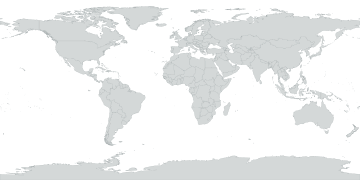
The markers locate the principal places discussed here. Modern country borders are orientation aids, not period boundaries.
 123456
The working system
Growers alter sites, varieties, rootstocks, canopies, water strategy, harvest dates, fire planning, and insurance—within uneven legal and financial limits.
Conventional, organic, biodynamic, regenerative, low-intervention, and technologically intensive approaches overlap more than marketing labels imply.
Consolidated distribution coexists with direct sales, tourism, clubs, online retail, social media, and hospitality. Regulation differs sharply by country and state.
Worker safety, migration, housing, wages, mechanisation, representation, and ownership are central to the ethics and resilience of wine regions.
Bottle weight, recycled glass, cans, kegs, bag-in-box, shipping distance, and winery energy now belong to quality and sustainability decisions.
Dated sequence
Temperature control, laboratory analysis, global consulting, and export growth spread more widely while regional styles diversify.
Organic, biodynamic, natural-wine, and revived-vessel movements gain new commercial and cultural visibility.
Direct-to-consumer sales, digital media, wine tourism, and data tools reshape discovery and producer economics.
Heat extremes, drought, fire, frost volatility, and altered harvest calendars make climate adaptation an immediate operating question.
Regions revise rules, trial varieties and rootstocks, reconsider packaging, and debate who benefits from wine’s value.
Actors
Carry out skilled adaptation and face direct exposure to heat, smoke, chemicals, seasonal insecurity, and mechanisation.
Balance biological risk, quality goals, debt, regulation, market access, and generational change.
Develop climate models, plant material, pest strategies, sensory methods, and practical guidance.
Decide whether new grapes, irrigation, alcohol levels, boundaries, and techniques fit protected identities.
Shape what reaches the market, what stories receive attention, and what production can remain viable.
Geography
Face heat, water, acidity, fire, and labour challenges while testing adaptation within valued identities.
May gain ripening potential but also face frost, rain, disease, and vintage volatility.
China, the United Kingdom, Japan, Canada, and others complicate a fixed Old World/New World map.
Consumption, education, restaurants, retail platforms, and culture can influence distant vineyards rapidly.
Reading the record honestly
What survives in the glass
The history in a glass now includes carbon, water, labour, logistics, packaging, data, fashion, law, and the deliberate revival of practices once considered obsolete.
Words to know
Keep digging
Sources are selected for primary evidence, institutional context, or scholarly synthesis. Historical interpretation remains open to revision.