
The house-style custodian
Peter Gago
Before the reputation
How they found wine
Gago spent eight years teaching chemistry and mathematics before moving into wine. In his own account, it was a growing immersion rather than a single miraculous bottle. Formal study at Roseworthy turned that interest into a professional route, and he joined Penfolds in 1989 working on sparkling wine.
He moved into red-wine work and became the fourth chief winemaker in 2002, succeeding John Duval. That origin gives his career a distinctive problem: how does a curious, technically trained person keep experimenting while caring for wines whose identities were established by predecessors? Grange was already famous; his task was to sustain its standards and make room for further work.
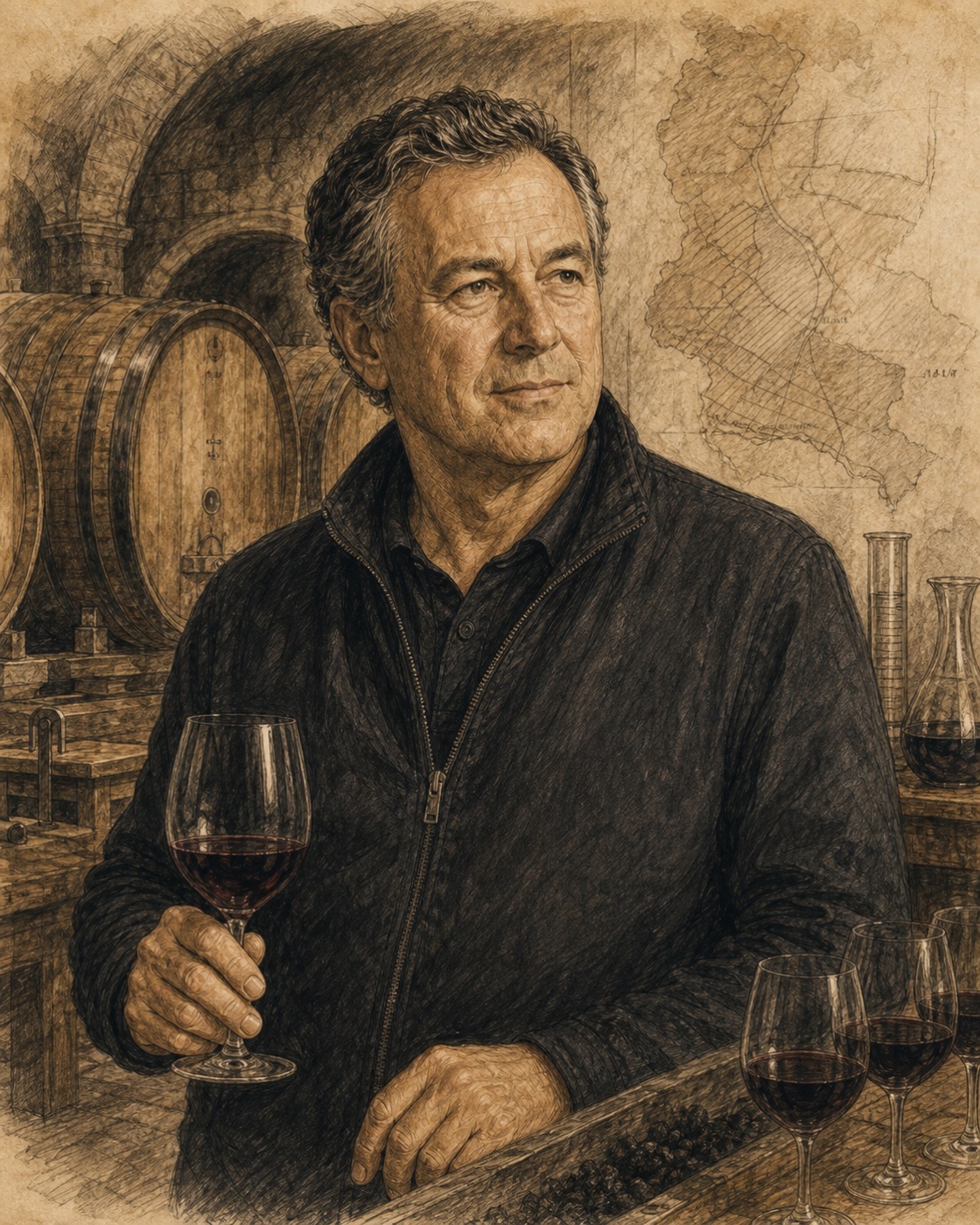
A former chemistry and mathematics teacher, Peter Gago joined Penfolds in 1989 and became its fourth chief winemaker in 2002. His job is unusually collective: protect an inherited multi-region house style while leading a large team and extending the portfolio across hemispheres.
Under his custodianship, Grange remains recognisable while sourcing and collaborations evolve. His importance is therefore continuity under scale—the difficult craft of changing a system without breaking its identity.
Beyond one bottle
Why the work mattered
His contribution is custodianship with controlled expansion. Penfolds’ house approach has been carried into new collaborations and places, while the established Bin wines require continuity across harvests. The teaching background also matters to how he explains wine publicly. This is a team leadership role, not authorship of every Penfolds innovation.
What they changed
Custodianship as innovation
Refinement of an inherited style can be as demanding as inventing a new label.
A team across hemispheres
Australian blending logic now informs projects in California, Bordeaux, and beyond.
Release as education
Vertical tastings and detailed notes keep bottle age central to the Grange proposition.
Follow the work
Wineries and working relationships
Penfolds’ international wines are company programmes. They are not automatically separate personal employers or estates owned by Gago.
Penfolds
Joined 1989; chief from 2002
Sparkling winemaker; red-wine enologist; chief winemakerA progression inside one company, not three winery jobs.
Champagne Thiénot × Penfolds
Champagne partnership; 2012 vintage releases discussed in interview
Collaborating chief winemakerWorked through the Penfolds collaboration with the Thiénot family, not as sole proprietor of Thiénot.
History reviewed . Roles and ownership may have changed.
Representative bottles
Where to meet the idea
- Penfolds Grange under Gago
A modern chapter of the house’s multi-region Shiraz, built for decades rather than release-day charm.
- Penfolds Yattarna Chardonnay
The white counterpart to the flagship idea: multi-region selection in pursuit of one style.
Study the signature
Turn the biography into a tasting.
Begin with Penfolds Grange under Gago, then place it beside Penfolds Yattarna Chardonnay when the opportunity allows. The point is not to crown a winner; it is to notice which choices remain legible across price, age, vineyard, and vintage.
Follow three linked ideas as you taste: custodianship as innovation, a team across hemispheres, release as education. Write down the evidence you can actually perceive, then return to the producer’s history and ask which part of the story the glass supports—and which part belongs to reputation.
Penfolds openly works as a team. The chief winemaker is a custodian and final decision-maker, not the solitary author of thousands of lots.