
The altitude experimenter
Nicolás Catena Zapata
Before the reputation
How they found wine
Catena combined an economist’s education with responsibility for a family wine business, taking it over in 1963. The inherited model included large volumes for the domestic market. Economic instability made the question of how to create lasting value more than an abstract academic exercise.
While at Berkeley in the early 1980s, he visited Napa with his family and saw the quality and confidence emerging around Robert Mondavi. That comparison encouraged a different ambition for Argentina. Back home, higher vineyards and careful experimentation became ways to test whether Mendoza could produce internationally compelling wine rather than simply more of the same product.
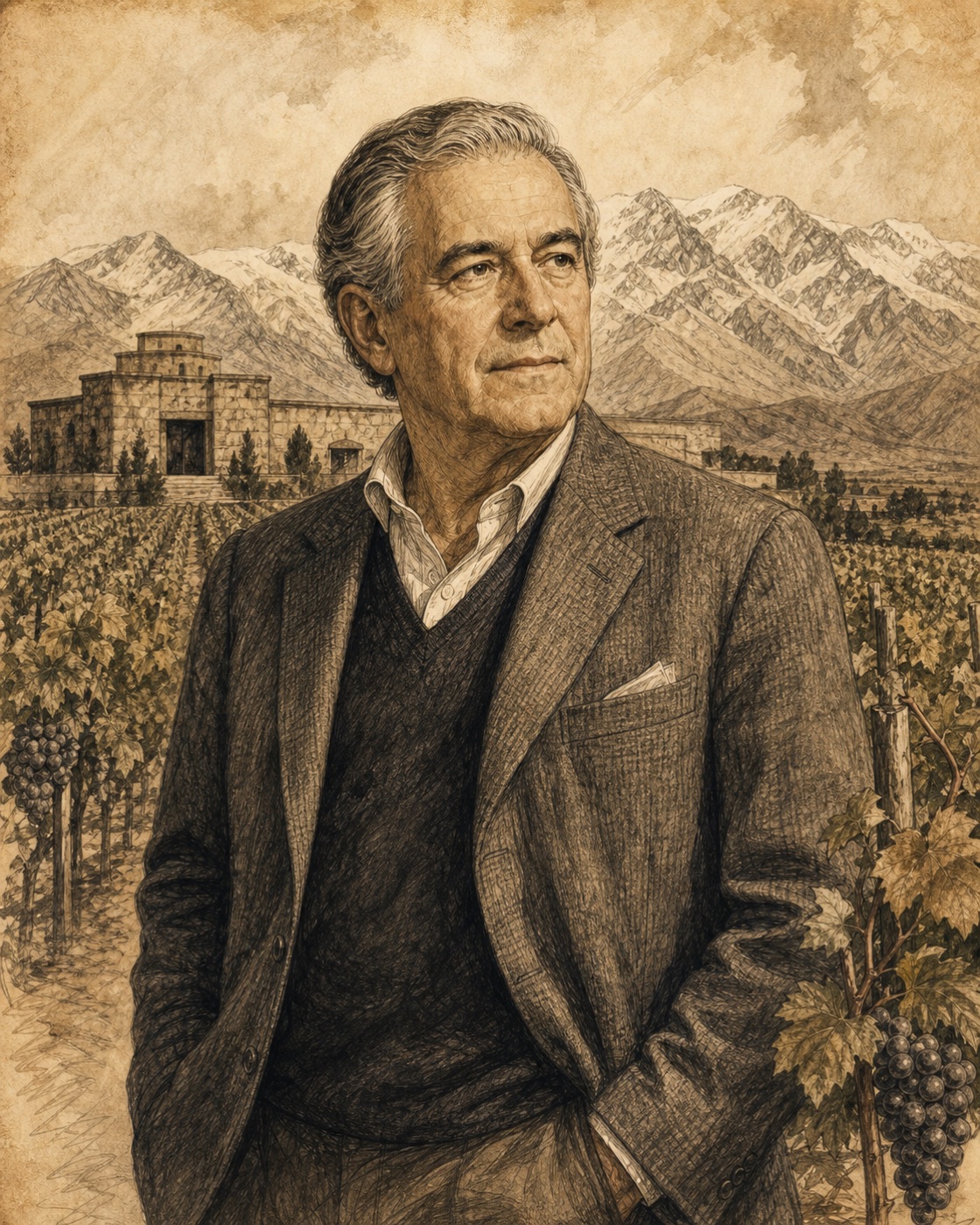
Economist Nicolás Catena Zapata took control of his family business in an era when Argentina was associated with high-volume domestic wine. Inspired partly by California, he sold bulk assets, invested in fine wine, and tested cooler, higher sites along the Andes.
The Adrianna Vineyard, planted at about 1,500 metres in Gualtallary, became the clearest symbol of that work. Selection among Malbec vines and systematic study of altitude and soils helped reposition both the grape and Argentine wine.
Beyond one bottle
Why the work mattered
His important change was investing in the possibility that altitude, sites and research could support a different Argentine wine economy. The resulting prominence of Malbec and high-elevation vineyards came through growers, researchers and winemakers as well as ownership decisions. Catena’s role is best understood as strategic leadership and sustained experimentation, not lone cellar invention.
What they changed
High altitude as a quality tool
Cooler temperatures and intense sunlight were investigated rather than treated as a simple slogan.
Malbec selection
Plant-by-plant trials helped identify material suited to balanced, fine-grained wine.
Argentina as fine-wine origin
Export, blind comparison, and vineyard research challenged the country’s bulk-wine image.
Follow the work
Wineries and working relationships
Corporate holdings and family projects extend beyond a simple winemaker résumé. Robert Mondavi was a source of inspiration, not Catena’s employer.
Catena family business / Bodega Catena Zapata
Took over 1963
Family business leaderShifted the business toward fine-wine quality and site research.
Escorihuela · Rutini
Early 1990s
Investor / acquiring business leaderThe university biography records acquisitions; this is corporate involvement, not a head-winemaker role.
Bodegas CARO
1998 partnership in UCEMA biography
Joint-venture partner with the Rothschild familyA separate Franco-Argentine collaboration.
History reviewed . Roles and ownership may have changed.
Representative bottles
Where to meet the idea
- Nicolás Catena Zapata
The Cabernet–Malbec flagship created to place the estate in international comparative tastings.
- Adrianna Vineyard Mundus Bacillus Terrae Malbec
A parcel-level expression linking altitude, limestone-rich soils, and Malbec.
- White Stones Chardonnay
Proof that the high-altitude thesis extends beyond Argentina’s signature red grape.
Study the signature
Turn the biography into a tasting.
Begin with Nicolás Catena Zapata, then place it beside Adrianna Vineyard Mundus Bacillus Terrae Malbec when the opportunity allows. The point is not to crown a winner; it is to notice which choices remain legible across price, age, vineyard, and vintage.
Follow three linked ideas as you taste: high altitude as a quality tool, malbec selection, argentina as fine-wine origin. Write down the evidence you can actually perceive, then return to the producer’s history and ask which part of the story the glass supports—and which part belongs to reputation.
Catena’s transformation is a family and research-team project, including Laura Catena, Alejandro Vigil, vineyard crews, and the Catena Institute.