
The benchland classicist
Cathy Corison
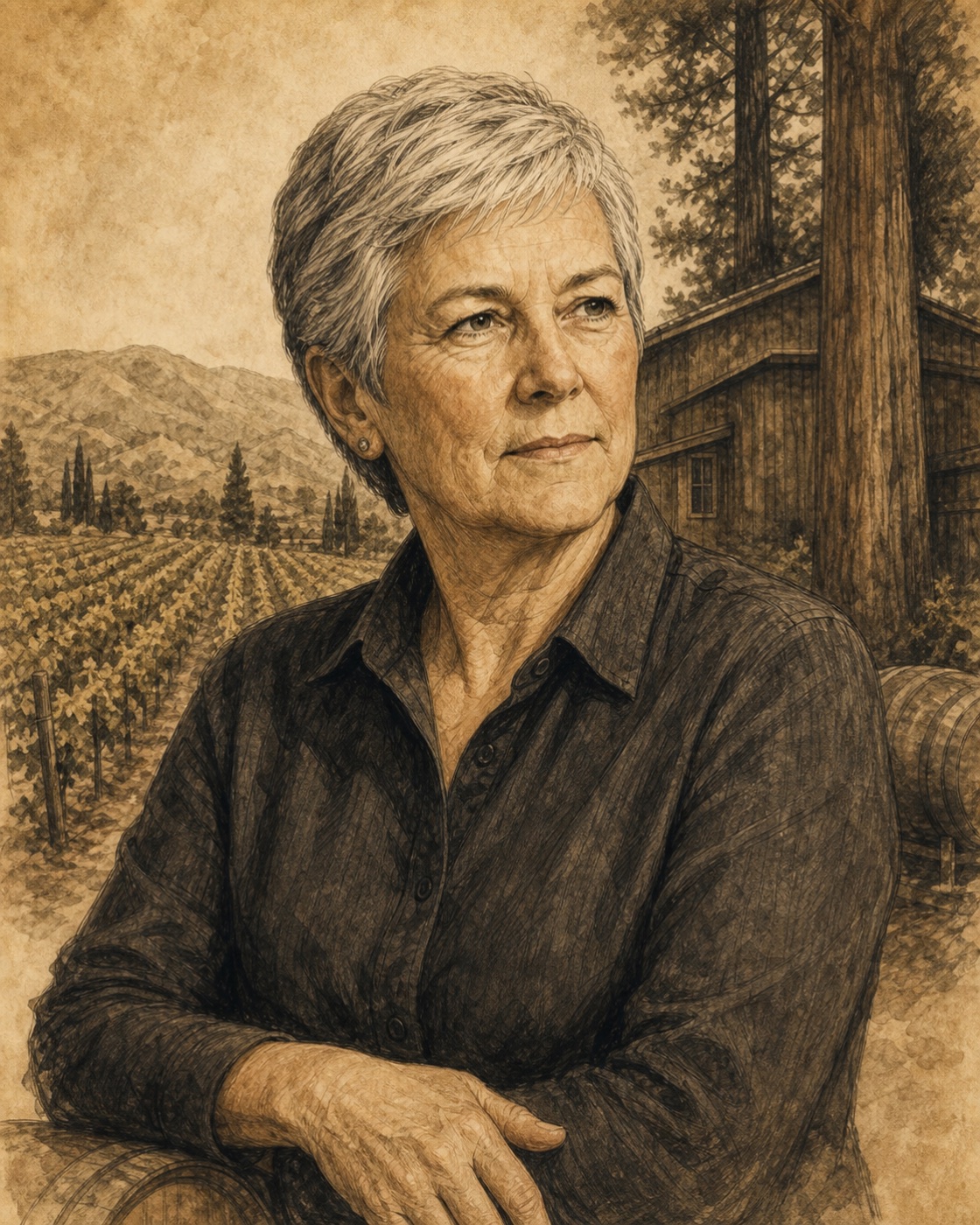
Before the reputation
How they found wine
Corison was studying biology at Pomona when she took a wine appreciation class on a whim. Wine appealed as a collaboration among living systems as well as something pleasurable to drink. Two days after graduating in 1975, she arrived in Napa intent on making it her profession, then completed a master’s degree at UC Davis.
Her early path led through Freemark Abbey and Yverdon to Chappellet. In 1987 she began buying grapes and barrels for her own Cabernet while still making wine for others. Ownership came gradually: purchased fruit and borrowed capacity first, then Kronos Vineyard and a winery. That makes the origin a story of building room for her own judgement rather than simply inheriting a place.
Cathy Corison studied biology before earning a master’s degree in enology at UC Davis and making Cabernet for leading Napa properties. She founded Corison in 1987, initially using rented facilities, with a clear purpose: aromatic, structured Cabernet from the cooler alluvial bench between Rutherford and St Helena.
Buying and planting roots at Kronos Vineyard gave that philosophy an estate center. Corison’s importance lies partly in consistency through changing fashion—harvesting for energy, managing extraction, and trusting bottle age while many peers pursued greater ripeness and scale.
Beyond one bottle
Why the work mattered
Corison kept a persuasive alternative Cabernet style visible through periods that rewarded greater ripeness and scale. Her work shows that power, freshness and ageworthiness can coexist. The contribution is a sustained example, supported by particular benchland vineyards and a family team, rather than a universal rule about one correct alcohol level.
What they changed
Benchland Cabernet as a style
A narrow, well-drained Napa corridor became the basis for perfume, structure, and moderate power.
Classicism through fashion cycles
Earlier picking and disciplined extraction preserved a recognizable line across ripe decades.
Kronos as an estate argument
Old vines and a single vineyard turned farming detail into the winery’s most focused expression.
Follow the work
Wineries and working relationships
The producer’s narrative and timeline vary slightly on the Chappellet transition, so the decade and explicit timeline date are shown rather than silently harmonized.
Sterling Vineyards
Early Napa years
Tasting-room employmentAn entry into the local wine world, not a head-winemaker appointment.
Freemark Abbey
1978
Harvest internEarly cellar experience after her master’s degree.
Yverdon
1979–1980
WinemakerFirst winemaker position.
Chappellet
1980s; timeline dates appointment 1981
Head winemakerTen vintages of Cabernet-focused work.
Staglin · York Creek · Long Meadow Ranch
Overlapping early Corison years
Winemaker / outside client workHelped support the development of her own project.
Corison Winery
First vintage 1987
Founder and winemakerKronos purchased 1995; Sunbasket purchased 2015 after years of sourcing.
History reviewed . Roles and ownership may have changed.
Representative bottles
Where to meet the idea
- Corison Napa Valley Cabernet Sauvignon
The multi-vineyard benchmark for the winery’s aromatic, ageworthy house language.
- Corison Kronos Vineyard Cabernet Sauvignon
The estate’s old-vine, single-vineyard summit.
- Corazón Anderson Valley Cabernet Sauvignon
A cooler-climate comparison that reveals what site changes around Corison’s sensibility.
Study the signature
Turn the biography into a tasting.
Begin with Corison Napa Valley Cabernet Sauvignon, then place it beside Corison Kronos Vineyard Cabernet Sauvignon when the opportunity allows. The point is not to crown a winner; it is to notice which choices remain legible across price, age, vineyard, and vintage.
Follow three linked ideas as you taste: benchland cabernet as a style, classicism through fashion cycles, kronos as an estate argument. Write down the evidence you can actually perceive, then return to the producer’s history and ask which part of the story the glass supports—and which part belongs to reputation.
Calling Corison ‘anti-ripe’ oversimplifies her work. The goal is physiological flavour with balance, and the harvest decision changes with each season.