
Sacramental and colonial demand
Mission and church requirements helped establish vineyards, while towns, mines, garrisons, and trade created wider markets.
c. 1500–1800 · Americas, southern Africa, and beyond
European vines travelled through imperial, missionary, and commercial networks, but new wine regions were built through local adaptation and unequal labour systems.
The period in context
Spanish and Portuguese colonial systems carried Vitis vinifera, sacramental requirements, tools, and expertise into the Americas. The results depended on altitude, water, soils, disease, Indigenous knowledge, local markets, and the labour of Indigenous, enslaved, and coerced people.
At the Cape, the Dutch East India Company established a refreshment station and vineyards in the seventeenth century. Colonial settlement, dispossession, slave labour, and exchange with Indigenous peoples formed part of the cultural landscape. Similar complexity followed vines wherever empire carried them.
Historical geography
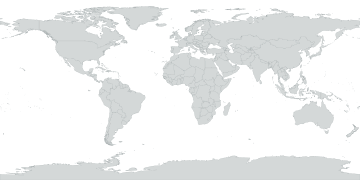
The markers locate the principal places discussed here. Modern country borders are orientation aids, not period boundaries.
 12345
12345The working system
Mission and church requirements helped establish vineyards, while towns, mines, garrisons, and trade created wider markets.
Growers learned new irrigation patterns, altitudes, harvest calendars, pests, and soils. European instructions could not simply be transplanted.
Colonial vineyards often depended on seized land and Indigenous, enslaved, indentured, or otherwise coerced labour. This is structural history, not a footnote.
Varieties such as Mission/Listán Prieto and Muscat families became foundations for distinctive local drinks, foods, rituals, and economies.
Dated sequence
Iberian colonisation begins sustained movement of European vine material and sacramental wine demand into the Americas.
Vineyards develop in Mexico, Peru, Chile, and the Cuyo region east of the Andes.
The Dutch East India Company establishes its Cape refreshment station under Jan van Riebeeck.
Van Riebeeck’s journal records the first Cape wine from local grapes.
Constantia is established near the Cape and later becomes internationally famous for sweet wine.
Actors
Created institutional demand, directed land and labour, and moved vine material through imperial networks.
Possessed local environmental knowledge and endured displacement, coercion, and cultural disruption; experiences varied greatly by region.
Supplied essential agricultural, cellar, construction, and domestic labour while the historical record often obscured their names.
Documented the early colonial Cape vineyard project; neither represents the whole origin story of South African wine.
Geography
Colonial Mexico became an early centre of American viticulture, followed by restrictions and regional persistence.
Pacific routes, Andean environments, irrigation, and colonial cities supported expanding production.
A Mediterranean-climate landscape formed through Company settlement, slavery, Indigenous interaction, farms, towns, and later estates.
Strategic wine-producing and provisioning points within oceanic trade systems.
Reading the record honestly
What survives in the glass
Wine became global, but varieties, techniques, labour relations, and regional identities were remade rather than simply copied from Europe.
Words to know
Keep digging
Sources are selected for primary evidence, institutional context, or scholarly synthesis. Historical interpretation remains open to revision.